0
 1
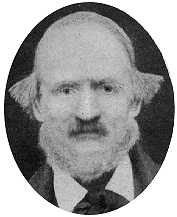
"Life of James Kippen"
Written by Granddaughter Catherine H. White
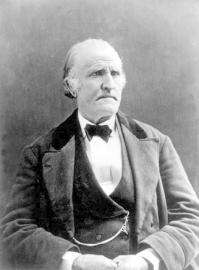
No one can bequeath to posterity a richer heritage than the memory of a noble and well directed life, devoted with unselfish affection to the up building of the human race. Such a man will wield an influence that will not cease with his departure from earth's scenes. The life of James Kippen has been largely devoted to the welfare of his fellow beings.
He was born February 3. 1820, Perthshire, Scotland. He is the son of Robert and Catherine Cambell Kippen, who were both natives of the Highlands of
Scotland, where they lived and died. Our subject spent the first 24 years of his
life within 16 miles of the place of his birth and received a common school
education in his native land. On June 16, 1842, after listing to one of the Mormon missionaries, who were preaching in that country, He became an adherent member of the Mormon Church, bring baptized into that faith at Mansadie Parish.
So enthused was he in this new religion that soon after he became a convert, he began to preach in his native land to his associates and friends, but so far as known, none of them ever became converts, he being the only one in his family and the only one in that community to join the Mormons.
In 1844, he sailed for America, crossing the Atlantic Ocean in an old sailing vessel, and arriving at Nauvoo, Illinois in April of the same year, where he remained until the following year in August. (He was in Nauvoo at the time Joseph Smith was killed.) Then he went to Saint Louis, where he followed the trade which he had learned in his native land with his father and oldest brother, that of a mason. After working in Saint Louis and vicinity for a short time, he next located in Lexington, Missouri, and later went to Independence in the same state where he contracted the fever and ague, which hung on for 3 months and left him very weak. In 1848, he outfitted an ox team with provisions preparatory to crossing the plains to Utah, which he did, arriving in Salt Lake City on October 4 1848.
Here he followed his trade for a short period, having placed the first rock in the old tithing office, and also assisted in building President Brigham Young's first house. In the spring of 1850, he located in Bountiful, Utah, where he secured thirty-five acres of land, at that time in a wild state and cobered with willows, sage and underbrush, he erected a splendid brick home, sunk an artesian well to supply water for both his stock and irrigating purposes. In addition to his home place, he owned two hundred acres of valuable farming land in Morgan County, where his family resided. Farming and the stock business were his principal avocations through life.
While residing at Nauvoo, he met and married Isabella Watson, daughter of
Andrew Watson. The marriage ceremony was preformed by Hyrum Smith, the brother of the prophet. His second marriage occurred in 1853, when he married Catherine Watson. He has been the father of ten children, Joseph, Catherine, Margaret, (my great-grandmother); Jannett who died aged two and a half, James, Duncan, Robert, Elizabeth, and George. His children were residents and worthy citizens of Utah. Duncan was called in 1895 on a mission to the Samoan Islands, where he spent 28 months. In 1878, our subject was called to go on a mission to his native land, and served two years in that country. While there, he visited the scenes of his early boyhood days, and met one brother and two sisters as the remainder of the family had passed away.
Mr. Kippen was a firm believer in the teachings of his church regarding work for the dead, doing work along this line in the temple for members of his family who had died out of the faith of the Mormon Church, believing that by this means he would be able to save their souls. He passed all through the scenes of hardships and difficulties which the settlement of Utah made a matter of history, and during the Johnston Army troubles, he served as a guard in the Green River country and in Echo Canyon. While much of his life had been given to the maintenance of his families and laying the foundation for a comfortable living for his declining years, yet one of the greatest desires of his life had been to preach the Gospel, and this direction he has lost no opportunities but has done all in his power to bring salvation to the human race. He was ordained a High Priest.
Three different times during his life he has been at the point of death but by divine providence his life had been spared. In July of 1901, while driving across the railroad tracks, one of the fast express trains thundered down the track striking his wagon and tearing it to pieces, and throwing Mr. Kippen on to the south side of the wagon road. From this he only experienced a slight jar. Another evidence of a narrow escape was while he was serving on his mission to Scotland; he had converted a lady whose brother became enraged over it and picked up a club and struck him over the head. The blow was one which might ordinarily have resulted in death, but it never fazed Mr. Kippen. He also has been shot at, but never wounded.
His 3rd child Margaret was my Great-grandmother Kippen. They had a daughter Catherine who married Ralph G. Warner of Mountain Green in 1911. Ralph and Catherine Warner had 8 children. The 5th child (my mother) June married Verl J Poll in 1941 living their lives in Mountain Green, Ut. I, Robert W. Poll the oldest child of 8 continue to live in Mountain Green with our 8 children and 32 grandchildren as of this date, March 16, 2009.
.
.


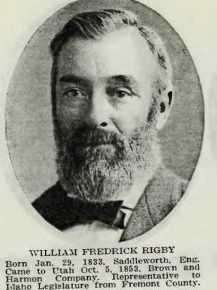
 Brother Joseph