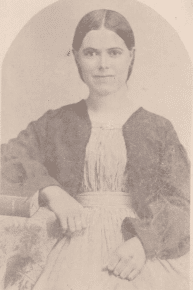
ALLEN, Alanson David

His father, Albern, and oldest brother, Rufus, were with the Mormon Battalion on their march to California. They were released on July 16, 1847 and went to Utah. Alanson stayed with his family at Winter Quarters. He was seventeen at the time. Realizing their need for winter supplies, he went back to Eastern Missouri and bought and harvested crops and brought them back to his family at Winter Quarters.
0 1
Read Time:3 Minute, 1 Second

Alanson David Allen was born May 1, 1829 at Deposit, Tompkins, Delaware County, New York. He was the son of Albern Allen and Marcia Allen. His parents joined the Church and moved to Missouri. Alanson knew and talked with the Prophet, Joseph Smith. He was within hearing distance at the time the Prophet was martyred. They experienced the trials and threats of mobs when they were in Nauvoo. They obeyed Brigham Young when he counseled the Saints to obey their priesthood leaders. His father, Albern, and oldest brother, Rufus, were with the Mormon Battalion on their march to California. They were released on July 16, 1847 and went to Utah. Alanson stayed with his family at Winter Quarters. He was seventeen at the time. Realizing their need for winter supplies, he went back to Eastern Missouri and bought and harvested crops and brought them back to his family at Winter Quarters. Alanson had envisioned the Great Salt Lake Valley and the trip they would have to endure prior to actually going. They arrived safely in October 1848 with the George A. Smith Company.

In the summer of 1850, he met Chastina Hadlock. They were married on Nov. 10, 1850. They lived in Ogden for about a year. Brigham Young called them to go to Willard. In 1853 they moved to 3-Mile Creek (Perry). Four years later, they returned to Ogden near where the Union Depot is now. In 1860 they were called to go to Hyrum, near Logan and help with a settlement. In 1866 they moved to Huntsville where they lived for the rest of their lives. In 1861 he was made a Captain in the Utah Militia and served in this capacity until 1866. During this time the Echo Canyon War broke out and he took an active part. He had many encounters with the Indians, one where he and 5 others were called to the Salmon River. One of the 5 was killed, but all suffered from exposure. Alanson was never well after that.

Having a quick mind and memory. Alanson was a diligent student of The Book of Mormon. He was a Seventy and was called on a mission to Nebraska. He served for sometime, but was unable to stay because of ill health. He had a fine speaking voice and would write poetry. He spoke at the Fourth of July event. He was kind and generous to those in need. His employment included farming and working on the railroad. He was with the crew that brought the railroad into Ogden. They had to work hard and didn’t have many luxuries. One son remembered their diet being mostly bran mush and bran bread.

Alanson was an affectionate father. He and Chastina raised a fine family who.all grew to maturity. They were honest and trustworthy citizens. Their children, their birthdates and spouses were:

  1. Emeline Clarissa Aug. 26, 1851 Erastus Perry Bingham
  2. Albern Alanson Dec. 28, 1852 Louisa Stowell
  3. Orin Daniel Mar. 18, 1854 Anna C. Benfrup
  4. Emily Chastina Nov. 30, 1855 Joan Newy
  5. Marinda Feb. 15, 1857 John Ingles
  6. Esther Sept. 27, 1858 John Tangreen
  7. Ammon April 23, 1860 Isabella Hyslop
  8. Hyrum Feb. 20, 1862 Nancy A. Wilson
  9. Samuel Sept. 15, 1863 Louisa C. Dainelson
  10. Sarah Ann Dec. 9, 1865 William G. Moyes
  11. Emma Rozina Jan. 18, 1868 John H. Jorgenson
  12. Mary Vileta Jan. 29, 1870 died Aug. 5, 1901
  13. David Orbo April 21, 1872 Emma Lousia Berlin
  14. Andrew Stephen Feb. 23, 1874 Mary Elizabeth Hyslop

Alanson David Allen passed away March 3, 1887 at the age of 58 in Huntsville, Weber County, Utah and is buried in Ogden.


Happy
Happy
0 %
Sad
Sad
0 %
Excited
Excited
0 %
Sleepy
Sleepy
0 %
Angry
Angry
0 %
Surprise
Surprise
100 %
You May Also Like

WALLACE, George Benjamin

July 4 Sunday – Rain this morning. Public meeting. Elders P. P. Pratt, Taylor and Father Smith spoke against growing cold and careless, and neglecting to pray. They urged all to give thanks to God, who is blessing us all the time. They also spoke against swearing and taking the name of God in vain. They gave strong warning and spoke of some of the law which will be put in force hereafter. They exhorted to union, obedience, etc. and exhorted the fathers concerning their children, how to bring them up, etc. They said if we forgot God it would go with us as it did with the Lamanites, etc. We must not set fire to the prairie for it is a signal for the Indians to gather together. We have now come 175 miles. The conclusion is to travel each company of 50 by itself and to have it encamp and herd by itself.
View Post

PORTER, Sanford: A Visionary Man

The last night there came a Voice–clear, audible, and distinct, "There is a God, and He has known the desires of your heart this number of years. I will instruct you three times this night the way that is right- -that you need never again doubt, but shall be satisfied in your mind concerning God.”
View Post

MAUGHAN, Harrison Davenport & Mary Freestone

Education had already become a high priority in the mind of this teenager. After twelve or fifteen months of employment she had saved enough money to enroll in the new Brigham Young Academy in Logan. Where had she learned what she needed to know to get admitted? How was she able to make her way in the environment of an academy? She may have attended school briefly as a small girl and perhaps for one year just after returning from Franklin Meadows. Mary left one little school workbook, labled “Alpine City, Utah.” It is filled with evidence of studies in math, geology, grammar (including diagraming sentences) and a lot of theology from the Bible. She also left another workbook in penmanship and a series of well-written essays on a variety of subjects. These showed good spelling and extraordinary penmanship, a beautiful script worthy of a highly educated person. Mary attended Brigham Young Academy for perhaps only three months, or maybe asmuch as two semesters. At the end of the spring term in 1882, the students exchanged messages in little autograph books, with one greeting per page in the form of a poetic sentiment. Each page is written in beautiful script – a very impressive exhibit, when compared to twenty-first century handwriting, which is often illegible at the college level!
View Post

SWEETEN, Colen Hagle

Finally, I heard his muffled voice calling from the bottom of the well. He said that the horse filled the entire hole. There was just about enough mud and water to cover the horse. He could not find anything of the man or the shovel.
View Post

ALSON, Thomas

At the time there were no free schools held in Utah, so students were required to pay tuition, which was rather difficult to provide; while attending with Peck, my tuition became considerable in arrears, therefore, he proposed that I assist him with classes at a salary of $1.00 per week and my tuition, (in all about $1.35 per week) the $1.00 per week to apply on deferred payments.I engaged to teach the Hoytsville School early in January 1876, at a salary of $45 per month. The school house consisted of one log room about 30 by 40 feet, heated by a stove in the center. The teacher was also the janitor etc.
View Post

GREEN, Elizabeth Jane

Candace asked Hamilton about his mother’s pictures and he answered “I don’t know, I’ve never touched them.” Candace asked if she could get them and he gave his consent. She went into the other room and came out with some pictures carefully wrapped in tissue and brown paper. It was such a thrill to find a picture of Elizabeth Jane Green as a young mother and five of her sons, a picture of my grandfather James Copeland Orr, taken before he left on a mission, a picture of Charley, Walter, Richard and Earnest. Some of these pictures had been taken up at Mercur, probably when the boys had taken some produce to market or gone up to Mercur on a date or to a dance. Mercur at this time was one of the biggest towns in Utah and the people of Clover and St. John sold nearly all of their produce at Mercur.
View Post