0
 1
- Born: 9 October 1835, Greenwood, Steuben, New York
- Died: 22 November 1912, Pocatello, Bannock, Idaho
- Pioneer: 2 October 1847, Jedediah M. Grant Company (by wagon) Captain Hazen Kimball 3rd Ten
- Parents: Elihu Marcellus Allen and Lola Ann Clawson
- Pioneer Arrival: 2 October 1847
- Company: Jedediah M. Grant Company, Captain Hazen Kimball 3rd Ten
- Married: Mary Elizabeth Graham, born 8 October 18361 Laurel Hill, Chester, Pennsylvania
- Marriage Date: About 1853, Utah
- Spouse’s Death: 2 July 1906, Huntsville, Weber, Utah
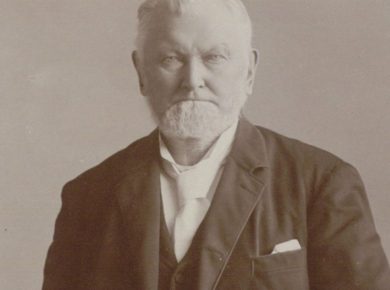
Elihu Moroni Allen was the sixth of 12 children born to Elihu Marcellus Allen and Lola Ann Clawson on 9 October 1835 in Greenwood, Steuben, New York. His parents were baptized into the LDS Church about 1834 or 1835 about the time of his birth.
Not much is known about his childhood, except that his family left New York and moved to Log Creek, a spot four miles southeast of Far West, Caldwell, Missouri. The persecution of the Saints became worse. On 18 May 1839, his father Elihu Marcellus Allen executed an affidavit in Quincy, Adams, Illinois itemizing a bill of damages against the State of Missouri for $1,000 for property lost and expenses incurred during the expulsion. The Allen family then moved four miles east of Burton, Adams, Illinois. Within two weeks in December 1845 his sister and two of his brothers died.
In the year 1846 the Allen family began their trek to Utah. They traveled across Iowa to the Missouri River. Elihu was then ten years old. On 12 March 1847 his youngest brother Joseph Brigham Allen, then about 18 months old, was “adopted” by Brigham Young shortly before the first group of Saints pulled out under the leadership of Brigham Young headed for Utah. Later that same year Elihu, his parents, and five other children crossed the plains to Utah in the Jedediah M. Grant Company. They were in the 3rd Ten under Captain Hazen Kimball arriving at Great Salt Lake Valley on 2 October 1847.
They lived that first winter in Great Salt Lake Valley. His mother, Lola Ann Clawson Allen, died on 17 February 1848, four and one-half months after their arrival. His father, Elihu Marcellus Allen, died 11 October 1850, also in Salt Lake City, Salt Lake, Utah.
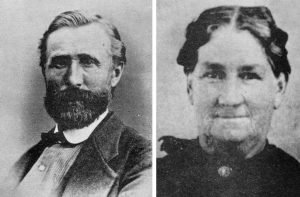
At the age of 18 years Elihu Moroni Allen was married to 16¬year-old Mary Elizabeth Graham in 1853 in Utah. She was the daughter of James Graham and Mary Elizabeth Butler Graham, pioneers of 1849 with the Howard Egan Company. Together they had 11 children. They made their first home in Riverdale, Weber, Utah. (They may also have lived for a time in the late 1850s in the LDS settlement of San Bernardino, California.)
In 1860 the road was opened through Ogden Canyon into the Ogden Valley known as Huntsville as a toll road. The charges were from 25 cents to $1.50, depending on if the load was heavy or light, loaded or empty, or if it was carried on foot or by horseback. The toll lasted 12 years, and on 20 February 1882 it became a public road.
About 1863 the Allen family settled in Huntsville, Weber, Utah where the last 7 children were born. Their first home in Huntsville was a two-story log house. Elihu made a lot of the furniture they used. He made chair frames from pine trees and made the seats from braided leather that he cured to a very soft pliable seat. His wife Mary Elizabeth was also very thrifty and utilized every scrap of material available for quilts or rag carpets. She did all of the sewing for the family by hand. Mary Elizabeth was also a very good cook with the vegetables from the garden they planted. Elihu hunted and fished, so the family had plenty of meat along with the chickens they raised. They literally lived off the land, as Elihu was a good farmer.
At first the Indians (believed to be Shoshone) gave the settlers a lot of trouble. Many wanted to leave the valley, but Brigham Young told them to stay as this was the place to raise true Latter-day Saints. After awhile the settlers learned to share with the Indians and treat them kindly and many of them became good friends. The Indians called Elihu “Baldy Allen” or sometimes “Lige”. Family tradition says that one day after a hunt the Indians stopped by and left squirrels and gophers for “Baldy Allen” to feed his papooses. Elihu waited until dark and buried them so the Indians wouldn’t know, as it wasn’t a good idea to turn down such a friendly offer of food.
On 7 July 1865 Elihu Allen was appointed by the court to appraise some wheat in a legal problem. After the matter was settled, he was given ten pounds of wheat for his services.
On 17 April 1885 Elihu became an Elder in the LDS Church, and on the same day he and Mary Elizabeth were sealed in the Logan Temple.
Elihu became a widower on 2 July 1906 when his wife of 53 years passed away at their home of heart failure at the age of 69 years. She was buried in the Ogden City Cemetery.
Elihu Moroni Allen passed away 22 November 1912 at the age of 77 years in Pocatello, Bannock, Idaho of chronic endocarditis following several months of bronchitis. His body was sent to Ogden, Weber, Utah and he was buried next to his wife in the Ogden City Cemetery.
Children
- Charles Marcellus Allen, born 29 May 1854, Riverdale, Weber, Utah, died 17 July 1918
- Elihu Moroni Allen, born 4 September 1858, Riverdale, Weber, Utah, md. (1) 18 October 1880 Mary Ann Baird, (2) Fannie Huntsman, died 21 March 1914, Rupert, Minidoka, Idaho.
- Mary Losina Allen, born 23 August 1860, Riverdale, Weber, Utah, md. 18 October 1879 Hyrum Blanch Pidcock, died 10 June 1916, LaGrande, Unionl Oregon
- Phoebe Isadora Allen, born 21 June 1862, Riverdale, Weber, Utah, md. 9 November 1882, Peter Edward Chatelain, died 11 January 1918
- John Franklin Allen, born 11 August 1864, Huntsville, Weber, Utah, md. 27 March 1887 Mary Alice Harmon, died 26 March 1944, Burley, Cassia, Idaho
- George Adelbert Allen, born 1 June 1866, Huntsville, Weber, Utah, md. 23 May 1893 Lydia Musetta Gribble, died 7 October 1931
- Lola Bernetta Allen, born 1 July 1868, Huntsville, Weber, Utah, md. 20 January 1885/6 Alexander Chatelain, died 8 March 1942, Salt Lake City, Salt Lake, Utah
- Joseph William Allen, born 7 March 18701 Huntsville, Weber, Utah, md. 7 March 1895 Helen Adeline Hatton, died 22 February 1925
- Eliza Emma Allen, born 24 December 1872, Huntsville, Weber, Utah, md. (1) 7 July 1890 Thomas Wright, (2) Jay Grant Crandall, died 30 May 1949, Ogden, Weber, Utah
- David Allen, born 14 August 1874, Huntsville, Weber, Utah, md. 28 July 1893 Petria Pearl Jensina Jensen, died 7 March 1931, Aberdeen, Bingham, Idaho
- James Thomas Allen, born 3 September 1876, Huntsville, Weber, Utah, died 11 July 1922, Weber County, Utah


 Brother Joseph

 Pioneer John