 0
 1
Frontier Teacher

Some insights into their experiences can be gleaned from the life of Editha Morgan Anderson who was born in Franklin County, Massachusetts in 1803, likely near the village of Montague. The community of Deerfield, not far from Montague, is remembered in U. S. history because of the French/Indian raid there in 1704, during the Queen Anne’s War, where dozens of male inhabitants were killed and more than a hundred women and children were taken hostage, most of whom were later ransomed.
Editha’s father was Ezra Anderson, her mother was Tryphena Morgan Anderson, and she had two sisters who both died when they were young adults. The woes of the family began earlier when Ezra died in an epidemic in 1813. Editha left no record of how she and her mother survived before they joined the Church of Jesus Christ of Latter-day Saints in June 1836. Reasons for them joining must have been religious fervor as well as the promise of finding a better life further west in the society of other saints.
What Editha did between 1836 and 1842, when she and her mother were enumerated in a census in Nauvoo, is a mystery. If they migrated there in the early 1840s Editha would have been a spinster in her late 30s, and her widowed mother would have been in her late 60s. Both were of an age when security rather than adventure should have dominated their agendas. From afar, it is puzzling how they could marshal the resources to leave their home, move to a fledgling community on the banks of the Mississippi River, and do so without family support.
Editha left no record of how she sustained herself and her mother in Nauvoo, although she likely scratched out a living as a teacher. Her “pay” may have included a place to live, various kinds of produce, but relatively little cash. There are no records that show she owned property in Nauvoo. Nonetheless, a brief entry in church records indicates she contributed goods or services to building the Nauvoo Temple. She exercised a compassionate quality while there when she agreed to raise an eleven year old orphan by the name of W. Lafayette Ball. His father and mother died within a half year of each other and he lost his two siblings a few months earlier. Before his death from consumption, Lafayette’s father arranged with Editha to care of the boy, most likely because she was a family friend. The Balls came from Shutesbury, Massachusetts about ten miles southeast of where the Andersons lived, and the Andersons and Balls may have moved to Nauvoo together. Part of the agreement was for Editha to be custodian of about $200 worth of assets that Lafayette’s father left upon his death.
Although not noteworthy at the time, Editha and her mother lived in the 2nd Ward in Nauvoo, where, for a time, Arza Adams and his family also lived. This became noteworthy about ten years later when Editha became Arza’s plural wife in American Fork, Utah.
There is another gap in Editha’s written history from the time she took in Lafayette in mid-1845 in Nauvoo, and when she arrived in Utah on September 21, 1848 in Brigham Young’s Camp and Captain Alvin Nichols’ group. Along the way her mother died, perhaps on the way to Winter Quarters where they may have moved in the late summer of 1846 with the last group that left Nauvoo. Again, one has to wonder how she dealt with the death of her mother, took care of Lafayette, assembled the resources to make two moves west, and sheltered and fed her two-member family without relatives on whom to rely. The aid and comfort provided by the church undoubtedly supported some of her needs.
The 1850 Census lists Editha and Lafayette living in Salt Lake City, but the Bishops’ Report of 1852 notes they were then living in the Mill Creek Ward, south east of Salt Lake City. Sometime during the next year they moved to what later became American Fork where she soon married Arza Adams, one of the first settlers of the community. This was Arza’s first plural marriage and he later went on to wed three additional women: Catherine Cunningham, Marilliah Olney, and Elizabeth Gaskell. Like Editha, Elizabeth was also an older single woman.
It would be interesting to know the details of how Editha came to marry Arza. He was in his early fifties at the time and she was well past child bearing age. Fulfilling religious obligations, rather than romance, most likely explains the marriage. She may have agreed to the union because of religious teachings about the importance of this sacrament for her eternal salvation. Arza, in turn, may have, one day, found Bishop Leonard Harrington’s hand on his shoulder and hearing him say,
“Brother Adams you ought to consider plural marriage, both for your salvation as well as for the well-being of Sister Anderson.”
Whatever Arza’s degree of enthusiasm for polygamy was, it would have been awkward for him to refuse the bishop’s call, given that he was one of Harrington’s counselors. The marriage fulfilled dual objectives: it satisfied religious beliefs, and it also solved the awkward social problem of a single women living on the frontier by attaching her to a family. It gave her, in some sense, a public recognition of belonging.
By happenstance, Hosea Stout was in American Fork at the time of Arza and Editha’s marriage and recorded impressions of Editha in his journal.
“…while at American Creek I had the satisfaction to witness the triumph of Mormonism over the traditions of our fathers for George A. (Smith) sealed Arza Adams to an old maid aged 48 as withered and forbidding as 4 doz. years of celibacy might naturally be supposed to indicate. She joyfully took his hand and consented to be part of himself as number two. Thus, entering into a respectable state of matrimony under auspicious circumstances when nothing except the privileges of Mormonism would have permitted” (Brooks, Vol. 2. p. 498).
Stout felt that Arza was doing Editha a favor by marrying her, perhaps a dominant perspective among church leaders at the time regarding how adult single women should be accommodated in a frontier community. At the same time, Stout’s unflattering comments reflected a large measure of chauvinism and disregard for the trials that single women endured in Zion. His comments say nothing about Editha’s character, compassion, intelligence, or internal fortitude.
No common person would have accepted a new religion and then migrated from Massachusetts to Nauvoo, on to Winter Quarters, and still later on to the Intermountain West — caring for an aged mother and taking in an orphan along the way. No common women could have scratched out an existence along the way in a society that relied on families. Without a strong belief in her religion, no common woman would have accepted a marriage that promised little in the way of material support, public recognition, or emotional reinforcement. Whatever else she was, Edith, like many other mature single Latter-day Saint Women, had internal strength and strong religious beliefs sufficient to tolerate an environment that was unsympathetic toward mature single women, as exemplified by Stout’s comments.
There is no indication that Editha and Arza ever lived together as man and wife. She received a ¾ acre plot of land on the south edge of Arza’s property in American Fork, and built a small log cabin on it in 1854, perhaps with some help from Arza. Later Editha and Lafayette built an adobe home, 16 by 18 feet in size, on the lot.
Shelly (p. 75) mentions that Editha was one of the first school teachers in American Fork, likely doing some teaching before she had her own home/school. During the religious revival of 1856-57 she was stirred by the fervor and was re-baptized on April 20, 1856 by William Parsons. Interestingly, her name is listed on the church records for this ordinance as Editha M. Adams, one of the few places where she used her married name.
Editha established a private school in her small log cabin that was located on 1st North and about 70 West in American Fork. It served as a bedroom, living room, and a tightly packed classroom. The dwelling featured one door, one window, two beds, a wood stove, and a rest facility located out back of the cabin. Her rudimentary school attracted a dozen or so students, about the same number of youngsters as attended another school that met in a community-owned building that served as a place of worship and education.
Students of all ages attended her school and she organized them into small groups according to grades, the brightest pupil in each group being assigned as the class leader. They shared a small number of copies of McGuffey’s Reader and a book by Nelson for texts. Instead of pencils, the students used a piece of sharpened slate wrapped with cloth or small pieces of wood as writing instruments to scratch on larger pieces of slate. Memorization, penmanship, and spelling were emphasized. One of Editha’s teaching techniques involved calling a group to the front, after they had copied a lesson, and then having them recite the lesson back to the other students. Annie Logie remembered that Editha usually had several pans of milk on a shelf along the side of the room, and that some of the boys would surreptitiously stick their fingers into the pans and lick off the cream going to and from the front of the class.
The lack of regular bathing and changing of clothing made the ambiance in the classroom odoriferous during the winter, so Editha assigned one of her students, Ammon Olsen, to be the school “smeller.” When it became especially offensive, Editha told Ammon to get busy and sniff out each student. Culprits were sent outdoors to “air out” for a quarter-of-an-hour before being allowed to take their seats again. One of Editha’s students, Annie Logie (Clark), didn’t recall any girls being sniffed out, although she allowed that some of them may have been guilty along with the boys.
Annie’s parents, like most other parents of children in the school, had little cash to pay for the schooling of their children. To pay for his children’s education, Annie’s father, Charles Joseph Gordon Logie, gave Editha firewood and crafted some school furniture. This included building a small two-person bench that was tailored to fit his two children, Annie and Charley. The Logies were so poor that their children went to school without shoes, even during the winter. Editha took pity on Annie on especially snowy days and carried her on her back to the Logie’s home located about a block away. Even those fortunate pupils who wore shoes during the winter sometimes received special treatment. Ester Hindley’s father owned a local store and gave his daughter new shoes that were envied by other students. Occasionally, when the pathway home was wet and muddy, Editha would ask one of the older students, for example Ben Greenwood, to tote Ester on his back to the Hindley’s home to conserve her new shoes.
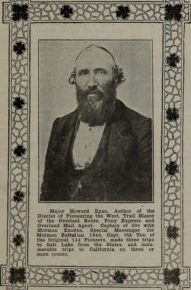
Editha retired from teaching about the time a public school was established in American Fork in 1868. It was the first school in Utah that was financed by local taxes. By then Lafayette was a young man and old enough to contribute some to the upkeep of the household. For a number of years he worked for Major Howard Egan as a Pony Express rider and then as a mail hauler on the route from Salt Lake City to California, where his colleagues gave him the nickname of “Bolly.” Later, along with Major Egan, he helped to guard Brigham Young’s grave in Salt Lake City for several months after the President died.
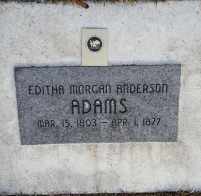
After Editha passed away on April 1, 1877, misfortune dogged her foster son Lafayette. In early 1878 he was called to serve a mission helping Indians farm in the Deep Creek area in western Utah. During his mission, at the age of 44, he married a widow by the name of Charlotte Shelley from American Fork on May 23, 1878. Their marital bliss was short lived in Deep Creek, however, as Lafayette soon developed health problems that rapidly worsened. In his journal he described symptoms that were consistent with stomach cancer. Only five months after his marriage he expired in American Fork and was buried there.
Editha died without leaving a will, perhaps assuming her modest estate would simply pass to Lafayette. After her death, Lafayette mentions in his journal that he talked with Bishop Leonard Harrington in American Fork about transferring the title of Editha’s property to his name. The bishop suggested it might cost about $40 to do so. Lafayette’s attention was immediately diverted from this matter by marriage and then by ill health. After his untimely death Charlotte was left to wrestle with the land title problem. She called on Bishop Harrington to help her as administrator of the estate. The process drug out for more than four years and Charlotte eventually bought Editha’s property for $400, most of which Charlotte re-inherited via the claims that her deceased husband, Lafayette, had earlier placed against Editha’s estate. This included the $200 worth of property that Lafayette had entrusted to Editha for Lafayette as well as various “loans” he made to Editha after she retired from teaching.
What to make of Editha’s life? The fragments of information that are available about her earthly existence show she lived an honorable but humble existence. Her father died when she was young, her two sisters died a few years later, and she was left with a dependent mother, who, in turn, died along the trail west. Raising the orphan Lafayette was a comfort to her, educating a number of children was also likely fulfilling, and being a spiritual wife of Arza Adams gave her some religious satisfaction, although little in the way of romance. Hundreds of other single, mature, L.D.S women likely experienced similar lonely lives, only slightly leavened by loveless plural marriages.


 Brother Joseph