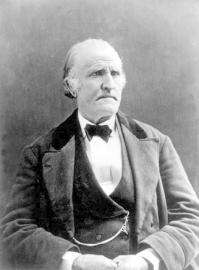
ASHBY, Nathaniel

The Ashbys were seaman and ship wrights until after the War of 1812. Nathaniel however, was apprenticed to a shoemaker at an early age to learn the shoemaking trade. He became expert in the making of fine shoes and started his own business.
0 1
Read Time:3 Minute, 14 Second

Nathaniel Ashby‘s parents were Benjamin and Mary Young Ashby. The Ashbys were seaman and shipwrights until after the War of 1812. Nathaniel however, was apprenticed to a shoemaker at an early age to learn the shoemaking trade. He became expert in the making of fine shoes and started his own business.

Nathaniel and Susan Ashby

On 30 Nov. 1826, Nathaniel married Susan Hammond of Marblehead, Mass. The couple soon owned besides their shoe manufacturing business, several houses which they rented.

When Erastus Snow came as a missionary to Salem, the Ashbys were converted to the L.D.S. Church and were baptized in 1841.They planned to move to Nauvoo and gave money to Elder Snow to build a house and help toward the construction of the Nauvoo Temple.

In Oct. 1843 they left Salem for Nauvoo traveling by train and boat. Erastus Snow had built a large duplex brick house, one half of which was to be occupied by the Ashbys.

In 1844 Nathaniel was called to the Eastern states as a missionary and a delegate to support Joseph Smith as a candidate for President. After the martyrdom of Joseph and Hiram Smith he and the others were called home.

The Ashbys had lived in Nauvoo three years when the Saints were driven out. In August, 1846 they started westward to Winter Quarters with three wagons, one driven by Nathaniel, one by son Ben, and the other by John Hill. Nathaniel was in poor health and after a few weeks of traveling, camp was made a few miles from Bonaparte, Iowa to wait until he was feeling better. Instead he grew worse and died at age 41. He was buried along the trail in a coffin built from boards purchased from a nearby sawmill.

Nathaniel and Susan Ashby were parents of 12 children, one of which died as a baby.

The following sons were also Utah pioneers:

Benjamin, Born 19 Dec. 1828 – Died 19 Nov.1907; Married (1) Ann Chester – 14 children

(2) Mary Jane Dyer 1 child.

Ben drove a wagon from Nauvoo to Winter Quarters then on to the Salt Lake Valley. He was called on a mission to England in April, 1853, and was released in March, 1857 nearly four years later. He was one of the men in charge of the first handcart company to cross the plains. Ben went to Echo Canyon with his company to keep out Johnston’s Army and to Sanpete for the trouble with the Blackhawk Indians. He settled with his family, first in Spanish Fork and then in Salt Lake City. He helped in building the Salt Lake Temple. In later years he worked in the Temple and was also a Stake Patriarch.

Nathaniel: Born 25 May 1835, Died 18 March 1882 Married: (1) Mary Virginia Garr 10 children; (2) Martha Ann Truman 6 Children

Nathaniel drove a wagon from Winter Quarters to the Salt Lake Valley for a Brother Haven. He lived with his mother until her death in 1851. He participated in the Echo Canyon campaign in 1857 under Col. Robert T. Burton. After his first marriage the Ashbys were called on a colonization mission to Southern Utah and moved to St. George where they made their home. Nathaniel served as a bishop in the St. George 4th Ward. He married his second wife in 1870. In 1881 he was called on a mission to the Sandwich (Hawaiian) Islands. He was accompanied by his wife Martha and son, Benjamin. Because of ill health, Nathaniel started home to the U.S. in 1882 but died on the Pacific Ocean of consumption. He was brought home to St. George for burial.

The other three sons were small boys when they came to Utah. Richard Born 26 Dec. 1836

William Hardin Born 16 July 1839 John Jefford Born 9 Dec. 1845

Happy
Happy
0 %
Sad
Sad
0 %
Excited
Excited
0 %
Sleepy
Sleepy
0 %
Angry
Angry
0 %
Surprise
Surprise
100 %
You May Also Like

JACOBSEN, Christian Jensen: Frontier Craftsman

Another life altering experience occurred in 1854 when L.D.S. missionaries introduced the Jensens to a new religion. After a short investigation Christen and Kirsten were baptized on a cold day in December and became the first members of the church in their local area. Soon after, Christian was called to be a local missionary and also to preside over two branches of the church. In the fall of 1857 he was assigned to open a mission on LæsØ, an island located midway between Jutland and Sweden. As a missionary he received frosty receptions but soon encountered some inhabitants in need of his clock repairing skills. This led him to adjust his strategy and avoid the topic of religion until he had the family’s clock dismantled. Once the family knew him as a clock repairman, they were more prone to discuss religion with him. Using this strategy, and after visiting the island several times, Christian baptized a dozen or so members and organized the Byrum Branch there.
View Post

BOOTH, Edwin

This biography originally appeared on pioneerstories.org 1833 – 1906 Edwin Booth was born in the English town of Blackley Lancashire England on September 12, 1833. His parents joined the “Mormon”…
View Post

GASKELL, Elizabeth: A Forgotten Pioneer

Mature, single women who were early converts and emigrants to Utah have received short shrift in Latter-day Saint History.Although the two ill-fated handcart companies of 1856 suffered most of the deaths, several of the wagon companies that were bringing up the rear, including the one in which Elizabeth traveled, were also caught in the early winter storms that swept the barren highlands of Wyoming in October and November.
View Post

HILL, George Washington: Stalwart Convert and Missionary to the Indian People

The missionaries were "to labor among the Indians in Oregon country." They were instructed leave their homes and families and " to settle among the Flathead, Bannock or Shoshone Indians….teach the Indians the principles of civilization; teach them….to live in peace with each other and with the whites;….to settle down….to build houses…" (7) This mission became known as the Salmon River Mission.
View Post

JOHNSON, Benjamin Franklin

Every house was a hospital, but without nurses. There were hardly enough men to bury the dead. As Benjamin had cared for the sick at the Kirtland Poor Camp, he knew what should be done and was immediately called upon by Joseph to help. He reported: “I had come to Nauvoo on horseback and as the houses of the brethren were scattered for some distance up and down the river, I kept my horse under the saddle and rode from house to house giving medicines and caring for the sick, and for six weeks did not take off my boots or coat for one night of sleep.”
View Post

ALLEY, George H.

It is not difficult, then, to see this young man fitting perfectly into the scene, when, on April 3, 1860, the riders of the Pony Express began their mad, daring dash between St. Joseph, Missouri and Sacramento, California. He was ideally equipped for this adventure. His career as a "Pony Rider" began when he signed in at the Salt Lake City Station located on the east side of Main Street between First and Second South Streets.
View Post

JOHN, Thomas & Margaret Thomas

The first three nights on the trail were spent on the banks of the Elkhorn River, which was not far out of Winter Quarters. The river had many fish in it and some of the company fished a good deal while camped at that location. Others spent time harvesting grapes which were in abundance along the banks of the river. The company saw many buffalo herds and abundant antelope, deer, and elk along the trail. They only harvested one buffalo, but had many deer and antelope along the way. This journey was made before the white man exterminated the buffalo by shooting thousands and then leaving the carcasses to waste.This was not the end of the influence of the white man. Henry John documented the following: “The horse and the cow were soon to take the place of the buffalo; sheep were to replace the elk, deer and antelope. Domestic fowl claimed the place of the wild turkey; grouse and little prairie dogs were given wheat saturated with poison in order to move them out of the way so fields of grain could be raised. Wild plums and bending branches of wild fruit were to be rooted up and the more luscious fruits- peaches, pears, apples and others- were to take their place. The Indian wigwams were to be moved; white man’s cottages and beautiful residences were to take their places (2).” Henry Miller had a very stern reputation and lived up to that reputation on this journey as well. When the company came to the Green River, Captain Miller told them all to get out of the wagons and ford the stream on foot. The river was ice cold and one old man that had been very sick and worn out climbed on a mess box that was bolted on the back of a wagon. When Captain Miller saw this, he jumped into the river and pulled the old man off and threw him into the cold river. Twenty eight people died on the trip and many thought a good portion of those fatalities were attributable to Captain Miller’s harsh, unforgiving supervision
View Post

FERRELL, Maggie Anna: A life history

At Pueblo they laid over for a day and a half to wait for another train to come through the mountains. The mountains were so steep that the only way to get the trains up over them was to put one engine on front and the other on back (one to push and one to pull) up the steep hills and then to hold them back as they went down the steep grades. Maggie was very frightened of the mountains and very homesick. When they were on the high ridges where Maggie could look down into the canyons she was very sure that they would fall down into them. The high mountains did not look very beautiful to the little fifteen year old from the low rolling hills of the Bluegrass country of Kentucky, and Tennessee and Illinois. She was very thankful when they reached Salt Lake City and the long trip was over.
View Post