KARCHNER, William Decatur and Margaret Jan Casteel

0 1
Read Time:4 Minute, 36 Second
This article originally appeared in Vol.50 No.2 (2011) issue of Pioneer Magazine

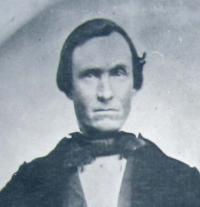
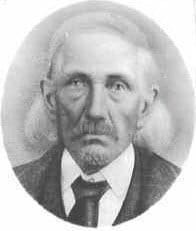
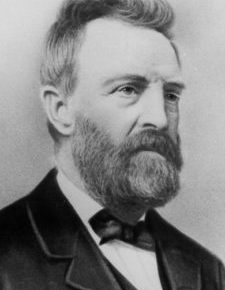
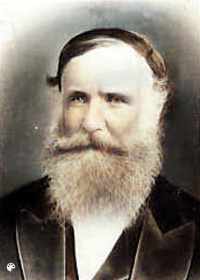
William Decatur Kartchner was born May 4, 1820, in Montgomery Co., Pennsylvania. In 1826 his father, John Christopher Kartchner, died, leaving his mother with five children in poverty. William and his brothers worked hard long hours, early and late, for poor pay and at times did not get enough to eat. William worked in a blacksmith shop, where during the winter he was called up at three in the morning to make fires and call the cook. Work started at daylight and continued until seven p.m. and occasionally all night.

William later went into partnership in Washington Co., Illinois, with his brothers, Peter, as farmer, John, as trader and William, as blacksmith.

On May 7, 1842, William was told of two Mormon elders 10 miles away so he saddled his horse and rode there, having previously read “Voice of Warning” by Parley P. Pratt. William stayed overnight and was baptized the next day, May 8. His brother John met him at the gate on his return and cursed him and the Mormons in such a manner for the next month that William left his brothers and went to Nauvoo, worked on the temple, and was baptized in the river for his father and other deceased relatives.

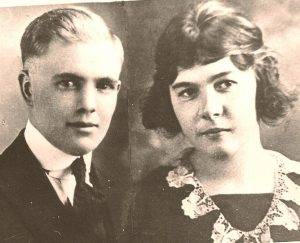
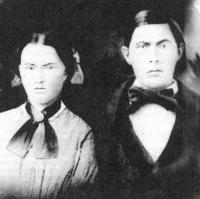
Margaret Jane Casteel was born Sept. 1, 1825, in Copper County, Missouri, to Jacob Israel Casteel and Sarah Nowlin Casteel. Margaret was a woman of fine intellect and sterling character, modest and refined in manner, deeply religious. She was baptized a member of the Church at 14 in Pike Co., Illinois. When she was 18, she married William Decatur Kartchner, on Mar. 17, 1814, in Nauvoo.

William set up a blacksmith shop at his father-in-law’s place. The mob was threatening the settlers and so he stood guard the greater part of the winter, and during a very wet spring he came down with rheumatism. The rheumatism became so severe that it afflicted him the rest of his life.

Margaret and William began their westward journey in September 1844. There was much hardship and short rations of food; rations were reduced to one gill of corn a day.

During the fall of 1845, William crossed the river and went on foot 60 miles to see his brother, John Kartchner. He gave them welcome and a comfortable home. William learned of a pioneer company leaving for the Rocky Mountains in the spring of 1846. His determination to join this company annoyed his brother John, who had made him fine offers of land if he would stay with him for five years. William told John, “I would rather be a Mormon’s dog than to stay in this county, when my people had been robbed, pillaged, murdered and now exterminating orders issued to them to leave the United States.”

William’s camp arrived in the Salt Lake Valley about three days behind Pres. Young’s, reaching the Great Salt Lake Valley July 27, 1847.

They located at a spring about nine miles southwest of the city and began the usual building of the adobe house, fencing and farming the land allotted to them. Their food was very scarce. Their “bread stuff gave out” and so he had to kill his lead ox for food.

In the winter of 1850 a call was made for a group to colonize San Bernardino, California. The Kartchners and the Casteels were among those called to go. The Kartchners remained at San Bernardino until the later part of 1857, when they were called to return to Utah and settled at Beaver, Utah.

William and his family received a call Oct. 9, 1865, to go to the Muddy River. About every six months they moved to a new townsite (the old site washed out when the dams broke), until the winter of 1869 when they moved to Overton and then to Panguitch Mar. 20, 1871. William was called to organize a Sunday School and soon had about one hundred scholars. He set up a mail route connecting Marysvale and Kanab, as well as a post office at Panguitch. In 1874 Joseph A. Young organized a United Order, and William served as secretary and as a board member.

Margaret was always busy raising chickens, spinning, weaving and putting up fruit, both fresh and dried. By this time the family consisted of six sons and five daughters. Two sons and a baby daughter died in infancy.

At General Conference in St. George in 1877, William, his sons and sons-in-law were called on a mission to Arizona Territory, the Little Colorado River settlements. Floods swept away the settlements and the family had to move to the new settlement of Snowflake, Arizona, in 1878.

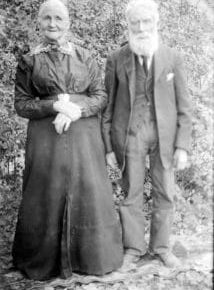
The family helped to colonize four of the western states. Now Snowflake was to be their permanent home. They took part in the activities of the new settlement, especially in the religious affairs. However, Margaret Jane Kartchner became ill and died on Aug. 11 at 56.

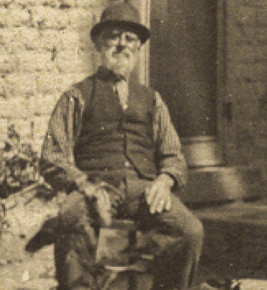
William Decatur Kartchner died May 14, 1892, in Snowflake. He had 21 children—his wife Margaret Jane Casteel had 11, and his wife Elizabeth Gale had 10.

Sources: Autobiography of William Decatur Kartchner, copy on website http://kartchner.surnames.com; family history records; autobiography of Elizabeth Gale Kartchner on same website; “W. D. Kartchner, Man of Steel, True to the Faith”; personal history of Margaret Jane Casteel from The Kartchner Family Book, compiled by Karen H. Miller, 2004.

Happy
Happy
0 %
Sad
Sad
0 %
Excited
Excited
0 %
Sleepy
Sleepy
0 %
Angry
Angry
0 %
Surprise
Surprise
100 %
You May Also Like

STEED, Milton Ezra & Ida Hansen

The bishop had just come out of the chapel ad was standing on the top step visiting with another rancher when, unnoticed, that young man walked across the church yard, up the steps, and hit that bishop square on the jaw and knocked him down. Silence settled over the crowd; people stood motionless in a state of shock. Some of the men had their fists clenched, but no one made a move. All were wondering what the bishop would do. The bishop, however, was silently asking what the Lord would do if he were the bishop. The young man stood over the bishop with his fists clenched, glowering down at him. After a few seconds, which seemed much longer, the bishop got up and looked that young man squarely in the eye and calmly said, “Well brother ________, if that is the way you feel, perhaps you had better hit the other cheek.” He turned his head and waited.
View Post

WOOLSEY, Joseph Henry and Abigail Schaeffer

When her daughter Agatha Ann Woolsey, the first wife of John D. Lee, introduced her to the Gospel, she embraced it whole heartedly, remaining faithful from her baptism 17 Jun 1838, in Vandalia, Fayette County, Illinois, until her death on the cold dreary plains of Wyoming, just before “Rocky Ridge” on the way to the summit of the Rockies.
View Post

GLEASON, John Streator: Rush Valley Miner

John S. Gleason did indeed own the Mountain Lion mine, or parts there-of, but also the Blue Wing mine listed above and much to our surprise, at least seventeen other lodes shown in Figure 13.0. Two miles north of Ophir is Jacobs City in Dry Canyon. Some of the richest lodes of the Ophir Mining District came from this location. John S. Gleason owned in part the Iris(Ira) and Jacobs Hill lodes (Shoo Fly) in Dry Canyon. Millions of dollars of rich metals were taken from the Ophir and Jacobs City locations. The date of sale of the Mountain Lion Lode no. 2 was 4 March 1871. It was sold with the webster and women rights lodes for $2,000 dollars. The Mountain Lion Lode and thirteen other lodes were sold on 10 June 1871 for the combined sum of$5,000 dollars.
View Post

ALLEN Jr., Daniel: A Life of Consecration

Having completed their assignment, Daniel and his committee returned to Nauvoo, only to find buildings burning, mobs raging, and the saints gone. Daniel hurried to his home to find that his family was still alive, but his wife Mary Ann had just had a new baby and was very ill. He pled with the mob to let him stay a few days so his wife could recover, but they said they would kill them all if they weren’t gone by the next day. They hurriedly loaded what they could in the wagon and made a bed for Mary Ann and the baby. The Allen wagon was one of the last three to leave Nauvoo. They traveled together for a short distance, but couldn’t keep up because of Mary Ann’s grave condition. Being left alone with only one other wagon, they trudged through the mud and snow as best they could until they reached the head of Soap Creek (it looks like this might be less than 100 miles from Nauvoo). Mary Ann had struggled so valiantly, but could endure no more, so she whispered her last words to her loving husband…”We’ll meet again dear love in a better world and I shall wait your coming”. She died on the trail in May, 1846, along Soap Creek, Davis County, Iowa with no one but her family and the angels in heaven to mourn her passing.
View Post

JAMESON, Charles: Haun’s Mill Survivor

Charles Jameson was one of the Haun’s Mill victims that survived. “Oh, what a time that was! [Charles Jameson] was shot several [4] times. He crawled into the brush. The men followed him. One said, ‘Shoot him.’ Another said, ‘No, let him suffer. He’s dying anyway.’ But he did not die; he lived to go to Utah and lived to a good old age (6).” They were able to extract one bullet, but Charles carried the other three slugs with him for the rest of his life.
View Post

ASHCROFT, Henry

In those days, the Saints in each settlement were instructed by the General Authorities to have dramas and other amusements for entertainment. In the field of music and drama, Henry was especially gifted. He was a member of the first dramatic organization of Hyde Park. He, Rachel Seamons (Hancey), and Eliza Seamons (England) received much praise for their stage work. Henry had a wonderful bass voice and sang in the choir.
View Post

MAUGHAN, Harrison Davenport & Mary Freestone

Education had already become a high priority in the mind of this teenager. After twelve or fifteen months of employment she had saved enough money to enroll in the new Brigham Young Academy in Logan. Where had she learned what she needed to know to get admitted? How was she able to make her way in the environment of an academy? She may have attended school briefly as a small girl and perhaps for one year just after returning from Franklin Meadows. Mary left one little school workbook, labled “Alpine City, Utah.” It is filled with evidence of studies in math, geology, grammar (including diagraming sentences) and a lot of theology from the Bible. She also left another workbook in penmanship and a series of well-written essays on a variety of subjects. These showed good spelling and extraordinary penmanship, a beautiful script worthy of a highly educated person. Mary attended Brigham Young Academy for perhaps only three months, or maybe asmuch as two semesters. At the end of the spring term in 1882, the students exchanged messages in little autograph books, with one greeting per page in the form of a poetic sentiment. Each page is written in beautiful script – a very impressive exhibit, when compared to twenty-first century handwriting, which is often illegible at the college level!
View Post

TAYLOR, Allen: Captain

Allen’s company of 445 people was twice as large as any of the other four companies that traveled that year. Apparently, Allen had earned his reputation as an effective leader when he had led rescue teams and wagons back to Nauvoo to rescue stranded saints who could not go on by themselves. There were two groups of wagons and Allen’s group traveled twice as fast as the other.
View Post

WOOD, George Lymer: An Incident in the Life

"The usual method of disposing of the dead was to weight the bodies and dump them overboard. When others and I asked the privilege of removing our dead and burying them on land, the Captain was hateful and mean about it. All of my dear ones except Samuel's wife I had to perform this last earthly service for. Others of the party had sustained like losses, and were as anxious as I to bury them as decently as possible. The Captain at last agreed to wait and we hired a Negro to help dig a trench big enough to put them in all together. We removed the dead from the boat and began our heart¬breaking task, but had it only partly done when the boat whistle blew and the boat began to get underway. All ran hastily back except the Negro, one woman and myself. She and I stood at the grave site of our dead and watched them go. What bitterness of spirit I experienced only God knows. Was this what I had come to America, the home of the brave, for? Here I was with two strangers standing beside the open grave of a group of strangers. Our common interests were all lying before us or fast receding from sight, subject to the whim of a heartless thing in human form. "Surges of emotion swept over me, sorrow, anger, love, fear, and despair, but my nearest duty was to protect these rapidly decomposing dear forms of mine from the ravages of wild beasts, heat, and other elements. Perhaps I had been blessed and spared to perform this last service. If! were dead with them our bodies would rot together. So I urged on my companions the need for work. I felt responsible for seeing this thing through.
View Post