HARWOOD, James Taylor: Utah Artist

0 1
Read Time:1 Minute, 30 Second

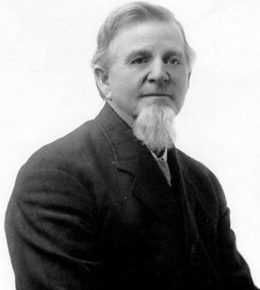
James Taylor Harwood was bom in Lehi, Utah, in 1861, and somehow amid the hard work common of the pioneer life, he nurtured an instinctive love of and talent for art. “During those early years, my pencil worked industriously at every opportunity,” he wrote in his autobiography.

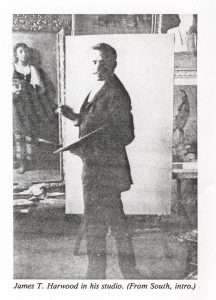
James T Harwood (1861-1940) in his studio.

He felt a need to study and learn, and in 1885, he traveled to San Francisco and enrolled in the California School of Design. In order to be accepted, he had to submit a painting; his submission was a bunch of grapes that his teacher called the “best piece of work every presented there by an applicant.”

After studying for one year in California, Harwood returned to Utah where he opened the Salt Lake Art Academy, In June 1888, Harwood held an auction (he auctioned off more than 100 oils and drawings) and raised money for his training in Europe, By September, he had arrived in Paris, where he enrolled in the Julian Academy, one of the most influential and successful private schools in France, Harwood spent two years studying and learning in Europe before returning back to Utah, where he once again opened a studio in Salt Lake City.

His reputation quickly drew talented and skilled students, some of whom would become the second group of Utah artists to go to France for further education. Thus he led the way for Utah artists to further hone and polish their skills; collectively these early artists left a rich legacy of beautiful pieces that have lasted more than a century and inspired scores of artists to pursue their dreams.


Christ Calling Peter and Andrew, by J.T. Harwood
Happy
Happy
0 %
Sad
Sad
0 %
Excited
Excited
0 %
Sleepy
Sleepy
0 %
Angry
Angry
0 %
Surprise
Surprise
100 %
You May Also Like

POND, Stillman Pond

On February 2nd 1846 the migration west began. Stillman and his family remained in Nauvoo until after the battle of Nauvoo in September 1846 when they were driven at the point of a bayonet across the river. Tribulations and hardships were many as the winter set in early and the Mormon refugees were without the proper food, clothing and shelter. The camp was ravaged by malaria, cholera, and consumption. The Pond family fell victim of all of these diseases. Stillman’s wife, Maria, became consumptive and all the children were afflicted with malaria. Snow fell early on the plains of Iowa and along the way Stillman and Maria buried their son Lowell Anson in September of 1846 on the plains of Iowa. Maria’s body wracked with pain and bowed down with grief for the loss of her son; was unable to walk and was confined to her bed in the back of the wagon with the fever of malaria. In this condition she gave birth to twin boys Joseph and J. Hyrum, the later part of September and the twins died a few days later and were also buried along the trail in Iowa.
View Post

GREEN, Elizabeth Jane

Candace asked Hamilton about his mother’s pictures and he answered “I don’t know, I’ve never touched them.” Candace asked if she could get them and he gave his consent. She went into the other room and came out with some pictures carefully wrapped in tissue and brown paper. It was such a thrill to find a picture of Elizabeth Jane Green as a young mother and five of her sons, a picture of my grandfather James Copeland Orr, taken before he left on a mission, a picture of Charley, Walter, Richard and Earnest. Some of these pictures had been taken up at Mercur, probably when the boys had taken some produce to market or gone up to Mercur on a date or to a dance. Mercur at this time was one of the biggest towns in Utah and the people of Clover and St. John sold nearly all of their produce at Mercur.
View Post

ARMSTRONG, Francis

From this humble beginning began the rise of one of Utah's greatest entrepreneurs of his day or any other day. He obtained his own saw mill, then a lumber company, then a construction company. As the years went by, he purchased a flour mill, several huge ranches, and developed sugar companies, banks, savings and loan operations, railroads, transfer companies, insurance companies, and eventually electric street cars (the second in the world) and the supporting electricity production company.
View Post

BELLISTON, Thomas & Sophia

A harrowing experience occurred between Christmas and New Years, just as he turned fifteen. Thomas and his brother, Jim, had gone with the reluctant consent of their father to haulwood on a very cold winter day. They found themselves returning home after dark when the temperature had dropped to bitter freezing. Both nearly lost their lives.
View Post

ASHTON, Edward

Edward was apprenticed to a man who would teach him how to make shoes. He was bound for three years for his board and room, and his mother paid the sum of six sovereigns (approx $30.00) for his apprenticeship. This was not a happy experience as he did not get enough food and it was not of the highest quality, and he was required to do all kinds of work besides the trade he was supposed to be learning. The man was most unkind and Edward suffered a great deal of abuse as his employer routinely beat him.
View Post

The Adventures of Nathan W. Adams

Much fanfare accompanied the completion of the transcontinental railroad at Promontory Point, Utah on May 10, 1869. Two weeks later Major John Wesley Powell and nine companions in four row boats left Green River, Wyoming, with almost no fanfare, to explore the Green and Colorado Rivers. It was a trip fraught with danger that only six of the men completed. Although not involved in running the river, my great uncle, Nathan Adams, would later share the adventures experienced by Powell’s second exploration crew as they mapped the Grand Canyon area during the 1870s. A hundred and forty years later only a few intrepid tourists visit Promontory Point each year, while tens of thousands of tourists, many of them from foreign countries, enjoy the marvelous scenery discovered by Powell and his colleagues.
View Post