0
 1
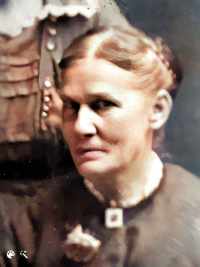
Elizabeth Horrocks was born in Macclesfield, Cheshire, England on August 5, 1826. She is the daughter of Edward Horrocks and Alice Houghton. Elizabeth was the oldest of 11 children, and when she was about 7 years old she worked in a silk factory enabling her to assist her parents in supporting the family. At the age of 15 she joined the Church of Jesus Christ of Latter-day Saints, and seven years later she was married to Elder Aaron Jackson of Eyme, Derbyshire, England. They were blessed with three children, namely: Martha Ann, Mary Elizabeth, and Aaron.
On the 22nd of May, 1856, the tiny Jackson family started on an oceanic and overland voyage for Utah, which was an eventful and ever memorable journey. Elizabeth wrote about her journey to Utah to share with her posterity. In her own words she wrote:
“I have a desire to leave a record of those scenes and events, through which I have passed, that my children, down to my latest posterity may read what their ancestors were willing to suffer, and did suffer, patiently for the Gospel’s sake. And I wish them to understand, too, that what I now write is the history of hundreds of others, both men, women and children, who have passed through many like scenes for a similar cause, at the same time we did. I also desire them to know that it was in obedience of an eternal reward- an exaltation to eternal life in His kingdom- that we suffered these things. I hope, too, that it will inspire my posterity with fortitude to stand firm and faithful to the truth, and be willing to suffer, and sacrifice all things they may be required to pass through for the Kingdom of God’s sake.”
The ship that carried the family across the Atlantic landed in Boston on June 30, 1856. After a short stay in Boston, they moved on to Iowa City where they prepared for their journey across the plains in handcarts they built. They were part of the Handcart company captained by Edward Martin. After a long, dreary and toilsome journey the company reached Fort Laramie on the 8th of October. In Elizabeth’s writings we read:
“Our provisions by this time had become very scant, and many of the company went to the Fort and sold their watches and other articles of jewelry. With the proceeds they purchased corn meal, flour, beans, bacon, etc. Hitherto, although a ration of a pound of flour had been served out daily to each person, it was found insufficient to satisfy the cravings of hunger… Shortly after leaving Fort Laramie it became necessary to shorten our rations that they might hold out, and the company be not reduced to starvation. The reduction was repeated several times. First, the pound of flour was reduced to 3/4 s of a pound, then to a half of a pound, and afterward to still less per day. However we pushed ahead. The trip was full of adventures, hair breadth escapes, exposure to attacks from Indians, wolves and other wild beasts. When we reached the Black Hills, we had a rough experience. The roads were rocky, broken and difficult to travel. Frequently carts were broken down and much delay was caused by the needed repairs.”
After leaving Laramie and before reaching the Platte river, Elizabeth’s husband, Aaron was afflicted with mountain fever. He was able to eat more than his rations, but he had no energy. While crossing the Platte he only made it to a sandbar in the middle of the river where he sank down through weakness and exhaustion. Elizabeth’s sister Mary Horrocks Leavitt waded through the water and assisted him the rest of the way. The river was exceedingly cold and while some men carried some of the women on their backs, many women tied up their skirts and waded through like the heroines that they were!
After crossing the river and tremendous storm of snow, hail and wind hit the handcart party adding to their suffering. It was necessary to lighten the loads of the handcarts as well as the wagons carrying the supplies, so a great deal of the bedding and clothing had to be destroyed. Elizabeth tells about the worst night of her life:
“About the 25th of October, I think it was – I cannot remember the exact date – we reached camp about sundown. My husband had for several days been much worse. He was still sinking, and his condition now became more serious. As soon as possible after reaching camp, I prepared a little of such scant articles of food as we then had. He tried to eat but failed. He had not the strength to swallow. I put him to bed as quickly as I could. He seemed to rest easy and fell asleep. Bout nine o’clock I retired. Bedding had become very scarce, so I did not disrobe. I slept until, as it appeared to me, about midnight. I was extremely cold. The weather was bitter. I listened to hear if my husband breathed- he lay so still. I could not hear him. I became alarmed. I put my hand on his body, when to my horror I discovered that my worst fears were confirmed. My husband was dead. He was cold and stiff-rigid in the arms of death. It was a bitter freezing night and the elements had sealed up his mortal frame. I called for help to the other inmates of the tent. They could render me no aid; and there was no alternative but to remain alone by the side of the corpse till morning. The night was enveloped in almost Egyptian darkness. There was nothing with which to produce a light or kindle a fire. Of course I could not sleep. I could only watch, wait, and pray for the dawn. But oh, how those weary hours drew their tedious length along. When daylight came, some of the male part of the company prepared the body for burial. And oh, such a burial and funeral service. They did not remove his clothing- he had but little. They wrapped him in a blanket and placed him in a pile with thirteen others who had died, and then covered him up in the snow. The ground was frozen so hard that they could not dig a grave. He was left there to sleep in peace until the trump of the Lord shall sound, and the dead in Christ shall awake and come forth in the morning of the first resurrection. We shall then again unite our hearts and lives, and eternity will furnish us with life forever more.
“I will not attempt to describe my feelings at finding myself thus left a widow with three children, under such excruciating circumstances. I cannot do it. But I believe the Recording Angel has inscribed in the archives above, and that my sufferings for the Gospel’ sake will be sanctified unto me for my good. I could therefore appeal to the Lord alone; fatherless. I appealed to Him and He came to my aid.
“A few days after the death of my husband, the male members of the company had become reduced in number by death; and those who remained were so weak and emaciated by sickness, that on reaching the camping place at night, there were not sufficient men with strength enough to raise the poles and pitch the tents. The result was that we camped out with nothing but the vault of Heaven for a roof, and the stars for companions. The snow lay several inches deep upon the ground. The night was bitterly cold. I sat down on a rock with one child in my lap and one on each side of me. In that condition I remained until morning.
“It will be readily perceived that under such adverse circumstances I had become despondent. I was six or seven thousand miles from my native land, in a wild, rocky, mountain country, in a destitute condition, the ground covered with snow, the waters covered with ice, and I with three fatherless children with scarcely nothing to protect them from the merciless storms. When I retired to bed that night, being the 27th of October, I had a stunning revelation. In my dream, my husband stood by me and said, ‘Cheer up, Elizabeth, deliverance is at hand’. The dream was fulfilled.”
On the 28th of October Joseph Young, Daniel Jones and Abel Garr galloped in camp. Those three men were from the relief company sent by Brigham Young from Salt Lake. The camp welcomed them with tears and cheers as they brought word of provisions and clothing waiting for them at Devil’s Gate. After reaching Devil’s Gate the company decided to leave most of the freight there for the winter. The company decided to continue onto Salt Lake. Elizabeth writes:
“It was several days after that – I do not remember the exact date – that we made the last crossing of the Sweetwater. In speaking of that memorable event, Elder John Jaques says: “It was a severe operation to many of the company. It was the last ford the company waded over. The water was not less that two feet deep, perhaps a little more in the deepest parts, but it was intensely cold. The ice was three or four inches thick and the bottom of the river muddy and sandy. The stream seemed to be about forty yards wide. Before the crossing was completed, the shades of evening were closing around, and this, as everyone knows, is the coldest hour of the twenty-four, especially at a frosty time. When the handcarts arrived at the bank of the river one poor fellow who was greatly worn down with travel exclaimed: ‘Oh dear, I can’t go through that!’ His heart sank within him and he burst into tears. But his heroic wife came to his aid, and in a sympathetic tone said, ‘Don’t cry, Jimmie, I’ll pull the handcart for you.’ In crossing the river the shins and limbs of the waders came in contact with sharp cakes of ice which inflicted wounds on them which did not heal until long after they arrived in this valley. And some of them are alive, some of them bear the marks of them to this day.
“After this crossing we camped for several days in a deep gulch called Martin’s Ravine. It was a fearful time and place. It was so cold that some of the company came near freezing to death. The sufferings of the people were fearful, and nothing but the power of a merciful God kept them from perishing. The storms continued unabated for some days. Said I. K. Hank in speaking of it: ‘The storms during the three days were simply awful. In all my travels in the Rocky Mountains, just before and afterwards, I have seen nothing like it – nothing worse.’ When the snow at length ceased falling, it lay thick on the ground, and so deep that for many days it was impossible to move the wagons through. I and my children with hundreds of others were locked up in those fearful weather-bound mountains.
“Elder Hanks gives the following graphic pen pictures of his first meeting with Martin’s company which he with others had been sent to relieve, and which some of them had given up for lost, believing that they had perished in the storms. ‘I think,’ he said, ‘the sun was about an hour high when I spied something in the distance that looked like a black streak in the snow. As I got near to it, I perceived it moved, than I was satisfied that this was the long looked for handcart company led by Captain Martin. I reached the ill-fated train just as they had camped for the night. The sight that met my gaze as I entered their camp can never be erased from my memory! The starved forms and haggard countenances of the poor sufferers, as they moved slowly, shivering with the cold to prepare the evening meal, was enough to touch the stoutest heart. When they saw me coming they hailed me with joy inexpressible.’
“Children, I was there. Martha Ann was there. Mary Elizabeth was there, they, my daughters, and Aaron, my son.”
The emigrants with the Martin Handcart company finally reached Salt Lake City on Sunday, November 30, 1856. Elizabeth and her children moved to Ogden and stayed with her brother until they were rested and recuperated. Elizabeth married William Kingsford and became a prominent business woman. Elizabeth concludes her writings with these words of faith, courage and gratitude:
“…the Lord has blessed me, and rewarded me with abundance of this world’s good, for all my sufferings, and has also blessed me with the highest blessings of a spiritual nature that can be conferred upon man or woman, in His Holy Temple, in mortality. I have a happy home for which I thank my Father in Heaven.”
Elizabeth Horrocks Jackson Kingsford died in Ogden on October 17, 1908.


 Brother Joseph