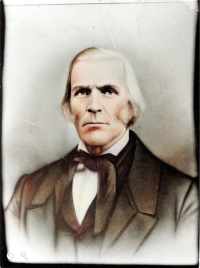
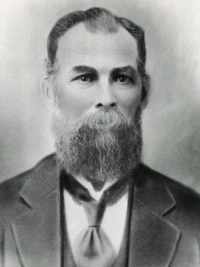
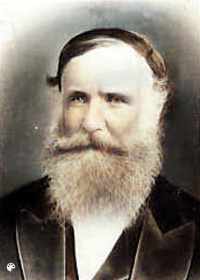
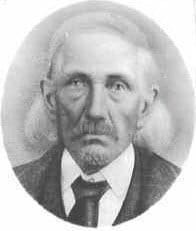
ALLEN, Andrew Lee

The family moved to Provo, where Andrew and his sons helped to build the Provo Fort. Andrew taught his sons to work and take care of their animals. The sons worked quite often as teamsters. Andrew was an excellent rope maker and knew how to make dyes from plants. He made tassels and decorations for his teams.
0 1
Read Time:5 Minute, 5 Second

Andrew Lee Allen‘s mother died when he was nine years old. He went to live in Rochester, New Hampshire, with his grandfather, Reverend Avery Hall, and wife, Abigail. He learned the blacksmith trade and received religious instruction from his grandfather. He left his grandfather’s home at age fourteen, apparently making his way into the world. At age 21, he joined in the War of 1812 to help protect American vessels at the Canadian border. He proposed a toast at a barn raising that British soldiers took as an insult and was taken prisoner by them.

The soldiers imbibed too much, and when they went to sleep, he was able to make his escape.

He moved to Cattaraugus County, New York, and improved upon a large farm. He improved the land and built a house. When he was 33 years old, he married Clarinda Knapp, and they had a family. One day, Mormon Missionaries called at the house and left literature. Andrew was not at home, but he became interested in their message and rode a mule 80 miles to find them and hear them preach. He was baptized at once and was a faithful follower of the L.D.S. Church. His wife’s family was unhappy with her situation, and they became estranged from her family. Andrew sold his home and farm in New York, and the family joined other Saints in Kirtland, Ohio. From then on, they moved westward, never prospering, living in various places in Illinois and Iowa until they finally reached Utah in 1852.

The family moved to Provo, where Andrew and his sons helped to build the Provo Fort. Andrew taught his sons to work and take care of their animals. The sons worked quite often as teamsters. Andrew was an excellent rope maker and knew how to make dyes from plants. He made tassels and decorations for his teams.

In 1855 his sons Charles, James, and Andrew went to help settle the Mormon colony in San Bernardino, California. They built homes there. In 1858 they hauled freight to Salt Lake City. When they returned to California, they took their Mother, Clarinda, sister Susan, and brothers Levi and Sidney. They cited health reasons. In 1862, Clarinda desired to return to Utah. She did not go back to live with Andrew in Provo but went to Richmond, Utah, and stayed with her son. She died there in December 1862.

In 1863, Andrew married Martha Christina Johnson, a widow with a young son. Andrew adopted the boy who was called Charles August Allen. Martha and Andrew separated after a couple of years, and Andrew married Ann Hughes in 1867. She was a good wife to him until he died in 1870. He was buried in Provo, but the grave site has been lost. His grandchildren have built a monument to him and Clarinda at her grave site in Richmond, Utah.

Andrew and Clarinda were members of the L.D.S. second Ward when they lived in Provo. Andrew was very religious and serious about his church work. A granddaughter who wrote about him said he was a hard-working man who could split as many rails in a day as any two ordinary men. She said he loved to fish, and although he grew up under trying circumstances, he developed good character traits.

Andrew Lee Allen:

  • Born: 24 Nov 1791, Limerick, York, Maine
  • Died: 14 Aug 1870, Provo, utah

Came to utah: 13 Aug 1852, wagon Co., John Higby, Captain

Parents: ELIJAH ALLEN, father, MEHITABLE HALL, mother

Spouse #1: CLARINDA KNAPP, born 10 Aug, 1802, Bethlehem, Litchfield, CT. md II Deg 1824, Cattaraugus Co., New York. She died 7 Dec 1862, Richmond, Cache, Utah.

Children by first wife:

1. ELIJAH ALLEN, born 7 feb 1826, Burton, cattaraugus, N. y. md 2 May 1852, ELIZA ANN BICKMORE at silvercreek, pott., Iowa. She was born 29 Jan 1830, Madison, IL, and died 26 Mar 1901, Cove, Cache, Utah. He died 21 Apr 1866, Salt Lake City, Utah.

2. LYDIA JANE ALLEN, born 5 Jun 1827, Allegany, Catt., N.Y., died 15 Oct 1870, Richmond, Cache, Utah. Unmd

3. SOPHRONIA ALLEN, born 6 Nov 1828, md first, 1 Dec 1851, Jacob H. Rose (divorced). Md second, 23 Feb 1863 at San Bernardino, CA, Abraham Foster. She died 19 Oct 1912, Richmond, Cache, Utah

4. CHARLES HOPKINS ALLEN, born 15 Oct 1830, Allegany, Catt., N. y. d l5 Jun 1864 at Richmond, Utah, Elizabeth Adelaide Hoopes. MD Second, Annie Eliza Jones, 69 Oct 1890, at Logan, Utah. He died 18 Feb 1922, Mesa, Maricopa, AZ.

5. ANDREW LEE ALLEN, born 16 Aug 1832, Allegany, Catt., N. y. Md 4 Mar 1872 MINERVA WHITTLE, in Salt Lake City, Utah. Md second, 8 May 1884, ANNIE SPACKMAN in Logan, Utah. He died 8 Jun 1918, Cove, Cache, Utah.

6. JAMES ALLEN, born 12 Oct 1833, Allegany, Catt., N. y. Md 24 Dec 1860, MARY ELIZABETH MATTHEWS, at San Bernardino, CA. He died 17 Jan 1890, Richmond, cache, Utah.

7. SIDNEY DAVID ALLEN, born 12 Aug 1835, Allegany, Catt., N. y. Md first before 1862, LUCRETIA WINN, md second 31 Jul 1865, MARGARET ANN COOPER, AT Richmond, Utah. He died 1 Jan 1905, Bedford, Lincoln, Wyoming.

8. SUSAN ALLEN, born 31 Dec 1837, Kirtland, Ohio. Md 4 Jul 1858 at Provo, Utah, JOHN CORNOG GOASLIND. She died 16 Apr 1924, Logan, Utah

9. LEVI KNAPP ALLEN, born 1 Apr 1842, Virginia, Cass, IL. Md 11 Dec 1888 LIVINIA MERIAM HENSON at Logan, Utah. He died 18 Feb 1928, Cove, Cache, Utah.

10. JULIA ALLEN, born 8 Jun 1844, Plymouth, Hancock, IL. She died 4 sep 1858, Provo, Utah, unmd.

Spouse #2: MARTHA CHRISTINA JOHNSON, born in Sweden in 1825 Md 30 May 1863, Provo, Utah.

1. CHARLES AUGUST ALLEN, born 24 Oct 1847, Kalen S., Sweden to JOHAN JOHANNAS and Mar*~a Christina JOHNSON. Charles was adopted by Andrew Lee Allen and used the ALLEN name. He md 19 Jan 1873, ELVON LAVERIA STEWART, at Provo, Utah. He died 18 Sep 1932, Provo, Utah.

Spouse #3: ANN HUGHES, md 16 Nov 1867, Provo, Utah

Happy
Happy
0 %
Sad
Sad
0 %
Excited
Excited
0 %
Sleepy
Sleepy
0 %
Angry
Angry
0 %
Surprise
Surprise
0 %
You May Also Like

POND, Stillman Pond

On February 2nd 1846 the migration west began. Stillman and his family remained in Nauvoo until after the battle of Nauvoo in September 1846 when they were driven at the point of a bayonet across the river. Tribulations and hardships were many as the winter set in early and the Mormon refugees were without the proper food, clothing and shelter. The camp was ravaged by malaria, cholera, and consumption. The Pond family fell victim of all of these diseases. Stillman’s wife, Maria, became consumptive and all the children were afflicted with malaria. Snow fell early on the plains of Iowa and along the way Stillman and Maria buried their son Lowell Anson in September of 1846 on the plains of Iowa. Maria’s body wracked with pain and bowed down with grief for the loss of her son; was unable to walk and was confined to her bed in the back of the wagon with the fever of malaria. In this condition she gave birth to twin boys Joseph and J. Hyrum, the later part of September and the twins died a few days later and were also buried along the trail in Iowa.
View Post

HOLBROOK, Judge Joseph Holbrook: Faithful Saint

He served in the state legislature from 1859 to 1862 inclusive, it being held at the court house in Salt Lake City. January 20th, 1864, he was again appointed Judge of Davis County. There was a company of "Silvergrays" formed in the south portion of Davis Co. and mustered into service on the 8th day of August 1857, from members of the Nauvoo Legion. They were called the "Mountain Sharps."
View Post

FREESTONE, George: and his Wives, Alice Carlisle and Jennie Lind

George found himself, as a fifteen year-old, driving four yoke of oxen on a heavy freight wagon to the Utah Territory. His younger brother, James, later wrote that he had driven sheep 1,000 miles barefooted across the Plains. “In Alpine,” George wrote, “between 1855 and 1856, I spent about half of my time building forts to fight against the Indians and half my time killing crickets.” The family struggled against these odds to make a living. Then in 1858, they lost their father when he was killed by Indians.
View Post

WOOD, George Lymer: An Incident in the Life

"The usual method of disposing of the dead was to weight the bodies and dump them overboard. When others and I asked the privilege of removing our dead and burying them on land, the Captain was hateful and mean about it. All of my dear ones except Samuel's wife I had to perform this last earthly service for. Others of the party had sustained like losses, and were as anxious as I to bury them as decently as possible. The Captain at last agreed to wait and we hired a Negro to help dig a trench big enough to put them in all together. We removed the dead from the boat and began our heart¬breaking task, but had it only partly done when the boat whistle blew and the boat began to get underway. All ran hastily back except the Negro, one woman and myself. She and I stood at the grave site of our dead and watched them go. What bitterness of spirit I experienced only God knows. Was this what I had come to America, the home of the brave, for? Here I was with two strangers standing beside the open grave of a group of strangers. Our common interests were all lying before us or fast receding from sight, subject to the whim of a heartless thing in human form. "Surges of emotion swept over me, sorrow, anger, love, fear, and despair, but my nearest duty was to protect these rapidly decomposing dear forms of mine from the ravages of wild beasts, heat, and other elements. Perhaps I had been blessed and spared to perform this last service. If! were dead with them our bodies would rot together. So I urged on my companions the need for work. I felt responsible for seeing this thing through.
View Post

CURTIS, Celestia

The people were screaming for they thought there was no help for them. Celestia’s father (Enos Curtis) raised his hand and commanded the wind to cease and for the boat to stand still in the name of the Lord. The wind did cease and the boat stood still until the men on the bank could get ropes to them to pull them to safety.
View Post

JOHN, Thomas & Margaret Thomas

The first three nights on the trail were spent on the banks of the Elkhorn River, which was not far out of Winter Quarters. The river had many fish in it and some of the company fished a good deal while camped at that location. Others spent time harvesting grapes which were in abundance along the banks of the river. The company saw many buffalo herds and abundant antelope, deer, and elk along the trail. They only harvested one buffalo, but had many deer and antelope along the way. This journey was made before the white man exterminated the buffalo by shooting thousands and then leaving the carcasses to waste.This was not the end of the influence of the white man. Henry John documented the following: “The horse and the cow were soon to take the place of the buffalo; sheep were to replace the elk, deer and antelope. Domestic fowl claimed the place of the wild turkey; grouse and little prairie dogs were given wheat saturated with poison in order to move them out of the way so fields of grain could be raised. Wild plums and bending branches of wild fruit were to be rooted up and the more luscious fruits- peaches, pears, apples and others- were to take their place. The Indian wigwams were to be moved; white man’s cottages and beautiful residences were to take their places (2).” Henry Miller had a very stern reputation and lived up to that reputation on this journey as well. When the company came to the Green River, Captain Miller told them all to get out of the wagons and ford the stream on foot. The river was ice cold and one old man that had been very sick and worn out climbed on a mess box that was bolted on the back of a wagon. When Captain Miller saw this, he jumped into the river and pulled the old man off and threw him into the cold river. Twenty eight people died on the trip and many thought a good portion of those fatalities were attributable to Captain Miller’s harsh, unforgiving supervision
View Post

Daniel Rapalyea Allen

Daniel Rapalyea Allen operated flour mills in Flushing, New York, St. Louis, Kanesville and Perryville, Iowa, West Jordan, American Fork Canyon along with a saw mill, and American Fork City (600 North 150 East, just south of current Star Mill). The mills in the latter two locations were owned by him. Following several floods which destroyed the canyon mills and associated bridges, he returned to West Jordan.
View Post

ALLEN Jr., Daniel: A Life of Consecration

Having completed their assignment, Daniel and his committee returned to Nauvoo, only to find buildings burning, mobs raging, and the saints gone. Daniel hurried to his home to find that his family was still alive, but his wife Mary Ann had just had a new baby and was very ill. He pled with the mob to let him stay a few days so his wife could recover, but they said they would kill them all if they weren’t gone by the next day. They hurriedly loaded what they could in the wagon and made a bed for Mary Ann and the baby. The Allen wagon was one of the last three to leave Nauvoo. They traveled together for a short distance, but couldn’t keep up because of Mary Ann’s grave condition. Being left alone with only one other wagon, they trudged through the mud and snow as best they could until they reached the head of Soap Creek (it looks like this might be less than 100 miles from Nauvoo). Mary Ann had struggled so valiantly, but could endure no more, so she whispered her last words to her loving husband…”We’ll meet again dear love in a better world and I shall wait your coming”. She died on the trail in May, 1846, along Soap Creek, Davis County, Iowa with no one but her family and the angels in heaven to mourn her passing.
View Post

JENKINS, Jane: A Widow Supporting Her Family

In order to support herself and her family of small children, Jane made cookies, cakes, and bread which were put into small home made baskets and the children would sell them to regular customers and at the Southern Down Resort. In order to have a variety of cakes, the mother and children would go down to the seashore when the tide was out and gather larva from the rocks. This substance looked somewhat like lettuce. They washed the sand from it and put it into baskets and buckets. It was later baked as part of the cakes. These children thought nothing of walking three or four miles and selling this food for a schilling a pound. Sometimes Cecilia and Ann worked as nurse girls and as ladies maids.
View Post