This article originally appeared in Pioneer Magazine, 2010 Vol.57 No.3
by Wendell A. Bryce
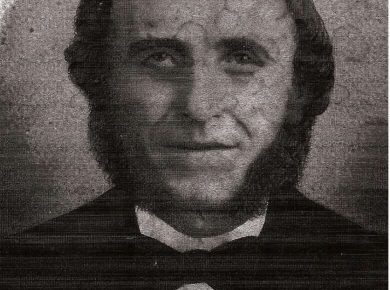
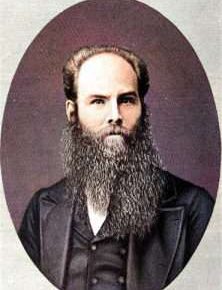
Ebenezer Bryce was born in Dunblane, Perthsire, Scotland, on November 17, 1830. His parents were Andrew Bryce and Janet Adams. Ebenezer was the third child of eight children.
At 10 years Ebenezer began working in the shipyards. At 15 years he became an apprentice. In the spring of 1848 he became interested in The Church of Jesus Christ of Latter Day Saints. His father, family and friends did not share his enthusiasm. His father would lock up his clothes to keep him from attending the meetings. He was baptized in April and was determined to go to Utah. His father followed him on board a ship to persuade him not to go. but he was still intent on going.
Ebenezer came to the U.S. in the John Sharp Company arriving in New Orleans on October 27, 1848, aboard the “Erin’s Queen” from Liverpool with 232 souls. While in St. Louis he was ordained a Seventy on February 27, 1849. In March 1850 he started westward, traveling in the James Pace Company. They arrived in Salt Lake City September 16, 1850. No record of the company’s travels is known.
On April 16, 1854, he was married to Mary Ann Park by George A. Smith in the Smith home. The new couple made their home in Salt Lake City where Ebenezer began working as a carpenter and millwright. He was soon asked to go to Tooele to work on a sawmill. In March 1856 Ebenezer was listed as a private in Company A of the Tooele Top Battalion of the Nauvoo Legion. The family moved to Spanish Fork, then Mill Creek.
At the October Conference in 1861 he heard his name read along with others to go to Dixie in southern Utah and help settle that area. This must have been a particularly trying time. They had four young children with the oldest about 6 years. Another child was expected very soon. They arrived in the present area of St. George in early December. The city consisted of 7 tents before their arrival. Then there were 40 days of rain! —while camped in a wagon with four young children and a baby. In the spring they were then called to go to Pine Valley about 30 miles to the north to build sawmills. There he and Sam Burgess erected the fourth sawmill in Pine Valley.
It was about 1865 when Bishop William Snow asked him to design and be the builder for a Pine Valley Chapel. Ebenezer had not built any large buildings, but said, “If you will let me build it like a ship, I’ll build it.” He was told to go ahead.
They hand picked some trees from the gorge at the lower end of the valley on Santa Clara Creek. Because of the confines of the rock walls, the trees grew tall and straight. These trees were too large for the sawmills to cut, so they were squared into timbers with broad axes.
The sides of the church were built laying on the ground. To raise the sides into place, Ebenezer had a call that was used on ships. Ropes were attached to the sides and the call used to get everyone to pulling together to raise the sides. The building strongly shows his shipbuilding influence. Ebenezer said, “It might burn, it might float in a flood, it might tip over in a hurricane, but it will not break up.” The lower story was used as a school for many years and the upper story as the chapel. It is shown on aeronautical charts as a landmark to guide the aircraft pilots.
One of the little boys that went to school in the building would later develop the skip bombing technique that was used so successfully in World War II.
[Ebenezer was] advised to seek a warmer climate for Mary Ann’s health. [He] traded his home (which is still in use today) to Henry Slade for sheep and moved to the Paria River in Garfield County.
In developing water for home and irrigation, Ebenezer and two sons went up the creek until they found a series of springs. They set about cleaning these springs and developing more flow.
As they were working Ebenezer decided to go up the canyon further and explore. He was gone a long time, and when he returned he described the fantastic shapes and colors and said,
“Someday that will be a national park.”
Bryce Canyon Utah National Park United States
[“A group of families established the town of Clifton near the junction of the Paria River and Henrieville Creek, in 1874. Ebenezer Bryce and his family arrived in Clifton in 1875, but soon moved upstream to Henderson Valley (New Clifton). Ebenezer helped to complete a seven mile irrigation ditch from Paria Creek. Bryce built a road into the pink cliffs to make timber more accessible. People started to call the amphitheater where the road terminated, ‘Bryce’s Canyon.’ Ebenezer Bryce and his family moved to Arizona in 1880, but the Bryce’s Canyon name stuck.”1
The family had moved about two miles north of Pima, Arizona, where the settlement of Bryce is named in his honor. It was there that he died, in 1913, and is buried in Bryce Cemetery.
Bryce Canyon became a National Monument in 1923 and a full-fledged National Park in 1928.2]
Written by Wendell A. Bryce, March 9, 1983, excerpts from the family history of Jerry and Barbara Waters Cornia at http://barbcornia.com/genealogy/ getperson.php?personID=I183&tree=barb
Cited from National Park Service, Bryce Canyon at http://www.nps.gov/brca/historyculture/pioneer_history.htm
Lot Smith was bom in May 1830 in Williamstown, Oswego County New York, to William Orville and Rhoda Hough Smith, the fifth of twelve children. In late 1835 or early…
1858-1921 This article originally appeared in Vol.65 No.1 of Pioneer Magazine. by Susanne Lunt Peterson, granddaughter Sarah Ann Lunt, the daughter of Edward and Harriet Wood Lunt, was born in…
By Calvin Woolley Submitted by John Elggren Edwin Dilworth Woolley, Senior, the son of John Woolley and Rachel Dilworth was born at West Chester, Chester County, Pennsylvania June 28, 1807. …
The only time for any kind of play was at night, and on one occasion in the Spring of 1836 he stayed at play until after nine p.m. When he went to the house the doors were locked so he had to sleep in the hay in the stable. In the morning he went with the other hands to breakfast and to his surprise Mr. Miles, the old boss had prepared a large whip which he used on William’s back so unmercifully that it raised a solid scab half the length of his back. His cries were heard by all the neighbors, and then he was sent to work without breakfast. His oldest brother, Peter, came from the western country to visit him. Upon hearing his grievances, they laid a plan for William to run away and go with Peter. William had saved up five dollars and asked Peter if that was enough to bear his expenses. Peter told him that he could go without a cent.
by Orson F. Whitney, in History of Utah Vol.4 For more than two decades after the settlement of Salt Lake Valley, the right-hand man of Brigham Young—one with him in…
This biography originally appeared on pioneerstories.org Born: 19 September 1794, Strasburg, Lancaster, Pennsylvania, USA Died: 9 May 1869, East Millcreek, Salt Lake, Utah Territory, USA The Money Belt John deserves…
The pioneer mill-builder of Utah, also a prominent colonizer in California and in Arizona, Charles Crismon was known as a man of ability and enterprise. He was it born December 5,…
The family moved to Provo, where Andrew and his sons helped to build the Provo Fort. Andrew taught his sons to work and take care of their animals. The sons worked quite often as teamsters. Andrew was an excellent rope maker and knew how to make dyes from plants. He made tassels and decorations for his teams.
This article originally appeared on pioneerstories.org Richard Charles Mitchell was born at Hooper, Weber, Utah, on 16 December 1878. He was the youngest son of pioneer parents, James Mitchell and…
This article originally appeared in Vol.50 No.2 (2011) issue of Pioneer Magazine William Decatur Kartchner was born May 4, 1820, in Montgomery Co., Pennsylvania. In 1826 his father, John Christopher…
Samuel Whitney Richards 1 Samuel W. Richards, born in Richmond, Mass., August 9, 1824, was the sixth child of Wealthy Dewy and Phineas Richards. , , , A cousin –…
A TURBULENT TIDAL WAVE RAGED THROUGH THE CREEK CHASM DESTROYING EVERYTHING IN ITS PATH. THERE WOULD BE NO ACCOUNTABILITY AS TO WHAT WOULD TAKE PLACE AT THIS TRAGIC MOMENT…A CENTURY LATER, HISTORY BOOKS WOULD CHRONICLE THE EVENTS OF THE JULY 16, 1863 PINE VALLEY FLOOD.
Edward was apprenticed to a man who would teach him how to make shoes. He was bound for three years for his board and room, and his mother paid the sum of six sovereigns (approx $30.00) for his apprenticeship. This was not a happy experience as he did not get enough food and it was not of the highest quality, and he was required to do all kinds of work besides the trade he was supposed to be learning. The man was most unkind and Edward suffered a great deal of abuse as his employer routinely beat him.
By Richard D. Kirkham – Great Grandson Miracles of grace are well portrayed in the pioneer life of Lott Russon, born in Dudley, England, a place called “The Black Country”…
Submitted by Jake Smith William Greenhalgh Born: 7/29/1811, Bolton, Lancashire, England Died: 04/03/1882, Spring Lake, Utah William GREENHALGH was born on 29 July 1811, the son of Robert GREENHALGH and…


 0
0
 1
1
 Ebenezer Bryce was born in Dunblane, Perthsire, Scotland, on November 17, 1830. His parents were Andrew Bryce and Janet Adams. Ebenezer was the third child of eight children.


 Brother Joseph



 Pioneer John