 0
0
 1
1
from History of Utah, Vol. 4 by Orson F. Whitney
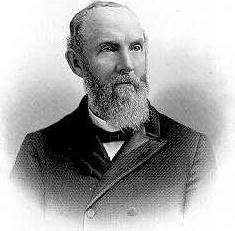
Adam Speirs, ex-Alderman of Salt Lake City, and present Bishop of the Tenth Ward, is a native of Beaver, Beaver County, Pennsylvania, where he was born July 7, 1834. His father, Thomas Speirs, came from Scotland with his parents in 1826, while his mother, Mary Cochran, was born near Belfast, Maine, where her ancestors had lived from before the war of the Revolution. The couple met and married in Pittsburgh, Pennsylvania. Thomas Speirs was a blacksmith and machinist, and forged the works of the town clock in Philadelphia. Removing to Beaver, he lived there, after the birth of his son Adam, for about five years, and then, having become a Latter-day Saint, went with his family to Illinois. He had been converted through the preaching of Orson Pratt, and forsook a good home and a prosperous business for the sake of his religious convictions. They arrived at Commerce, which became Nauvoo, in the spring of 1839.

(1834-1908)
There seven years of Adam’s boyhood were passed. He witnessed the marvelous growth of the city and bears to this day a vivid remembrance of scenes and incidents connected with its fate. Chief among these reminiscences is the martyrdom of the Prophet and Patriarch.
“I well remember,” says he, “the long procession that filed past during the day that their bodies lay in the Nauvoo Mansion. As the people viewed the beloved faces and cruel wounds of the martyrs, tears dimmed the eyes of scores of stalwart men, and hundreds of women wept as if they had lost ‘their first-born. I heard no threat of vengeance; all was deep sorrow. I also witnessed the desecration of the Temple by the mob, who expelled the remnant of the Saints left at Nauvoo after the great body had begun their westward march. My father secured two wagons on which were loaded our household goods, all the bulky furniture being abandoned. The mob searched the wagon under pretense of finding arms. They took all the money my father had, some thirty-five dollars, and also a fine rifle belonging to me. We stopped one year at Montrose, on the Iowa side of the river, where my father worked at. his trade and secured teams for the two wagons, and in November, 1847, we traveled across Iowa to Winter Quarters. All this while our relatives in the East were pleading with us not to go into the wilderness where we would be destroyed by Indians or perish from starvation.
“Father improved every opportunity to send his children to school. The family consisted of one daughter and four sons, I being the eldest son. At Winter Quarters under President Young’s direction, a large log schoolhouse was hastily erected and therein a school, which had a full attendance, was taught by Eli B. Kelsey and wife through the winter. I was one of the pupils. I have often thought since that such incidents as this are a sufficient answer to the baseless charge that the Mormon leaders and the Mormon people are opposed to education. Here was a community of exiles, camped through the winter on the Missouri River and expecting to abandon the place in the spring, erecting a substantial schoolhouse, that their children might be taught for a few months, before continuing their travels into the wilderness. No further comment is necessary.”
The spring of 1848 saw busy times at Winter Quarters, whose inhabitants were preparing to follow the pioneers and emigrants of the previous year. The Speirs family traveled with the last company, which was led by Amasa M. Lyman. It left the Missouri River the first week in July and arrived in Salt Lake Valley on the 17th of October. Says the Bishop:
‘‘I drove one of the teams—three yoke of oxen, or rather, two yoke of oxen and one yoke of cows, for the cows had to do their portion. I was fourteen years old and enjoyed the trip over the wild plains, though handicapped by the loss of my rifle. We saw thousands of buffalo and passed through large Indian villages—Sioux—but were not seriously molested. In fact, we were treated better by them than by the Christians we had left behind.
‘‘Arriving in the valley we immediately set about getting out logs from the canyon to build a shelter for the coming winter. After completing the sides, cauvas was used for the roof. We did not suffer greatly, though reduced to about one-half rations. In the spring of 1S49 the first contingent of gold diggers, three men with pack animals, stopped aud were entertained at in father’s house. They gave us the first account of the great exodus to the new-found goldfields of California. Thousands of others passed through during the summer, bartering off to the settlers goods and merchandise of every description in exchange for fresh ponies, provisions and outfits to enable them to hasten on to the land of gold.”
Adam Speirs learned the blacksmith’s trade from his father, and afterwards worked at it for many years. During the winter months he attended school in the old Council House—the University “parent school,’’ taught by Orson Spencer and William W. Phelps. He also attended Professor Orson Pratt’s course of lectures on astronomy. On the 6th of April, 1858, he took part officially, as counselor to the president of the Teachers’ Quorum, in the laying of the cornerstones of the Salt Lake Temple; being the youngest by many years among those who participated in that ceremony. He had been ordained to the office in question that very day. He was also present at the dedication of the Temple, forty years later.
During the year 1853 he was one of a company of mounted men, which, under James Ferguson and William H. Kimball, went east over the emigrant road to protect the incoming trains from Indians and lawless whites. After forty days of service, the danger being past, he returned home, to find that he, with seventy-five others, had been called to form a colony in the Green River country. John Nebeker was placed in command of this expedition, which proceeded to the part indicated, and there built Fort Supply, south of Fort Bridger, now in Wyoming.
About this time Mr. Speirs entered into the state of wedlock, marrying Miss Charlotte Clark, whose parents had shared in the early toils and trials of the Saints, being driven homeless from two farms in Missouri. President Brigham Young performed the ceremony, the date of which was December 3, 1854. The Wyoming colonists, after building their houses and stockade, tried farming, but met with indifferent success, owing to late and early frosts and snow. Upon the approach of Johnston’s army, Fort Supply was abandoned.
Mr. Speirs had taken an active part in the organization of the militia, and was probably the youngest man holding the rank of Captain in the Legion. His appointment came on June 29, 1857. He was one of the escort that met Governor Cumming at Fort Bridger and accompanied him to Salt Lake City. In the move, the Speirs family went to Manti, returning north in the fall.
Their residence was in the Tenth Ward, of which David Pettigrew was then Bishop, to whom Elder Speirs became second counselor on the first day of April, 1857. He served in that capacity until the death of Bishop Pettigrew, in December, 1865, after which he was first counselor to Bishop John Proctor., After Bishop Proctor’s death he succeeded him, being set apart as Bishop of the Tenth Ward by President John Taylor, June 20, 1877.
In the year 1870 Adam Speirs was elected justice of the peace for the First Precinct of Salt Lake City, and was continuously re-elected to that office up to the year 1880. During three and a half years he acted as police justice. From 1870 to 1882 he was an alderman, and sat in the city council. In the better part of the “eighties” he was nominated on the People’s ticket for the Legislature, but the redistricting of the Territory by the Utah Commission, and the adding of Park City to the First Precinct, gave the election to the Liberal candidate. In national politics Mr. Speirs has always been a pronounced Democrat. He is also an ardent advocate of free schools. He is the father of six sons and three daughters, and all but three of his children are living.


 Brother Joseph

 Pioneer John