MITCHELL, Richard Charles: Shelley Idaho Pioneer

They finally came to this underdeveloped part of Idaho where his family took advantage of the pre-exemption homestead rights and took up 360 acres of land two miles north of what is now Shelley, Idaho.
0 1
Read Time:3 Minute, 20 Second
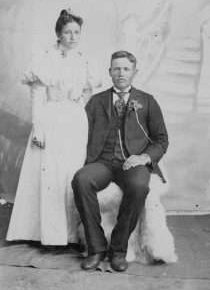
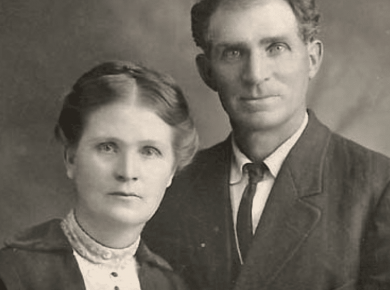
Richard and Sadie Mitchell

Richard Charles Mitchell was born at Hooper, Weber, Utah, on 16 December 1878.

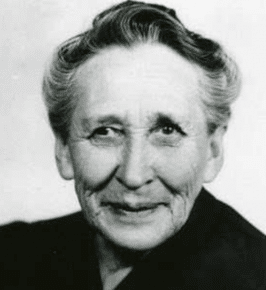
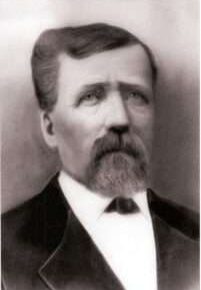
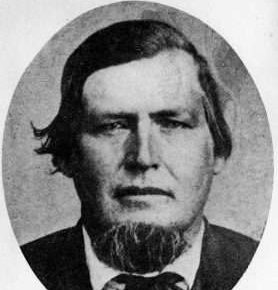
He was the youngest son of pioneer parents, James Mitchell and Anne Hull.  He came to the Shelley area with his family when he was a young boy.

His grandparents came from Scotland and England, as did his parents and family as converts to the Latter Day Saint Church.  They settled in many different cities before coming to Shelley such as Salt Lake City, Hooper, Utah, San Bernardino, California, and Franklin, Idaho.  They finally came to this underdeveloped part of Idaho where his family took advantage of the pre-exemption homestead rights and took up 360 acres of land two miles north of what is now Shelley, Idaho.

Shortly before this time, when the family was living in Franklin, Idaho, Robert Hull, brother of Ann Hull Mitchell and a nephew were killed by drunken Indians near Blackfoot while on their way to work on some land they had taken up.

The family of James Mitchell, Richard’s parents, came and settled here the day before the John F. Shelley family came from Iona, Idaho, and built the first home and store.

Thomas Mitchell, the eldest brother, worked in the Shelley Merc for Mr. Shelley for many years.  He also served as a Counselor to Mr. Shelley in the bishopric.  Church meetings were held in the John F. Shelley home first; then when a schoolhouse was built, they were held there until a church could be constructed.

There were many months of hard work ahead for the family.  As soon as possible a large two-room cabin was built of logs.  Also barns and corrals for the stock.  Sagebrush had to be dug out with a ‘grubbing’ hoe before the ground could be plowed.  Grandma insisted on a place for a large garden first.  Water for drinking and home use was hauled from the Snake River until a well could be dug a few years later.

By this time several of the older children were grown and married and had been given 40 acres of land by their parents (James and Ann).

Richard Charles met Sadie C. van der Vlies in Ogden, Utah and they were married in the Logan LDS temple.  She and her parents came to this country from Holland as converts and had settled in Ogden, Utah.  After their marriage, they came to the Mitchell ranch located two miles North of Shelley, Idaho, close to the Snake River.  By this time most of Richard’s brothers and sisters were married and had homes of their own.  Richard was the youngest and stayed on to help his father (James Mitchell) who had been crippled in a farm accident.  Richard and Sadie moved into the house with his parents until they could build a home of their own.

On 1 September 1918,  grandfather, James, passed away.  Several of the sons had sold out and moved to various parts of the country.  It was then that Richard, Sadie and family, and his mother (Anne Hull) moved to Burley, Idaho to be near his brother, Thomas Mitchell who had moved to Burley, Idaho.  The original farm was sold to Christian Anderson and he later sold it to Otto Beck.  It is now the first ward church farm.

Richard and Sadie at this time were the parents of seven children.  They moved to Burley, then due to a “bank failure” lost the farm there and then moved to Preston, Idaho where he was yard foreman at the Utah Idaho sugar plant.  But he always wanted to come back to Shelley.  This he finally did and bought a home from Heber Child and worked in the potato warehouses for many years.  They were the parents of nine children, two preceding them in death.

Richard Charles died 15 January 1952 in Shelley, Bingham, Idaho and was buried on 20 January 1952 in the Shelley Hillcrest Cemetery.

Happy
Happy
0 %
Sad
Sad
0 %
Excited
Excited
0 %
Sleepy
Sleepy
0 %
Angry
Angry
0 %
Surprise
Surprise
100 %
You May Also Like

ASHTON, Edward

Edward was apprenticed to a man who would teach him how to make shoes. He was bound for three years for his board and room, and his mother paid the sum of six sovereigns (approx $30.00) for his apprenticeship. This was not a happy experience as he did not get enough food and it was not of the highest quality, and he was required to do all kinds of work besides the trade he was supposed to be learning. The man was most unkind and Edward suffered a great deal of abuse as his employer routinely beat him.
View Post

NIELSEN, Ane: A Self Sufficient Pioneer

Ane was a hard worker. She had to work more like a man than a woman. She did a lot of work in the fields and with the animals. When anyone in the family needed help or advice on the farm, they would ask her. She could fix a broken harness as well as any man. She had quite a few sheep that her boys would care for. She would shear her sheep, then wash the wool and spin it into yarn. Following this preparation, she would weave it into beautiful cloth.
View Post

WRIGHT: John Pannell

In conversation with Bishop Maughan they were advised to try to find a suitable location on the Logan River, and accordingly set out again the 5th of June. They next formed a camp near the site of the old Brigham Young College and here they decided to remain. A survey of the land was immediately begun and the brethren cast lots for their locations. This was the beginning of our beautiful city of Logan, June 1859. Although John Pannell Wright was a member of the second group to locate on the site of Logan in June 1859, he is generally given credit by old historians as having been the father of our city. Apparently it was he who did the first surveying here and who designated the little settlement by the name of Logan. Apparently after Brother Wright and his son had surveyed a few blocks of land, which they did by only measuring with a tape or chain, there was a drawing or lottery for the purpose of acquiring home sites. ) They also helped build a bowery under which they held their meetings. They harvested their grain on Summit Creek (Smithfield). They often carried their guns in one hand and their shovels in the other. They succeeded in yielding good crops, as high as forty bushels of wheat to the acre. Mr. Wright left his tracks in the snow while cutting the last of the grain.
View Post

YEARSLEY Sr., David Dutton: Giving His All

The Yearsleys made their way through the bitter cold winter weather to Winter Quarters. The hardships were so extreme that some entire families were buried along the way. “Thus, from day to day, slowly and wearily traveling, went the exiled Saints across the undulating surface of snow-covered Iowa. The Roads were very bad, the weather cold and stormy, and the streams, now frozen, now swollen by spring freshets, almost and at times quite impassable. Again and again they were obliged to double teams on the heavily loaded wagons, to drag them through deep streams and miry marshes on their line of travel. Some days three or four miles would be the extent of their journey. Many a halt was made, at times for weeks (5).”
View Post

BARLOW, Oswald: History of a St. George Pioneer

Oswald Barlow was a member of Utah's first Martial Band, directed by Professor Thomas. Not only did he play the fife and drum, but he was also an expert dancer. So, in 1859, Oswald opened up his own school of dance. Many of the Saints were glad to receive instruction from him, and cultural arts were strongly encouraged by Brigham Young. In fact, several of Brigham's daughters were among the first pupils at his school. Oswald also had a splendid bass voice and was a good entertainer; therefore, many people loved to hear him sing.
View Post