REBER, Ernest: My grandpa from Santa Clara

0 1
Read Time:3 Minute, 28 Second

Submitted by Hank West, as student at Heritage Elementary School in St. George, Utah.

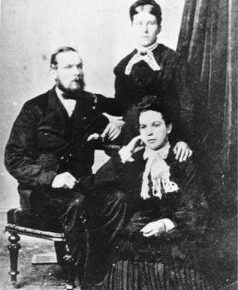
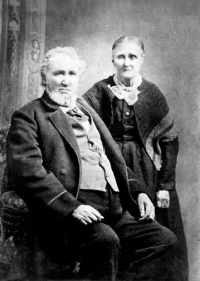
Ernest and Rosina Reber

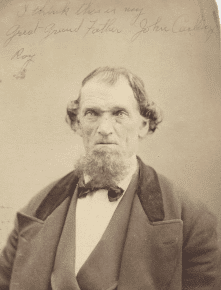
The Reber family came to this country from Switzerland. They lived on farms in the mountains around a small town called Shangnau, in Canton Bern, Switzerland. We have records that show they were probably there back to the 1400s, maybe even farther back. Our main ancestor was Christian Reber born in 1800. He had six children. Three of his kids joined the Mormon church in 1859. They were Johannes, Samuel and Fredrick. The Utah Rebers all come from these three pioneers.

Johannes and his family along with his brother Samuel came to America first. They traveled down the Rhine river, crossed the English Channel and sailed on a ship called the Underwriter in 1860. When they got to New York they traveled, by train, to Nebraska. Then joined the Captain Warren Walling wagon train to salt lake city, Utah. They arrived there in the fall of 1860. Brigham Young, the president of the Mormon church, sent them to Santa Clara in southern Utah, to colonize that area and farm.

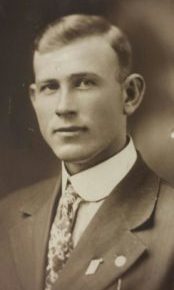
My grandfathers, father, Fredrick, followed the two other brothers to Utah in 1865. Fredrick’s first child born in America was my grandpa Ernest Reber. He was the first white child born in the historic Jacob Hamlin home on the west side of Santa Clara. The home still stands and is a Utah historical monument. He was raised in the Reber home just east of the current Mormon chapel on main Street. This home is also marked as a Utah historical monument. 

The family farmed and made adobe bricks. Many of the old homes that are still standing are made of Reber bricks. Ernest was a hard worker on the farm and in the brickyard. He was a good man and a very good friend. The town was very small and everyone knew him and looked up to him. He stood out from most of the other Swiss people because he was a large man. He stood over 6 feet and weighed well over 200 pounds. 

Reber home, in Santa Clara Ut

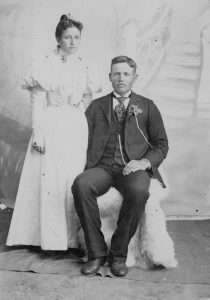
Ernest was married in 1896 to a local girl, Rosina Stahl. Grandpas first child, a little girl, was only 3 pounds at birth. They had to keep her warm in the oven and fed her with an eye dropper.

When she was only 13 months old the church called Ernest on a 2 1/2 year mission back to Switzerland. He was only 25 years old and it was very hard on his young family to be away for those 21/2 long years.

During his mission he became well known around the city of Zurich because he organized a choir that sang Swiss songs. His choir sang all around the area at local fairs and celebrations. Many Swiss people joined the Mormon church because of his influence. After returning home he was honored by the president of the church in a general conference for his Swiss choir and accomplishments on his mission. One very difficult time he had on his mission was the loss of his second child who died at birth.

Ernest took over the farm from his father Frederick and ran it successfully for many years. He had 5 children 4 boys and 1 girl They all worked on the family farm. Grandpa would walk to St. George on days off and work on the Mormon temple that was being built. He became a well respected man in the church and his community. He was a great husband and father. In 1949 he was called by the church to be the second counselor to St. George temple president Harold Snow. 

He was set apart for this calling in Salt Lake by church president George Albert Smith. Unfortunately a few months later Grandpa was killed in an accident in Santa Clara.

I have great respect for my early family and especially my grandpa Ernest. He was a wonderful example to us all and especially to me.

Happy
Happy
0 %
Sad
Sad
0 %
Excited
Excited
0 %
Sleepy
Sleepy
0 %
Angry
Angry
0 %
Surprise
Surprise
100 %
You May Also Like

BARNEY, Lewis

He discovered that the Mormons were a religious people, however, at that time he cared nothing for religion. “The Methodists and the Presbyterians had been trying to convert me to their faith. I came to the conclusion that religion of every kind was a hoax, and that none was right, and that all preachers of religion were hypocrites, and were preaching for money and popularity.”
View Post

MILEON, Marie-Michelle: Enduring Hard Work

Marie-Michelle Pierre-Louis Mileon was born in Jeremie, Haiti on 5 May, 1964. She is still alive but has given us permission to write and publish this story. She currently lives in Miami, Florida with her daughter Roselaure and several other family members. She has given us a great legacy with her hard work and diligence. She never gave up hope and continued forward no matter how hard life became. To this day Michelle is one of the happiest people I have ever met and there is nobody sweeter. A difficult life did not harden her heart.
View Post

JAMESON, Charles: Haun’s Mill Survivor

Charles Jameson was one of the Haun’s Mill victims that survived. “Oh, what a time that was! [Charles Jameson] was shot several [4] times. He crawled into the brush. The men followed him. One said, ‘Shoot him.’ Another said, ‘No, let him suffer. He’s dying anyway.’ But he did not die; he lived to go to Utah and lived to a good old age (6).” They were able to extract one bullet, but Charles carried the other three slugs with him for the rest of his life.
View Post

CARLING, John Witt

Wagons for Fleeing SaintsJohn Carling and his son Isaac worked at making and mending wagons for the Saints who were being driven from Nauvoo. The mob violence became so intense that the Carling family decided to leave with the main body of saints. Brigham Young sent Heber C. Kimball to inform John that if he would stay until all of the Saints had been provided with good outfits, not a hair of their heads would be harmed. They remained as requested, though some wives complained that they would all be killed. “The morning they were to leave, they were counseled to get to the ferry boats before the mobs were astir, and upon arriving at the ferry, the captain hurried them onto the boat and admonished them to be quick because they could see the mobs coming. Some were on horses, and others were running, but all with guns in their hands, and they were cursing. As the saints left the shore, they could hear the leader of the mob ordering his men to shoot. But as the men came to the shore, they stood still. It is told by some that two shots were fired but they missed the people in the boat.”
View Post

WOOLSEY, Abigail Shaeffer

John D. Lee had been ill with a heavy fever, probably the 'rocky mountain fever' and he was just starting to mend when Abigail, "Momma", came down with that same "rocky mountain fever", and soon went into a coma. Lee called for a stop here on the Sweetwater, where her family gathered around her and her daughters desperately tried to care for her. But to no avail. Abigail opened her eyes, looked lovingly on her worried, sad family and then died around midnight on the third of September 1848.
View Post

ALLEN, Joseph Stewart: Blessings For Those Who Serve

"I simply cannot go on any farther; my feet are too sore." They sought out a fallen log (tree) and there sat down to rest. There, too, they knelt down to pray. They prayed for some shoes out there in that raw, bleak country away from stores or from any town where shoes could be bought if they had the money to buy them. They must have had great faith for after sitting there awhile longer to rest they rose to go on and saw there beside the log a pair of shoes. "They were surely meant for you, Brother Allen," said his companion. "They would not do for me at all. They are too small." So Joseph put on the shoes which fit perfectly and they traveled on.
View Post

ASHBY, Nathaniel

The Ashbys were seaman and ship wrights until after the War of 1812. Nathaniel however, was apprenticed to a shoemaker at an early age to learn the shoemaking trade. He became expert in the making of fine shoes and started his own business.
View Post