0
0
 1
1
This article originally appeared in Vol.50, No.1 (2003) of Pioneer Magazine.
by Janet Peterson
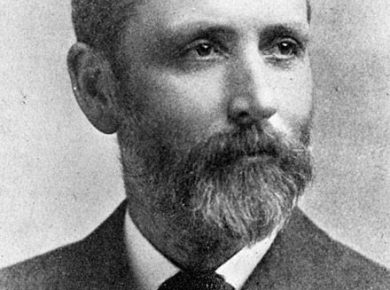
Ebenezer Beesley was born in Bicester, Oxfordshire, England, on December 14, 1840, the fourth child of William Sheppard Beesley and Susannah Edwards Beesley. Young Ebenezer was a musical prodigy. When his parents’ Wesleyan Methodist choir practiced in the Beesley home, six-year-old Ebenezer could sing parts with them. So impressed were they with his musical talent that a group of women wanted to send him to St. George’s Chapel in Windsor to be a choir boy. His parents refused to let him go.1
At about this time, his mother and father joined The Church of Jesus Christ of Latter-day Saints, and Ebenezer himself was baptized on September 22, 1849. Ten years later, Ebenezer married Sarah Hancock in England. The new Beesley family emigrated to Utah in 1859, making the journey via handcart. They settled in Tooele before moving to Salt Lake City; in Salt Lake, they resided in the Nineteenth Ward. Ebenezer and Sarah had ten children. In 1869, he married a plural wife, Annie Buckeridge, by whom he had six children.
Ebenezer was immersed in music. According to Spencer Cornwall, “leading the singing in the Sunday School, revising and preparing music for the Juvenile Instructor, directing the ward choir, studying the violin under Professors C. J. Thomas and George Careless, composing Sunday School music, compiling songbooks for Sunday Schools and Mutual Improvement Associations, later directing the production of the Latter-day Saints, Psalmody, were some of his busy activities.”2
Ebenezer composed music especially for the Sunday School Two of his hymns sung today, “Welcome, Welcome Sabbath Morning” and “We Meet Again in Sabbath School,” affirm the importance of Sunday School. The Deseret Sunday School Union printed music cards before the publication of its Music Book in 1884 so that the Saints could sing the new hymn tunes rather than relying on folk or Christian tunes. Ebenezer’s hymn “Never from Thee” was introduced as Card No. 5. Other hymns of Ebenezer’s appeared in the Tune Book for the Primary Association, the Juvenile instructor, and the Improvement Association Song Book. His hymn tunes were much loved in his day as they still are in our day.
In 1880, Ebenezer was called as conductor of the Tabernacle Choir, which he led for the next nine years. He also played in the Salt Lake Theatre Orchestra and often filled in for George Careless as conductor.
Ebenezer Beesley died on 21 March 1906 in Salt Lake City.
Eleven of Ebenezer Beesley’s hymn compositions appear in Hymns, 1985:
- “High on the Mountain Top”
- “What Glorious Scenes Mine Eyes Behold”
- “The Happy Day at Last Has Come”
- “God of Our Fathers, We Come unto Thee”
- “Great is the Lord”
- “Sing We Now at Parting”
- “Tis Sweet to Sing the Matchless Love”
- “Reverently and Meekly Now”
- “Let Us Oft Speak Kind Words”
- “Welcome, Welcome, Sabbath Morning”
- “We Meet Again in Sabbath School”
Notes
- Spencer Cornwall, Stories of Our Mormon Hymns (Salt Lake City: Deseret Book, 1975), 106-7.
- Cornwall, 107.
- “Latter-day Saints’ Psalmody, ” quoted in Karen Lynn Davidson, Our Latter-day Saint Hymns: The Stories and the Messages (Salt Lake City: Deseret Book 1988), 106.


 Brother Joseph
 Pioneer John