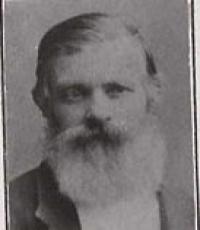
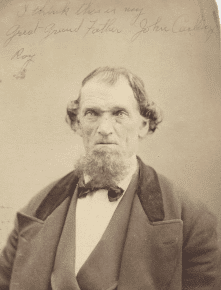
WALTERS, Archer: A Story of Commitment

Archer had said he would give his life if he could reach the “Valley of the Mountains in the land of Zion, with my family, that they may grow up under the influence of the Gospel of Christ.”
0 1
Read Time:3 Minute, 23 Second

Archer Walters was born to Henry and Sarah Walters on July 29, 1809 at Cambridge, England. He married Harriet Cross on August 26, 1837 at Sheffield, England. Harriet was born October 21, 1809.

Archer’s mother, Sarah, died May 5, 1811, leaving Archer motherless two and a half months shy of his second birthday. He was raised by his father.

Archer and Harriet were taught the gospel and were baptized members of the Church of Jesus Christ of Latter-day saints in 1848. Until this time they had never thought of leaving England.

When Brigham Young set forth a plan, called the Perpetual Emigrating Fund, designed to assist in bringing poorer converts to America by ship, then transporting them by train to Iowa City, the family was excited. Under this plan, at Iowa City the immigrants would be outfitted with handcarts which would carry their minimal belongings as the people, themselves, would walk pulling their handcarts to the Salt Lake Valley.

Archer had said he would give his life if he could reach the “Valley of the Mountains in the land of Zion, with my family, that they may grow up under the influence of the Gospel of Christ.”

By this time, Archer and Harriet had five children: Sarah, born November 16, 1838; Henry, born October 14, 1840; Harriet, born August 8, 1842; Martha, born September 9, 1844; and Lydia, born September 23, 1850.

With his wife and four daughters and one son, Archer left England as a PEF immigrant aboard the ship Enoch Train on April 6, 1856. The ship left from Liverpool, England and arrived safely at Boston on May 1, 1856.

From Boston the immigrants took the train to Iowa City arriving on May 12, 1856, where they were to be outfitted with handcarts. Because he was a carpenter and had a set of his own tools, Archer was immediately put to work making handcarts and building coffins for those who died in the Iowa City camp. On the 1,300 mile trek from Iowa City to Salt Lake City, Archer repaired handcarts and continued to build coffins for those who died along the trail.

The Walters family, along with the other immigrants who arrived aboard the Enoch Train traveled in the Edmund Ellsworth Company, the first of the handcart companies. The Ellsworth Company left Iowa City on June 9, 1856.

Archer kept a detailed journal of the company’s travels for most of the trek which has proven to be a rich first hand account of the first of the handcart companies, and which has often been quoted by historians of the handcart companies including Wallace Stegner. Unfortunately, Archer made his last entry in the journal on Sunday September 14, twelve days before the company arrived in the Salt Lake Valley on September 26, 1856.

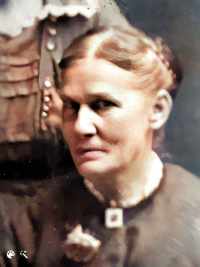
His work repairing handcarts, pulling his handcart and making coffins while often going without enough to eat wore him down. After September 14, Archer was too ill to write and he had to ride in one of the supply wagons. He never recovered from his illness and died in Salt Lake City on October 14, 1856 at age 47. His wife, Harriet, and the five children all survived the journey. Harriet lived another 27 years, dying on September 30, 1883 in Salt Lake City. The five children remained faithful, steadfast members of the Church of Jesus Christ of Latter-day Saints. Sarah, the oldest, became a plural wife of William Clayton, journalist of the Pioneer Company of 1847 and author of the hymn, “Come, Come Ye Saints.” She gave birth to eleven of William Clayton’s many children.

Archer Walters gave his life to reach Salt Lake City and just as he had hoped they would, his wife and children did grow under the influence of the Gospel of Christ.

For many years Archer’s handcart was on display at the Daughters of the Utah Pioneers Museum and Library in Salt Lake City as it was considered one of the best original example of an actual handcart company handcart in existence.


Happy
Happy
0 %
Sad
Sad
0 %
Excited
Excited
0 %
Sleepy
Sleepy
0 %
Angry
Angry
0 %
Surprise
Surprise
100 %
You May Also Like

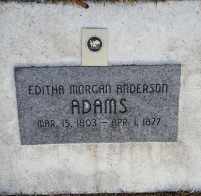
ANDERSON, Editha Morgan

Whatever else she was, Edith, like many other mature single Latter-day Saint Women, had internal strength and strong religious beliefs sufficient to tolerate an environment that was unsympathetic toward mature single women, as exemplified by Stout’s comments.Editha established a private school in her small log cabin that was located on 1st North and about 70 West in American Fork. It served as a bedroom, living room, and a tightly packed class room. The dwelling featured one door, one window, two beds, a wood stove, and a rest facility located out back of the cabin. Her rudimentary school attracted a dozen or so students, about the same number of youngsters as attended another school that met in a community-owned building that served as a place of worship and education.
View Post

HOLBROOK, Judge Joseph Holbrook: Faithful Saint

He served in the state legislature from 1859 to 1862 inclusive, it being held at the court house in Salt Lake City. January 20th, 1864, he was again appointed Judge of Davis County. There was a company of "Silvergrays" formed in the south portion of Davis Co. and mustered into service on the 8th day of August 1857, from members of the Nauvoo Legion. They were called the "Mountain Sharps."
View Post

ATKIN, Thomas Jr.

When the call came in late 1857, for men to defend the church against Johnston's army, Thomas and other Tooele men responded. The Tooele contingent, under the command of Major John Rowberry, was sent to Echo Canyon, October 10. They remained in Echo Canyon until December 1.
View Post

HIOTT, John: An Overlooked Pioneer

As far as history is concerned he was a faceless cipher who passed through life leaving few tracks and no one to mark his grave. It is easy to overlook that John and thousands of other forgotten Utah pioneers like him were critical in settling the Intermountain West. They dug the irrigation ditches, herded the cattle, built the shelters, attended meetings, maintained the roads, cut fire wood, tended the ill, mostly followed orders, and buried the deceased without fanfare. The accomplishments of their famous leaders would not have been possible without the blood, sweet, and tears of humble people such as John Hiott.
View Post

William Henry Adams, Sr.

William Henry Adams, Sr., was one of the first three settlers of Pleasant Grove on July 19, 1850 with Philo T. Farnsworth and John Mercer. He scouted the area along Provo River and came back with his report of straight logs for houses, and rocks for foundations. He surveyed the town site with these two assisting and set his own stakes for forty acres.
View Post

NIELSEN, Ane: A Self Sufficient Pioneer

Ane was a hard worker. She had to work more like a man than a woman. She did a lot of work in the fields and with the animals. When anyone in the family needed help or advice on the farm, they would ask her. She could fix a broken harness as well as any man. She had quite a few sheep that her boys would care for. She would shear her sheep, then wash the wool and spin it into yarn. Following this preparation, she would weave it into beautiful cloth.
View Post

CARLING, John Witt

Wagons for Fleeing SaintsJohn Carling and his son Isaac worked at making and mending wagons for the Saints who were being driven from Nauvoo. The mob violence became so intense that the Carling family decided to leave with the main body of saints. Brigham Young sent Heber C. Kimball to inform John that if he would stay until all of the Saints had been provided with good outfits, not a hair of their heads would be harmed. They remained as requested, though some wives complained that they would all be killed. “The morning they were to leave, they were counseled to get to the ferry boats before the mobs were astir, and upon arriving at the ferry, the captain hurried them onto the boat and admonished them to be quick because they could see the mobs coming. Some were on horses, and others were running, but all with guns in their hands, and they were cursing. As the saints left the shore, they could hear the leader of the mob ordering his men to shoot. But as the men came to the shore, they stood still. It is told by some that two shots were fired but they missed the people in the boat.”
View Post

HOWARD, Mary Ann Tolman

Her two younger sisters died while crossing the plains and they were just 300 miles from Salt Lake City when her mother passed away. Mary Ann, age 12, and Emma, age 10, washed and dressed their mother, wrapping her in sheets ready for burial. This was a very heart rendering experience for these two young girls. They gathered sage brush to cover and conceal the grave so the coyotes wouldn't find it so easily.
View Post