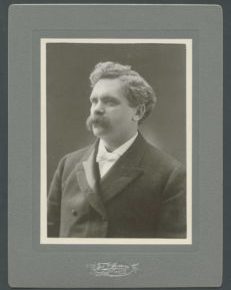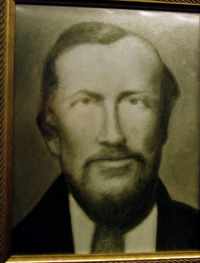
ALLSOP, Thomas Hill

STORY COPIED FROM FILES IN SUP LIBRARYWhen more people came to Sandy, Mr. Allsop sold some of his land. Later he donated land for the Church site and cemetary. He gave Sandy a big bowery where large parties could go and dance and have weenie roasts. The bowery, the reservoir and Allsop's Lane was known to all the people of Sandy and surrounding communities.
0 1
Read Time:6 Minute, 10 Second
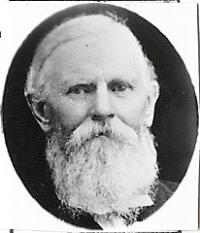
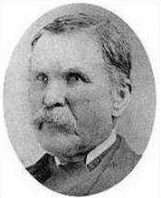
Thomas Hill Allsop (1835-1895)

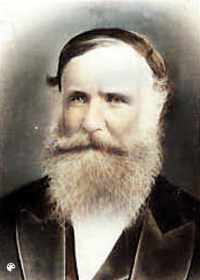
Thomas Hill Allsop was born in 1835 at Cheddleton, England. He joined the LDS Church Jan, 21, 1856 and came to Utah in 1857 with his wife, step-daughter and sister-in-law. They had their own outfit of two ox teams and all their supplies. When they arrived here they were sent to Provo by Brigham Young. Later, Thomas was sent to help guard Johnston’s Army. He stayed in Provo to help settle it. He built a large vineyard and orchard while there, then left it for those who were to follow.

From Provo, he moved to South Jordan. There, they lived in a dugout, where he taught school. Later, he made enough adobes to build rough houses for nearly all the Families around there.

Nine years later, they moved to West Jordan and from there to Midvale, where they lived for 2 years. While there he planted five hundred grape vines. They had started to grow nicely when the grasshoppers came and destroyed all but about 5 vines.

Then they moved to Sandy, where he took up a homestead of 240 acres. This was before the railroad came through and there were very few people in Sandy at that time. His homestead extended from the Alta road on the south to the Lindell farm on the north, and from the street in front of the Sandy Ward House to the County Road on the east.

Thomas was a very ambitious man, worked very hard to maintain his family and to the progress of the community. Very few men of his time accomplished so much. Yet, he was always_ trying to do something for the good of the people and for his country. He spent all he made in improving and developing them for he was always thinking of the future. He brought the first shade and fruit trees into Sandy. He planted many trees around his homestead, including a large apple orchard.

He was a surveyor for the government. He, with three other men, John Hardcastle, Thomas Goff, and Isaac Whithers brought the water from Little Cottonwood Creek to Sandy. The old settlers along the ditch thought they owned the water and were not going to let these men have any water to spread out on the benches. This brought a lawsuit against these four men, and Thomas Allsop went to work at the smelter to make money to fight this lawsuit.

While working at the smelter, he lost his right arm in an accident. He was a man to win,and finally won the lawsuit and they were able to bring the water down into Sandy. He built a reservoir above his orchard, where the water was stored. It was piped from there to the smelter for use there. It was also used by many of the people. This reservoir was used for pleasure also. In the summertime, boating and swimming was poplar. People from all the surrounding towns came to Allsop Grove for celebrations and pleasure. There was at one time a bowery, where folks could picnic. To reach Allsop Grove one would need to travel up Locust Street. It was heavily shaded with locust trees and a very secluded, beautiful lane. For generations it was also referred to as “Lover’s Lane”.

In the winter time, the reservoir was frozen over & besides the young folks using parts of it for skating, they cut huge blocks of ice and stored in an ice-house Mr. Allsop built, to store and supply the people with ice during the summer.

He also started a fish hatchery and planted some mulberry trees because he said there would be a big demand for silk in the future. He put some silkworms in his mulberry trees and intended to make progress in these lines.

At this time, the Manifesto was issued prohibiting the practice of polygamy, of which he practiced, having two wives. He would not desert his families, so he was taken to jail. While in jail, his fish and silk worms died for lack of care. When he got out of jail, he went to England as a home fireside missionary for six months and to gather genealogy.

When he returned to Sandy, his youngest wife left for a time, so he could stay. While she was away, he was thrown from a wagon and almost killed. He was taken to a hospital and cared for. During this time, his young wife had lost a child and was lonesome, so she went back to her folks. Thomas was not well, but he feared the authorities would put him back in jail, so when his wife returned, he had to get out in the middle of the night and leave home. A small boy took him to the train at Woods Cross, and from there he went to Logan. At Logan he worked in the temple, using a crutch with his only arm. Later, he worked in the Salt Lake Temple where he did much work.

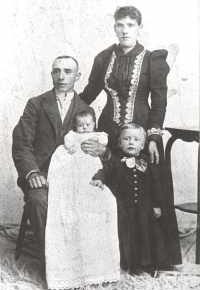
Thomas Allsop’s first wife was Elizabeth Mollart. To them were born the Following children: Sarah Ann, Emma Olive, Mollart Thomas, Joseph Henry, Albert George, Fannie Maria, and Henrietta. She died Aug. 30, 1895. His second wife was Mary Elizabeth Roberts. Their children were: Harriet Elizabeth, William, Mary Elizabeth, Samuel Francis, David Arthur, Laura Minetta, Olive Ann and Ruby Exile.

It is interesting to note that the second wife Mary Elizabeth had left home to visit with her sister in Eastern Utah. She was expecting a baby, but because of the polygamy situation, she had left home so Thomas would not have to return to jail. She had a trying time when she had the baby, and as she was in fact in exile, she named the baby, Ruby Exile. When Thomas heard of her distress, he packed his wagon with hot rocks and drove out to bring Mary and the new baby home. However, the baby died enroute and was buried on the trail.

Thomas had varied church assignments during his life. While in Utah, he was the ward clerk for Bishop Gardner and Bishop Stewart of Draper; also Bishop Rollins of South Cottonwood, Bishop Phillips of Union and Bennion.

Before the trains came to Sandy, he used to walk to Salt Lake to attend meetings and to business. He travelled to these various places mentioned above for twenty years to settle his tithing.

He was very ambitious and always doing something that would benefit those around him. He did much to help build up Sandy. He spent his money for things to build and beautify. He was very intelligent and talented and well-educated for his day. He taught school and music. He could play six different instruments, including the violin, piano, and organ, all of which he was an able teacher.

When more people came to Sandy, Mr. Allsop sold some of his land. Later he donated land for the Church site and cemetery. He gave Sandy a big bowery where large parties could go and dance and have weenie roasts. The bowery, the reservoir and Allsop’s Lane was known to all the people of Sandy and surrounding communities.

When Thomas Hill Allsop died he left a great posterity. They continue to honor him as a great pioneer, builder, missionary, teacher,

Happy
Happy
0 %
Sad
Sad
0 %
Excited
Excited
0 %
Sleepy
Sleepy
0 %
Angry
Angry
0 %
Surprise
Surprise
100 %
You May Also Like

WOOD, George Lymer: An Incident in the Life

"The usual method of disposing of the dead was to weight the bodies and dump them overboard. When others and I asked the privilege of removing our dead and burying them on land, the Captain was hateful and mean about it. All of my dear ones except Samuel's wife I had to perform this last earthly service for. Others of the party had sustained like losses, and were as anxious as I to bury them as decently as possible. The Captain at last agreed to wait and we hired a Negro to help dig a trench big enough to put them in all together. We removed the dead from the boat and began our heart¬breaking task, but had it only partly done when the boat whistle blew and the boat began to get underway. All ran hastily back except the Negro, one woman and myself. She and I stood at the grave site of our dead and watched them go. What bitterness of spirit I experienced only God knows. Was this what I had come to America, the home of the brave, for? Here I was with two strangers standing beside the open grave of a group of strangers. Our common interests were all lying before us or fast receding from sight, subject to the whim of a heartless thing in human form. "Surges of emotion swept over me, sorrow, anger, love, fear, and despair, but my nearest duty was to protect these rapidly decomposing dear forms of mine from the ravages of wild beasts, heat, and other elements. Perhaps I had been blessed and spared to perform this last service. If! were dead with them our bodies would rot together. So I urged on my companions the need for work. I felt responsible for seeing this thing through.
View Post

FERRELL, Maggie Anna: A life history

At Pueblo they laid over for a day and a half to wait for another train to come through the mountains. The mountains were so steep that the only way to get the trains up over them was to put one engine on front and the other on back (one to push and one to pull) up the steep hills and then to hold them back as they went down the steep grades. Maggie was very frightened of the mountains and very homesick. When they were on the high ridges where Maggie could look down into the canyons she was very sure that they would fall down into them. The high mountains did not look very beautiful to the little fifteen year old from the low rolling hills of the Bluegrass country of Kentucky, and Tennessee and Illinois. She was very thankful when they reached Salt Lake City and the long trip was over.
View Post

MELLOR Jr., James: Inspirational Story

Mary, however, was so hungry and faint that she finally told Louisa to go on without her. Louisa would have none of that. She instead walked ahead a short distance, kneeled down, and poured out her heart to the Lord to help them. She arose and headed back toward her mother on the same path she had just taken. She walked a short distance when she suddenly saw something in the prarie grass. It was a freshly baked pie! It was laying right side up, and the crust wasn't even broken. They both thanked the Lord for the immediate answer to her prayer, ate the pie, and resumed their tip toward the company. In the meantime, since they had not caught up with the company in the time expected, James Sr. had taken his handcart to go look for them. He found them and took them in the handcart back to camp.
View Post

HASKELL: George Niles

President Young told the men; "There would be no death from fighting befall you, if you keep the Lords Commandments. "There shall be no fighting except with wild beasts." The wild beasts turned out to be wild bulls of which there were several injuries and mules gored. The Battalion shot over twenty bulls before they quit charging the men, mules, and horses. George Niles Haskell enlisted at the age of 49. They journeyed on to Winter Quarters where he took his wife, one girl and a son and proceeded on to Kegs Creek, where he left them with friends and acquaintance. Malinda had married prior to this time. The men then left for Fort Leavenworth where they received their gear and proceeded toward Mexico. The family was to await the return of George Niles Haskell and the military pay from the Army was used to help to support them. President Young made arrangements with the Army and Govt. to remain here on Indian Land for the duration. George was Private #46 of Company B. Many of the Mormons traveled to the Missouri River with the enlisted men. He had enlisted for a year, 16 July 1846 to 16 July 1847.
View Post

ASH, Alma

This article originally appeared in the July/August 1983 issue of Pioneer Magazine by Steven R. Sorensen, City Creek Chapter British Convert’s Pioneer Spirit Waits 24 Years to be Fulfilled Alma…
View Post

SMOOT, Doug: Modern-day Pioneer of Technology

After completing 42 years at BYU, Doug now (2008) is a principal in Combustion Resources Co., continuing his work in energy, fossil fuels and combustion A member of several professional organizations, he has published approximately 200 technical articles, eight invited review articles, and four books on combustion. He received the first Governor’s Medal for Science and Technology in Utah in 1987. Two of his books (written with others) have been translated into Chinese. An internationally recognized authority in energy, combustion, and fossil fuels, Doug has consulted with over 100 organizations in the U.S., Mexico, China, Japan, India, Egypt and several European countries.
View Post

JACOBSEN, Christian Jensen: Frontier Craftsman

Another life altering experience occurred in 1854 when L.D.S. missionaries introduced the Jensens to a new religion. After a short investigation Christen and Kirsten were baptized on a cold day in December and became the first members of the church in their local area. Soon after, Christian was called to be a local missionary and also to preside over two branches of the church. In the fall of 1857 he was assigned to open a mission on LæsØ, an island located midway between Jutland and Sweden. As a missionary he received frosty receptions but soon encountered some inhabitants in need of his clock repairing skills. This led him to adjust his strategy and avoid the topic of religion until he had the family’s clock dismantled. Once the family knew him as a clock repairman, they were more prone to discuss religion with him. Using this strategy, and after visiting the island several times, Christian baptized a dozen or so members and organized the Byrum Branch there.
View Post

WOOLSEY, Thomas: Mormon Battalion Volunteer

On 15 Jun 1856 they left their all to overtake the first covered wagon train of Mormons, to cross the plains that year. The oldest daughter was sick with chills and fever when the journey began, and had to be carried from the house to the wagon. Her father's brother who did not belong to the LDS church and was opposed to their leaving their home, predicted she would not live to go far, but Elder Hickerson promised her she would not have another chill, and she never did.
View Post

ALLEY, George H.

It is not difficult, then, to see this young man fitting perfectly into the scene, when, on April 3, 1860, the riders of the Pony Express began their mad, daring dash between St. Joseph, Missouri and Sacramento, California. He was ideally equipped for this adventure. His career as a "Pony Rider" began when he signed in at the Salt Lake City Station located on the east side of Main Street between First and Second South Streets.
View Post