 0
0
 1
1
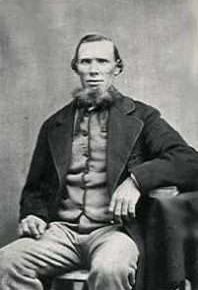
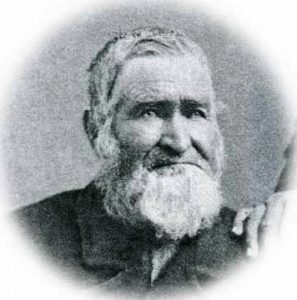
Nelson Higgins was born in Otsego County, NY on 1 Sep, 1806 (one month after the end of the Holy Roman Empire) to Daniel Higgins and Mary Dagget.
Compiled by LaRon Taylor 2006, updated 2/07
 The name Nelson means courageous, a champion, the chief. It didn’t take long for Nelson to live up to that name, and he did so throughout his life.
Several articles report that Nelson’s dad moved to Ohio when Nelson was 10 years old, but they don’t mention whether his mother went with his dad or not. Nevertheless, Nelson was left with his married sister in Otsego County, NY. His sister died less than one year later and Nelson decided to go find his dad in Huron County, Ohio (about 40 miles SW of Kirtland, Ohio). He journeyed by himself for the entire distance of about 400 miles and succeeded in finding his father. That was the first account of him living up to the name of Nelson, which means courageous. It was probably a special blessing to his father to have him back home because his father only lived another 13 years after that.
Nelson married Sarah Blackman 24 Dec, 1826 in Huron County, Ohio. It hasn’t been determined how he met her, but he probably met her as a neighbor after going to Ohio to find his father. Sarah was reportedly born 5 Apr, 1806 in Columbus, Oswego, NY, but both of her parents were born and died in Ohio. It is reasonable therefore, to assume she lived near Nelson in her teenage years.
In 1834, Nelson & Sarah learned about the Church of Jesus Christ of Latter-day Saints and they were baptized that year. Nelson was soon ordained a priest, and was assigned to preside over the small group of converts in that area. That must have been a brief assignment because he accompanied Joseph Smith and others of Zion’s Camp to Missouri that year. Zion’s Camp was a brutal experience that acted as a refiner’s fire on its members. They marched over 1000 miles and at the end of the journey, they contracted Cholera. Some fell away from the Church because of the tremendous hardships endured there, but others were anchored more solidly in their faith and testimony and Nelson was one of those. He remained true to the Church and to his Savior throughout his life and Zion’s Camp was probably the cementing influence upon his life. In February, 1835, Joseph Smith called a meeting of the members of Zion’s Camp and organized the Quorum of the Twelve Apostles from that group of men.
Nelson and Sarah went through the extreme persecutions inflicted upon the Kirtland saints in spite of the fact that he lived 40 miles southwest of Kirtland. He was ordained an Elder at the time of the dedication of the Kirtland Temple (27 March, 1836). Soon after that, he was ordained a seventy and became a member of the first Quorum of Seventy. One account states that Nelson & Sarah were baptized by Orson Hyde in 1833, and that he became an Elder shortly after that because he helped ordain John E. Page an Elder on 12 Sep, 1833.
As the persecutions escalated, Nelson and his family moved with the saints to Far West, Missouri. That was but a brief respite, however, because they were driven from there to Nauvoo, Illinois. They helped change the ugly, mosquito infested swamps of that area to a beautiful city that caused the entire state of Illinois to take notice. Their son, Alonzo, died in May, 1839, but we don’t know if they were in Illinois by that time. Their fifth child, Heber Kimball Higgins was born in September of that year in Hancock County, Illinois, so we know they were there by then.
The few years of peace in Nauvoo must have been a welcome experience for the saints who had been pushed from Kirtland, to Missouri, to Illinois. Nelson worked as a carpenter on the Nauvoo Temple and when it was completed enough to do endowments, both Nelson and Sarah were endowed on 5 June, 1846. There were 104 endowments done on that day. When the Nauvoo Legion was formed, Nelson Higgins became a 2nd lieutenant and then a lieutenant colonel. Times were good and times were bad. Persecution began to grow in the area, and a spirit of apostasy began to take hold of some of the members. Some of Nelson’s close friends fell away from the church at that time.
After the martyrdom of Joseph Smith, Brigham Young led the church as president of the Quorum of the Twelve Apostles. He organized the Second Quorum of Seventy and ordained Nelson as one of the Seven Presidents of the Second Quorum of Seventies. Persecutions continued to increase, and Nelson and Sarah moved out of Nauvoo only a few weeks after they received their endowments.
Prior to leaving Nauvoo, Daniel Allen, Nelson Higgins, and Samuel Shepherd were called as a committee to sell properties belonging to the saints in the Bear Creek area. They were successful in collecting a good deal of money for the saints, but when they returned, the mobs had hit Nauvoo and the exodus had already begun. This is the first thread we find that ties the families of Nelson Higgins and Daniel Allen in their dedicated struggle for survival. Their relationship must have been a close one because Daniel’s daughter, Diantha, married Nelson’s son, Alfred. We know Daniel was one of the last three families to leave Nauvoo, so there is a good possibility that the other two wagons were those of Nelson & Samuel. Also, Daniel went to Manti to set up a tannery in 1854, and the two children were married in 1858, so their friendship must have lasted a lifetime.
Upon arriving at Winter Quarters, Nelson joined the Mormon Battalion. This was done with mixed emotions because the government was asking them to help defend the country that had mobbed & killed so many of them. The following is quoted from the journal of Nathaniel V. Jones, who was one of the men enlisted in Nelson Higgins’ company:
“Got to Grand River, west of Pisgah, camped there until Colonel Allen came along with his aide authorized to raise a Battalion of Mormons of 500 men. You can better imagine my feelings than I can describe then. I must ask pardon for thinking or saying they may all go to hell together. I will see them (meaning the whole United States) in hell before I will fire one shot against a foreigner for them, those who have mobbed, robbed, plundered and destroyed us all the day long and now seek to enslave us to fight for them. I could not find words hard enough to say in just anger for that kind of treatment. However, President Brigham Young, Richards, Kimball, Benson and others came to us on the Missouri stream and preached faith into us for we were all mad. They said it would all be overruled for the best, and the only thing left for us was to furnish 500 men and march against the Mexicans, and they would try what could be done to have us get the country of California for fighting for it, and also get discharged with our guns and accoutrements, for said they ‘we know there is a deep settled plan if we do not raise these men that the mob will come against us and cut us all off, and not allow us to cross the Missouri River.’”
Nevertheless, in June of 1846, Nelson had moved his family to Winter Quarters, news of the war with Mexico was received, the Mormon Battalion was formed, Nelson joined, was appointed captain of Company D, and traveled over 100 miles up the Arkansas. The march began on July 21. That was a time of tremendous change and hardship on all that were involved. His family was able to journey with him because the army hired Sarah and two of her daughters to help with the laundry. One writer, John Steel, indicated that they started out with 1 spoon, 1 fork, 1 knife, a tin cup, and one blanket for each person. They traveled from Fort Leavenworth up the Kearns River to the Arkansas, which they followed up stream for another hundred miles. The last crossing of the Arkansas was on 15 September, 1846, and Nelson was given orders to go with a sick detachment to Bents Fort in Pueblo, which was hundreds of miles from any other town, but it was the best refuge they could find to stay out the winter. This was the first detachment sent to Pueblo and was called the Arkansas River Detachment. Food was scarce and many died that winter in Pueblo. After Nelson Higgins got the detachment to Pueblo, he returned to Santa Fe to rejoin the battalion there, but he arrived after the battalion had gone on. The local commanding officer gave Nelson permission to return to Pueblo on detached duty to help care for those wintering there. While there, the Higgins family increased with the birth of their 9th child.
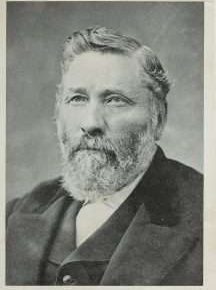
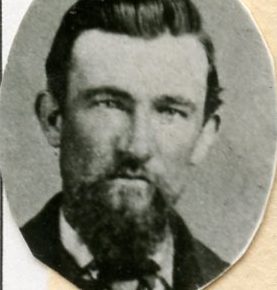
We get a glimpse of Nelson from his pension file from the battalion. It shows him as 5’11” tall, having a light complexion, blue eyes, and dark hair.
When spring finally came, they heard that the first group of saints had headed west so they eagerly packed up their gear and headed out. They made good time in their travel and arrived in the Salt Lake Valley on July 29, 1847, only 5 days after the first company of saints had arrived with President Brigham Young. Nelson’s company included 140 of the Battalion and 40 of the saints that had been divided from other battalion companies. His entry to the valley was welcome because he brought 29 wagons, 1 carriage, 100 horses and mules, and 300 head of cattle. That greatly increased the strength of the new pioneer settlement in the Salt Lake Valley.
In 1849, the Higgins family was asked to move into the Sanpete Valley to help establish a settlement there. He first settled in Manti, where he was elected mayor in 1853, then northwest to the town of Moroni. His skills in establishing settlements must have been noticed because he was then asked to move to Carson Valley, Nevada to settle that area in 1855. Records show that he was there until at least 1857. In 1864, Nelson and his family returned to Richfield, Utah to help that new community, and was there ordained a bishop by Brigham Young and Heber C. Kimball. The town was abandoned in 1867 because of Indian troubles, but regained in 1871 and Nelson Higgins resumed his position of bishop in that town until 1873. He then moved to Brooklyn, a small settlement between Elsinore and Monroe, and lived there for the rest of his life.
During these unsettled times in central and southern Utah, records indicate that Nelson Higgins married as plural wives, Margaret Duncan (1852) and Nancy Meribab Behmin (1856).
The areas of southern Utah that Nelson Higgins helped settle were under frequent attack by the local Indians, so Nelson aided in defense of those communities. He was successively captain, major and colonel during the Walker war while living in Sanpete County, and was a major and commanding officer all during the Black Hawk Indian war (9).
The following is excerpted from Heart Throbs of the West and shows Nelson Higgins’ losses to the Indians in Utah during the early years of settlement. His submittal was for reimbursement.
Veterans of Blackhawk War Ask For
Remunerations For Losses Incurred
THE UNITED STATES OF AMERICA
- To Nelson Higgins
- For Destruction of property by the Utah Indians in Utah Territory in the year 1853.
- To destruction of one Saw Mill near Manti City, in Sanpete County burnt by P Indians $3,000
- To destruction of 75 saw logs at the mill burnt by P Indians @ $3 225
- To destruction of 500 feet white pine board burnt by P Indians 3 cts 150
- To destruction of one frame dwelling house 200
- To destruction of sawn log dwelling house 150
- To destruction of 50 rods post & rail fence @ $150-100 burnt by P Indians 75
- To destruction of 10 acres of wheat, trampled down and pastured off by P Indian horses (total loss) 200 bush. @ $2 400
- To destruction of garden, vegetables, fruit trees, shrubbery & by P Indian 50
- To destruction of 100 bushels potatoes & carried away by P Indian @ $1 100
- Two cows driven away and killed by P Indian 60
- One ox driven away and killed by P Indian 50
- One horse taken by P Indians 100
- Total $4,560
Territory of Utah
Great Salt Lake County
I, Nelson Higgins Do Solemnly swear that the foregoing account is correct and true, that the property therein named was actually destroyed and stolen by said Indians during the year 1853, in Utah Territory. That said property belonged unto me, and that the amount is set down as low as I would have taken in cash for the same, as therein stated. And that I have not received any remuneration for the same.
NELSON HIGGINS
Sworn to and subscribed before me this 21st day of February A.D., 1856 W. I. Appleby, cts 1st Dist Cent U. States for the Y. Utah.
Nelson Higgins was feeble and scarcely able to move about during the last part of his life. He died in Elsinore, Sevier County, Utah on 20 Nov, 1890 (11).


 Brother Joseph