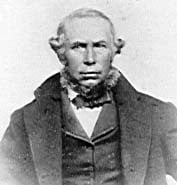
BENSON, Benjamin

0 1
Read Time:3 Minute, 48 Second

By Philip Wayne Ercanbrack: Third great grand-son of Benjamin Benson

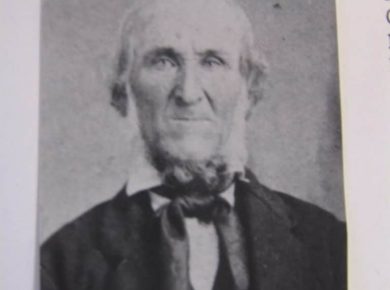
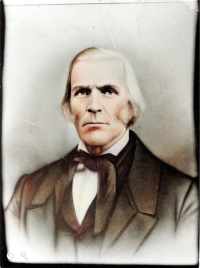
Benjamin Benson (1773-1846)

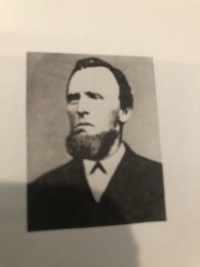
My name is Benjamin Benson, I was born in 1773 in Maple, Rensselaer, New York. I was a farmer most of my life and also learned the trade of Millwright to help support our family of 12 children with my wife, Keziah Messenger.

In the year of 1795, when I was 22 years old and living in the Town of Pompey, County of Onondaga, New York, I, being a very curious man, often wondered where all the Indians or native Americans originated. I made it a matter of prayer. I experienced a vision of an angel that appeared to me in a dream. He showed me an ancient record that was deposited in the earth and said it was a record of a people that came from Jerusalem. They were the forefathers of the Indians and that the record would be brought to light in a few short years. Then from a distance the angel then showed me the man who had been chosen to bring forth the record and said about him, “He is not yet born.”

We moved our family more than 1,000 miles from Allegany County, New York to Clinton County, Indiana by floating the Allegany and Ohio Rivers. I engaged in clearing timbered land, farmed, built saw and grist mills, encountered Indian raids and endured all the struggles of frontier life. In 1832, while living in Indiana, missionaries from the restored Church of Jesus Christ converted our whole family to the Church.

It all started when our daughter, Polly Benson, had a dream that she was doing the family washing out by our big shade tree near our home. In the dream she saw two men walking towards her with little satchels. She said that she heard a voice that told her, “Whatever those men are bringing you, accept it for it is true.”

So vivid was the dream that sometime later when she was actually doing the family wash, she saw two Elders of the Church of Jesus Christ of Latter-day Saints approaching and recognized them as the two men in her dream. She quickly invited them into the family home. My wife and I were happy to welcome them and we were anxious to hear their message about the restored gospel, Joseph Smith, and the coming forth of the Book of Mormon.

We readily accepted their teachings and soon joined the faith. I had been prepared to hear and accept the gospel truths years earlier. Following our conversion we committed to travel 800 miles by ox team to Jackson County, Missouri to be with the rest of the saints. We experienced all the persecutions and atrocities committed upon the members of the Church at the merciless hands of our persecutors.

Years later, in 1837 when I was 64 years old, while in Far West, Missouri, I had a private conversation with the Prophet Joseph Smith and related the whole experience to him of my dream many years earlier. He was very interested. He asked me to record everything that I had seen in the dream in detail and give him a copy, which I did a short time thereafter.

Eventually we finally were driven from Missouri, crossed the Mississippi River and settled in Warsaw, Illinois. I was 65 years old and now I had to start all over again. But my family and I had a close relationship with Joseph Smith and we supported him fully. I helped build the City of Nauvoo and worked on the Temple there. I also served on the Nauvoo High Council. Great was my sorrow at the martyrdom of the Prophet Joseph Smith and his brother, Hyrum in 1844.

Our family moved west with the saints in 1846 sorrowfully leaving the city we had helped to build. The journey was very hard on me. I was not young anymore and the rigors of the journey overcame me.

At the age of 73, I passed away near Winter Quarters. My wife and other family members continued on west and eventually reached the Salt Lake Valley in 1852. They first settled in Springville then later helped initiate the settlement of Fayette, Utah and worked on the Manti Temple.

It is my testimony that the Lord lives and that Joseph Smith is his prophet. How privileged I am to have known Brother Joseph and to have been baptized in the restored Church of Jesus Christ.

Happy
Happy
0 %
Sad
Sad
0 %
Excited
Excited
0 %
Sleepy
Sleepy
0 %
Angry
Angry
100 %
Surprise
Surprise
0 %
You May Also Like

WOOD, William Sr.

He was with the body of the Saints on their western movement when the call came for 500 of their gallant men to volunteer to fight in defense of the Government against Mexico. He enlisted in the Mormon Battalion July 16th 1846, marching with the company from Council Bluff, Iowa over a trackless plain where foot of man had never trod. On that perilous journey he helped to make roads, dig wells, and suffered untold agonies from hunger and thirst while marching on the desert day after day in the blazing sun. He was discharged at San Diego, California on July 16 1877.
View Post

FREESTONE, George: and his Wives, Alice Carlisle and Jennie Lind

George found himself, as a fifteen year-old, driving four yoke of oxen on a heavy freight wagon to the Utah Territory. His younger brother, James, later wrote that he had driven sheep 1,000 miles barefooted across the Plains. “In Alpine,” George wrote, “between 1855 and 1856, I spent about half of my time building forts to fight against the Indians and half my time killing crickets.” The family struggled against these odds to make a living. Then in 1858, they lost their father when he was killed by Indians.
View Post

GREEN, Robert Kenyon: Biography (1806-1884)

Winter in Ponca CampOn July 1st, 1846 a ferry was completed to cross the Missouri River. On the western side, a place called ‘Cold Spring Camp’ was established on recommendation of Bishop George Miller. It was late in the year, and the Green family pioneers had been delayed by heavy rains. They waited for instructions to either press on to the Rocky Mountains or find a place to spend the winter. Companies organized by Brigham Young and Heber C. Kimball at the Cold Springs Camp combined with Bishop Miller's Company and became the advance party for the church.
View Post

ALLEMAN, John

JOHN ALLEMAN and his family arrived in Nauvoo in 1838 from Pennsylvania with two wagons, ten horses and their household possessions. He bought farm land and built a brick home for his family. He assisted in building the Nauvoo Temple and served as a cavalryman in the Nauvoo Legion.
View Post

ARMSTRONG, Thomas Kirk

Thomas Kirk Armstrong was instrumental in developing the Utah territory with his team and wagon, his sawmill work, and in the sheep business at a location about seven miles east of Park City, Utah. He also maintained a dipping vat that all sheepmen used to dip their sheep in. They used a solution of tobacco and sulphur
View Post

POND, Stillman Pond

On February 2nd 1846 the migration west began. Stillman and his family remained in Nauvoo until after the battle of Nauvoo in September 1846 when they were driven at the point of a bayonet across the river. Tribulations and hardships were many as the winter set in early and the Mormon refugees were without the proper food, clothing and shelter. The camp was ravaged by malaria, cholera, and consumption. The Pond family fell victim of all of these diseases. Stillman’s wife, Maria, became consumptive and all the children were afflicted with malaria. Snow fell early on the plains of Iowa and along the way Stillman and Maria buried their son Lowell Anson in September of 1846 on the plains of Iowa. Maria’s body wracked with pain and bowed down with grief for the loss of her son; was unable to walk and was confined to her bed in the back of the wagon with the fever of malaria. In this condition she gave birth to twin boys Joseph and J. Hyrum, the later part of September and the twins died a few days later and were also buried along the trail in Iowa.
View Post

SMITH, Joseph Johnson

How happy they must have been to be in “Joseph’s City”. But the happiness didn’t last long. Within three months after arriving in Nauvoo, little Mercy became ill and died. Joseph’s wife, Mary, grieved with Joseph, but within two months, she and Joseph became excited again because she was going to have another baby. But again, the excitement was blunted by death as Mary died a week after her baby son, Joseph, was born and baby Joseph died twelve days later. Joseph now was left with just three year-old Caroline. His parents and two sisters and three brothers were still with him in Nauvoo, but how hard it must have been to have sacrificed so much in such a short time.
View Post

WOOD, George Lymer: An Incident in the Life

"The usual method of disposing of the dead was to weight the bodies and dump them overboard. When others and I asked the privilege of removing our dead and burying them on land, the Captain was hateful and mean about it. All of my dear ones except Samuel's wife I had to perform this last earthly service for. Others of the party had sustained like losses, and were as anxious as I to bury them as decently as possible. The Captain at last agreed to wait and we hired a Negro to help dig a trench big enough to put them in all together. We removed the dead from the boat and began our heart¬breaking task, but had it only partly done when the boat whistle blew and the boat began to get underway. All ran hastily back except the Negro, one woman and myself. She and I stood at the grave site of our dead and watched them go. What bitterness of spirit I experienced only God knows. Was this what I had come to America, the home of the brave, for? Here I was with two strangers standing beside the open grave of a group of strangers. Our common interests were all lying before us or fast receding from sight, subject to the whim of a heartless thing in human form. "Surges of emotion swept over me, sorrow, anger, love, fear, and despair, but my nearest duty was to protect these rapidly decomposing dear forms of mine from the ravages of wild beasts, heat, and other elements. Perhaps I had been blessed and spared to perform this last service. If! were dead with them our bodies would rot together. So I urged on my companions the need for work. I felt responsible for seeing this thing through.
View Post