EVANS, Abel

0 1
Read Time:3 Minute, 1 Second
This article originally appeared in Pioneer Magazine, 2010 Vol.57 No.3
by Ken Lott

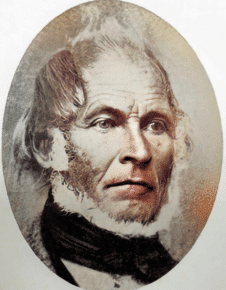
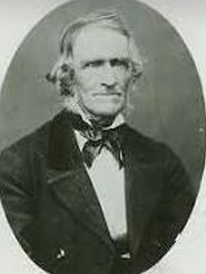
Born on June 17, 1812, in Llangan, South Wales, to Samuel Evans and Anne Hughes, Abel Evans was baptized as an infant into the “Independent” chapel in Llanboidy. The Independents, along with the Methodists and Baptists and several other faiths throughout Britain, were fiercely opposed to many of the beliefs of the Church of England. Because of their unwillingness to “conform” to the established church, they were known as “Nonconformists.”

Abel lived on the farm until at least the age of 9. By the time he was 14 years of age the family had moved to Merthyr Tydfil, an industrial town in the iron and coal mining district. Both Abel and his father probably worked in the mines.

Late in 1842 Lorenzo Snow sent an English convert, William Henshaw, into the area of Merthyr Tydfil to open up missionary work there. Abel and his father were both baptized into the Church by Elder Henshaw in February of 1844. Abel Evans was the ninth convert of Elder Henshaw. Abel’s mother, Anne, had died of tuberculosis just two weeks earlier. The promised blessings of the gospel at this time of their grief could have been a factor in the decision to be baptized.

Abel was single at the time and could devote his full energies to the work; he almost immediately became involved as a missionary. His first baptism was performed just seven weeks after his own baptism. Among Abel’s convert baptisms were Thomas D. Giles and family. This Thomas Giles, who later became blinded in a mining accident, came to be known as the “Blind Harpist of Utah.” Abel also baptized William and Jane Perkins, who had a baby boy, Benjamin, at the time of their baptism. The Perkins later immigrated to Utah and settled in Cedar City. Their son, Benjamin, was a central figure in the “Hole-in-the-Rock Expedition” in Southern Utah.

Four-and-half months after Abel Evans accepted the gospel, Joseph Smith and his brother Hyrum were martyred. With Joseph in the Carthage Jail until just a few hours before the Martydom was Dan Jones, a native of Wales who had been converted to Mormonism in 1843 while operating a steamboat on the Mississippi River. Joseph had called Dan to go back to Wales to serve a mission, and during that visit in the jail, the Prophet promised Dan that “You will see Wales and fulfill the mission appointed you ere you die.” Dan did go to Wales and Abel Evans became closely associated with him as Dan Jones became an outstanding leader of the missionary work in Wales. Abel was an effective missionary and there are recorded testimonies of priesthood blessings under his hands.

As with most Saints in those days, the overriding goal was to be able to immigrate to Zion. Abel and his father began saving in 1845 in hopes that they could soon go to America. Abel was finally able to leave in 1850 after six years of missionary service.

Abel sailed from England to New Orleans with a group of Saints headed towards Zion. On board ship, Abel met a young convert by the name of Mary Elizabeth Jones. The 37-year-old bachelor finally relinquished his celibacy and took Mary Jones to wife. The family lived in Winter Quarters for two years and arrived in the Salt Lake Valley in 1852. Shortly thereafter they settled in Lehi.


Source: Ronald D. Dennis, Indefatigable Veteran, History and Biography of Abel Evans, A Welsh Mormon Elder (Provo, Utah: Rhydybont Press, 1994).

Happy
Happy
0 %
Sad
Sad
0 %
Excited
Excited
0 %
Sleepy
Sleepy
0 %
Angry
Angry
0 %
Surprise
Surprise
100 %
You May Also Like

ROBERTS, Owen: Welsh Convert

On Friday, May 20th, they started on the railroad for St. Joseph, Missouri where they arrived safely; from thence they proceeded on their way up the Missouri River on the steamboat “St. Mary”. Here they were treated roughly by the crew and others. They had no where to sleep or sit, but were almost constantly compelled to stand on their feet night and day until May 26th where they landed on the banks of the Missouri River below Florence, Nebraska at which place they lodged for a while so they could fit up their teams and baggage to cross the plains to the Rocky Mountains.
View Post

MAUGHAN, Harrison Davenport & Mary Freestone

Education had already become a high priority in the mind of this teenager. After twelve or fifteen months of employment she had saved enough money to enroll in the new Brigham Young Academy in Logan. Where had she learned what she needed to know to get admitted? How was she able to make her way in the environment of an academy? She may have attended school briefly as a small girl and perhaps for one year just after returning from Franklin Meadows. Mary left one little school workbook, labled “Alpine City, Utah.” It is filled with evidence of studies in math, geology, grammar (including diagraming sentences) and a lot of theology from the Bible. She also left another workbook in penmanship and a series of well-written essays on a variety of subjects. These showed good spelling and extraordinary penmanship, a beautiful script worthy of a highly educated person. Mary attended Brigham Young Academy for perhaps only three months, or maybe asmuch as two semesters. At the end of the spring term in 1882, the students exchanged messages in little autograph books, with one greeting per page in the form of a poetic sentiment. Each page is written in beautiful script – a very impressive exhibit, when compared to twenty-first century handwriting, which is often illegible at the college level!
View Post

ASHTON, Thomas

Thomas took a very active part in the planning and construction of Lehi's first water ditch and was one of the city's first water masters, when no salary was attached to the office. He was also very active in planning and building Lehi's first bridge across the Jordon River.
View Post

ATKIN, Thomas

Mary became seriously ill with a "rupture" in her side. The doctors could do nothing to help her. Thomas, watching her suffer, resolved he would be more devoted in serving the Lord, if only the prayers and desires of his heart and those of his children regarding his beloved wife would be granted. Eventually, Mary was healed. He did not forget the resolution and promise he had made with the Lord and commenced in earnest to inquire of his spiritual advisors.
View Post

REES, Thomas: Poor Welch Immigrant

Thomas and his family wanted to go to Utah with the saints, but he didn’t have the money to do so. Thus, their pioneer pilgrimage began on their destitute little farm in Wales with an effort to save money for the journey. It took until 1868 for them to save enough to send Brigham and one of his older sisters to Utah. They sent them off with instructions to save money and help the rest of the family to come. Brigham sailed to the states on the steamship Colorado. If his sister traveled on the same ship with him, it was Elizabeth because she is the only one to closely match name and age (5). The ship carried 600 saints bound for Utah, and was the last of the year. It departed Liverpool on 14 July, 1868 (6), and arrived at the Castle Garden Immigration center of New York on 7 August, 1868 (7) They traveled by train to Florence, Nebraska (another account says the train took him to Wyoming), then walked the last 800 miles from there to Utah because the rail hadn’t been completed to Ogden yet. Records record him arriving in Utah in 1869, so he must have been delayed en-route. Brigham would have been one of the last of the pioneers to walk to Utah before the Golden Spike was driven in Ogden.
View Post

ANDERSON, Neil

One day, when it was soon time to harvest the beets, he called the boys together to show them how to top the beets. When he had them all around him he took a big beet and his best knife and toped the beet and at the same time he cut the end of his finger off. Then he said, "Boys, that will never do. Don't do it that way!"
View Post

WRIGHT: John Pannell

In conversation with Bishop Maughan they were advised to try to find a suitable location on the Logan River, and accordingly set out again the 5th of June. They next formed a camp near the site of the old Brigham Young College and here they decided to remain. A survey of the land was immediately begun and the brethren cast lots for their locations. This was the beginning of our beautiful city of Logan, June 1859. Although John Pannell Wright was a member of the second group to locate on the site of Logan in June 1859, he is generally given credit by old historians as having been the father of our city. Apparently it was he who did the first surveying here and who designated the little settlement by the name of Logan. Apparently after Brother Wright and his son had surveyed a few blocks of land, which they did by only measuring with a tape or chain, there was a drawing or lottery for the purpose of acquiring home sites. ) They also helped build a bowery under which they held their meetings. They harvested their grain on Summit Creek (Smithfield). They often carried their guns in one hand and their shovels in the other. They succeeded in yielding good crops, as high as forty bushels of wheat to the acre. Mr. Wright left his tracks in the snow while cutting the last of the grain.
View Post

JACOBSEN, Christian Jensen: Frontier Craftsman

Another life altering experience occurred in 1854 when L.D.S. missionaries introduced the Jensens to a new religion. After a short investigation Christen and Kirsten were baptized on a cold day in December and became the first members of the church in their local area. Soon after, Christian was called to be a local missionary and also to preside over two branches of the church. In the fall of 1857 he was assigned to open a mission on LæsØ, an island located midway between Jutland and Sweden. As a missionary he received frosty receptions but soon encountered some inhabitants in need of his clock repairing skills. This led him to adjust his strategy and avoid the topic of religion until he had the family’s clock dismantled. Once the family knew him as a clock repairman, they were more prone to discuss religion with him. Using this strategy, and after visiting the island several times, Christian baptized a dozen or so members and organized the Byrum Branch there.
View Post