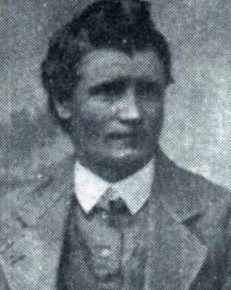
COX, Amos: Brief life story

One day she said “If you will have Amos Cox administer to me I think I will get well.” Father was only 17 years old at the time and had never administered to anyone in his life, but they sent for him out in the field where he was scything grain. He said he was dumb founded, but told them he would come. There in the field he asked Heavenly Father what to say and said he believed it was one of the most humbling experiences of his life. He went to the house, washed his hands, and sealed the anointing. He promised the girl that she would get well, then when he looked at her and saw how frail and pale she looked, he was scared and so weak that he sat down.
0 1
Read Time:4 Minute, 21 Second
From the pen of Cleesa Cox

Amos Cox born 8 October 1856 at Manti, Sanpete County Utah was the son of Orville Southerland and Mary Elizabeth Allen Cox. When Amos was a small boy they were called to go to the Muddy in Nevada and settle that part of the country, after many L.D.S. families had built canals set out orchards and vineyards and got the land to producing. The state set such a high tax that the Saints were unable to meet it, so were told to get out so grandfather and grandmother moved to Orderville, Utah where they later joined the Order.

Father remembered the long tables where everyone ate and where the butter was put on the bread and then scraped off so it was called bread and scrape, but he also remembers some very good meals that was served, which tasted especially good after a long day of scything with a hand scythe.

My father as well as Sister Brady Englestead has told me of how her sister who was about 14 years old, had been sick for months and got so she wouldn’t eat, and although they had the elders administer many times, still she seemed to get worse. One day she said:

“If you will have Amos Cox administer to me I think I will get well.”

Father was only 17 years old at the time and had never administered to anyone in his life, but they sent for him out in the field where he was scything grain. He said he was dumbfounded, but told them he would come.

There in the field he asked Heavenly Father what to say and said he believed it was one of the most humbling experiences of his life. He went to the house, washed his hands, and sealed the anointing. He promised the girl that she would get well, then when he looked at her and saw how frail and pale she looked, he was scared and so weak that he sat down. In a few minutes the girl asked for some bread and milk. She ate all of it, and wanted more, but her mother was wise and told her that she must not eat too much at once, but could have more later.

Father then went back to the field. The girl improved from that day on and lived to raise a large family. Father seemed to have the gift of healing. I have seen several persons whom the doctors had given up, but lived after father administered to them.

I also saw a case of someone who didn’t live, but father was using tobacco at the time as a doctor had told him to so as to remove the fat from around his heart, but father felt that was why the Lord did not hear his prayer, because he was breaking a commandment.

Father was married to Sarah Arletta Palmer 10 July 1876. I think in the Endowment house. Anyway he said he was endowed in Salt Lake City. They had been married a number of years but had no children, it was during the time of polygamy and as the government was trying to get the manifesto thru. Father went to Mexico and married my mother Grace Ellen Chestnut on the 4th of June 1894. They were married by Brigham Young Jr. son of President Brigham Young, who was down there for that purpose.

Father and mother are the parents of eight children. As there were no doctors in the L.D.S. Colonies at that time, Aunt Letty took care of the confinement cases with fathers help sometimes in Chiuchupa, Garcia, and Pechaco, the Mountain Colonies. Later they did some of that work in Colonial Juarez. Father also set the broken bones, extracted teeth, and treated snake bites. He said that with the help of the Lord they never lost a case.

Father also practiced the blacksmith trade and went as a guide with mining men from Boston and other Eastern cities. When I was about 12 years old, father sold a mining claim for five thousand dollars and we moved to Juarez. Father invested part of the money in the electric light company and bought a blacksmith shop and a home with the other part. We had electric lights, a telephone, an Edison Phonograph and linoleum on the floors, something we had never had in Chuichupa.

Also an organ of which we girls were very proud. I had taken a few music lessons in Chupy, now I took some more from a German music teacher, Mr. Hagg. Father was called on a mission to the Southern States with head quarters in Chattanooga, Tennessee. He had been out only eight months when the colonists were driven out of Mexico on account of the Mexican Revolution in 1912.

We had been in El Paso, Texas for over a month when the church authorities decided to release all men with families from the mission field, so father was released and we came to Utah in 1912 and settled at Orderville. Father had to start over from scratch then, and he lived in poverty until his death, 9 April 1937.

Happy
Happy
0 %
Sad
Sad
0 %
Excited
Excited
0 %
Sleepy
Sleepy
0 %
Angry
Angry
0 %
Surprise
Surprise
100 %
You May Also Like

COOLEY, Andrew Wood: A pioneer devoted to family

December 25, 1885. I wish I could have had the privilege of spending Christmas with you at home, but it is our lot to spend it apart. I hope you have spent it in a different way from what I have. We had a good dinner. The warden did the best he could to make the prisoners happy, but when a man’s liberty is gone, he can’t be happy when he has a family at home. I have thought of home the whole day long and so I do every day. I shall never be a happy man if I cannot enjoy the society of those that are my own flesh and blood which my family is. Things look dark to me, but I must hope for the best. God is at the helm
View Post

THOMSON Jr., Moses

Combined with the guarding that was surely required of Moses, we also learn from George Thomson’s biography that “Moses pushed and pulled on a handcart with a sick man in it for many days. Their rations got slimmer . . . When they got to the Sweetwater [River] near Devil’s Gate, Moses died with seven others the same night. . . . they were buried in shallow graves and covered with snow. This tragedy was a terrible blow to George and he did not get over it for years.”
View Post

Hyrum Woolsey To Utah – 1848 –

Hyrum Woolsey was closely associated with his brother-in-law John D. Lee, who married two younger sisters of Hyrum Woolsey, Agatha Ann Woolsey and Rachel Andora Woolsey. Hyrum Woolsey worked with John D. Lee as a laborer and as a teamster.
View Post

MELLOR Jr., James: Inspirational Story

Mary, however, was so hungry and faint that she finally told Louisa to go on without her. Louisa would have none of that. She instead walked ahead a short distance, kneeled down, and poured out her heart to the Lord to help them. She arose and headed back toward her mother on the same path she had just taken. She walked a short distance when she suddenly saw something in the prarie grass. It was a freshly baked pie! It was laying right side up, and the crust wasn't even broken. They both thanked the Lord for the immediate answer to her prayer, ate the pie, and resumed their tip toward the company. In the meantime, since they had not caught up with the company in the time expected, James Sr. had taken his handcart to go look for them. He found them and took them in the handcart back to camp.
View Post

BELLISON, James Thomas and Louisa

Before many days, an incident occurred which tells a lot about James' attitude toward draft animals. His granddaughter, Pearl Allen Read, tells of the company coming to a bog of mud in the trail which caused many wagons to get stuck. As each team came to the bog, the Captain standing there would join the drivers in whipping the animals to get them through.When it was his turn, James forbade the Captain. "These are my animals and no whip is to be used on them." Although James' team pulled through the bog successfully, the Captain was angry and thereafter continued to find fault with this independent member of his company.James Thomas' life-long insistence that his animals be treated well was admired by those who knew him and was learned and perpetuated by his children throughout their lives.
View Post

ALLEN, Alanson David

His father, Albern, and oldest brother, Rufus, were with the Mormon Battalion on their march to California. They were released on July 16, 1847 and went to Utah. Alanson stayed with his family at Winter Quarters. He was seventeen at the time. Realizing their need for winter supplies, he went back to Eastern Missouri and bought and harvested crops and brought them back to his family at Winter Quarters.
View Post

ORR, Robert Ustain: A Short Biography

Robert Orr was quite the character on the stage, taking mostly comedy roles. Adept at showing the humorous side of life, he was a good pantomime and had plenty of chances to use his talent. When they were able to have a stage curtain made, he was in charge of running the curtain up and down and kept the coal-oil lamps all clean and filled. The first play they put on was called "Ten Nights in a Bar Room", which Robert had a part. This play was a favorite for many years and they played it at the opening of each season. They also took their plays over to Camp Floyd, Eureka and Tooele.
View Post

ALLEN, Andrew Lee

The family moved to Provo, where Andrew and his sons helped to build the Provo Fort. Andrew taught his sons to work and take care of their animals. The sons worked quite often as teamsters. Andrew was an excellent rope maker and knew how to make dyes from plants. He made tassels and decorations for his teams.
View Post

ANDERSON, Editha Morgan

Whatever else she was, Edith, like many other mature single Latter-day Saint Women, had internal strength and strong religious beliefs sufficient to tolerate an environment that was unsympathetic toward mature single women, as exemplified by Stout’s comments.Editha established a private school in her small log cabin that was located on 1st North and about 70 West in American Fork. It served as a bedroom, living room, and a tightly packed class room. The dwelling featured one door, one window, two beds, a wood stove, and a rest facility located out back of the cabin. Her rudimentary school attracted a dozen or so students, about the same number of youngsters as attended another school that met in a community-owned building that served as a place of worship and education.
View Post