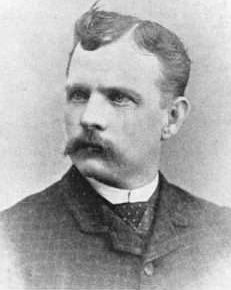
THOMSON Jr., Moses

Combined with the guarding that was surely required of Moses, we also learn from George Thomson’s biography that “Moses pushed and pulled on a handcart with a sick man in it for many days. Their rations got slimmer . . . When they got to the Sweetwater [River] near Devil’s Gate, Moses died with seven others the same night. . . . they were buried in shallow graves and covered with snow. This tragedy was a terrible blow to George and he did not get over it for years.”
0 1
Read Time:3 Minute, 53 Second

MOSES THOMSON, JR.

Born: 5 Feb. 1834 Kincardine, Perth, Scotland

Died: November 1856 on the Sweetwater River near Devil’s Gate

(Possibly at Martin’s Cove)

MARTIN HANDCART COMPANY – Age 22

Moses Thomson was the 5th of 8 children of Moses and Janet Steel Thomson. It appears that Moses and his two older brothers, George and Thomas Hyslop Thomson, were baptized members of The Church of Jesus Christ of Latter-day Saints, but their parents and five sisters were not. George was the first of the Thomson boys to join the Church, being baptized on April 7, 1847, at the age of 17. This so enraged his brother, Thomas, that he held George by force while his mother whipped him. (The boys’ father had died two years previously in 1845.) Nevertheless, Thomas also was later baptized.*

Moses had worked in the coal mines of Scotland, along with his father, brothers, and other male relatives, as soon as he was old enough to carry a candle for the miners to see to work. He also carried a little bucket of water for them to drink. The boys were paid a small wage for this service. They assumed heavier duties in the mines by about age 15.

George was also the first of the three Thomson boys to emigrate to America with the Saints. He came in 1851 aboard the ship Ellen, paying his passage with a full year’s savings. After making his way to Council Bluffs, Iowa, he contracted with Joshua Grant to drive a freight wagon to Utah. He traveled with only 11 other men and a young woman, Joan Bee, who cooked for this company. George and Joan were later married.

George first lived in the Sessions settlement, or present-day Bountiful, Utah. He married and worked hard and saved his money again. Some of it was earned by traveling back to Council Bluffs to bring other Mormon pioneers to Utah. When he had saved enough money, he sent to Scotland for his younger brother, Moses, to come to Utah.

Moses traveled from Glasgow, Scotland, to Liverpool, England, to emigrate with the other Saints aboard the ship Horizon in May of 1856. The President of this group was Edward Martin who also became the Captain of the Handcart Company in which Moses would travel toward Utah from Iowa City, Iowa. President Martin’s two counselors aboard ship were George P. Waugh (age 68) and Jesse Haven (age 42). Elder Waugh was a native of Scotland and both men, Waugh and Haven, were returning to Utah from missions; Waugh in Scotland, and Haven in South Africa and as well as a few months in Scotland. Most of the other Saints known to be from Scotland aboard the Horizon did not continue on to Utah with the Martin Handcart Company. (Some of these family names were Queen, Miller, Dow, Camp and Cain.)

Like other strong young men in the company, Moses would have been assigned to help those less able with their handcarts. He would have also been placed on guard duty at night. These shifts would typically last several hours and took their toll on those like Moses who sacrificed much-needed rest. Fellow traveler Benjamin Platt (age 23) wrote of this:

“ . . . we had to herd at nights and pull handcarts all days and many times I have been kept up until midnight and then stood guard until morning and then started again and it was this everlasting guarding that killed the people.”

Combined with the guarding that was surely required of Moses, we also learn from George Thomson’s biography that

“Moses pushed and pulled on a handcart with a sick man in it for many days. Their rations got slimmer . . . When they got to the Sweetwater [River] near Devil’s Gate, Moses died with seven others the same night. . . . they were buried in shallow graves and covered with snow. This tragedy was a terrible blow to George and he did not get over it for years.”

*According to family accounts, Thomas Hyslop Thomson immigrated to America in 1859 or 1860 with his wife and two children. He went as far as St. Louis, Missouri, obtained work, and remained there until the Civil War broke out and he was drafted into the army. “His wife heard from him once in awhile and then his letters stopped. She never did know whether he was killed or what became of him. George corresponded with her for two or three years and then she married again and moved to Dakota and he lost track of her. Nothing was ever heard of Thomas again.” (Biography of George Thomson)


Happy
Happy
0 %
Sad
Sad
0 %
Excited
Excited
0 %
Sleepy
Sleepy
0 %
Angry
Angry
0 %
Surprise
Surprise
100 %
You May Also Like

MAUGHAN, Harrison Davenport & Mary Freestone

Education had already become a high priority in the mind of this teenager. After twelve or fifteen months of employment she had saved enough money to enroll in the new Brigham Young Academy in Logan. Where had she learned what she needed to know to get admitted? How was she able to make her way in the environment of an academy? She may have attended school briefly as a small girl and perhaps for one year just after returning from Franklin Meadows. Mary left one little school workbook, labled “Alpine City, Utah.” It is filled with evidence of studies in math, geology, grammar (including diagraming sentences) and a lot of theology from the Bible. She also left another workbook in penmanship and a series of well-written essays on a variety of subjects. These showed good spelling and extraordinary penmanship, a beautiful script worthy of a highly educated person. Mary attended Brigham Young Academy for perhaps only three months, or maybe asmuch as two semesters. At the end of the spring term in 1882, the students exchanged messages in little autograph books, with one greeting per page in the form of a poetic sentiment. Each page is written in beautiful script – a very impressive exhibit, when compared to twenty-first century handwriting, which is often illegible at the college level!
View Post

COX, Amos: Brief life story

One day she said “If you will have Amos Cox administer to me I think I will get well.” Father was only 17 years old at the time and had never administered to anyone in his life, but they sent for him out in the field where he was scything grain. He said he was dumb founded, but told them he would come. There in the field he asked Heavenly Father what to say and said he believed it was one of the most humbling experiences of his life. He went to the house, washed his hands, and sealed the anointing. He promised the girl that she would get well, then when he looked at her and saw how frail and pale she looked, he was scared and so weak that he sat down.
View Post

ALLPHIN, Israel Dodge

A TURBULENT TIDAL WAVE RAGED THROUGH THE CREEK CHASM DESTROYING EVERYTHING IN ITS PATH. THERE WOULD BE NO ACCOUNTABILITY AS TO WHAT WOULD TAKE PLACE AT THIS TRAGIC MOMENT…A CENTURY LATER, HISTORY BOOKS WOULD CHRONICLE THE EVENTS OF THE JULY 16, 1863 PINE VALLEY FLOOD.
View Post

William Henry Adams, Sr.

William Henry Adams, Sr., was one of the first three settlers of Pleasant Grove on July 19, 1850 with Philo T. Farnsworth and John Mercer. He scouted the area along Provo River and came back with his report of straight logs for houses, and rocks for foundations. He surveyed the town site with these two assisting and set his own stakes for forty acres.
View Post

ASHTON, Thomas

Thomas took a very active part in the planning and construction of Lehi's first water ditch and was one of the city's first water masters, when no salary was attached to the office. He was also very active in planning and building Lehi's first bridge across the Jordon River.
View Post

BINGHAM, Erastus

Erastus Bingham stood up on his wagon wheel and talked to the Saints, telling him that he proposed to obey the council of president Brigham Young, that he and his family would remain until Spring and invited all to join with him in accepting the invitation of the Indians to share their camping ground. About one half of the company remained with Erastus Bingham; the others decided to attempt the journey Westward with their commander, Bishop Miller. They pushed on Westward but met with a great many losses. The Indians stole some of their animals; and they suffered from the cold and lack of food and were compelled to return, some of them camping near Erastus Bingham’s camp. The Ponca Indians were very kind to the families who were sharing with them their camping ground, even bringing meat for some of the most destitute families. They wintered with the Ponca Indians, living in their wagons and a wickiup the friendly Indians provided for them.
View Post