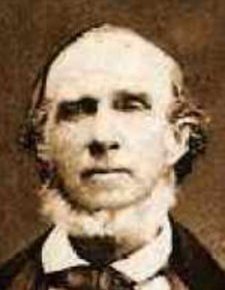
CURTIS, Enos

Enos live a wonderful life, enduring the trials of crossing the plains, becoming a Patriarch, and helping to build up the Kingdom of God in Utah. He helped to build the city of Springville, Utah, and went with Brigham Young to the South  of Utah, coming back in the winter of 1856. He didn’t feel well that spring, but kept on working.
1 1
Read Time:4 Minute, 4 Second

Enos’ childhood remains a bit of a mystery. He was born October 9th 1783 at Kinderhook, Columbia, New York, the oldest child of Edmond and Polly (Avery) Curtis. Shortly after his mother died, when Enos was about 5 years old, his father left him in the care of neighbors who were travelling west. The record does not indicate that he ever saw his father again.

Those who raised him had a positive influence on him, for instilled in his nature were many truly great and noble qualities. He was especially known for his kindness. Somehow he was blessed to receive some education which enabled him to read, and sign his name.

At the age of 22 Enos met and married Ruth Franklin in New York City, December 15, 1805. They moved to Pennsylvania where they had the 1st of 14 children. Of these, six daughters and three sons lived to grow up and marry.

Enos heard of the restored gospel from his son-in-law Elial Strong and Levi Gifford and soon joined the Church in late 1830 or early 1831. He was baptized by Lyman Wight.

He was ordained an Elder in early 1831 and served a mission with his son-in-law, Alpheus Gifford, Eleazar Miller and Abraham Brown. On this mission they met with Brigham Young and Heber C. Kimball. Both of whom said that it was the testimonies of these elders that helped to convert them.

They were able to speak and sing in Tongues. He served at least two mission at the time, one of them to Canada for about 6 weeks, creating the first branch there.

Enos never lived in Kirtland, but did move to Missouri and suffered through the trials and hardships the Saints suffered there, being driven out of, of having their homes burned. They fled to Quincy, then on to Yelrome, a community established by Isaac Morley.

Here too they had troubles. One of the stories is told here:

When Enos Curtis and his family lived near Nauvoo he and his four grown boys took a contract to put up some wild hay probably 40 or 50 miles away from home. The boys were at the hay camp and the father Enos was in Nauvoo when he heard that the mob was coming thru the country and that the camp where the boys were would be in their path and they would be in danger, so he rode horse back in the night to the camp where the boys were.  They were sleeping in a barn and about two o’clock in the morning could hear the horseman coming across the prairie.  Of course, in those times they were always on the watch for danger and they knew it was some trouble a horseman coming at that time of the night so  they hurried into their clothes and were somewhat alarmed.  When one of the boys said don’t be afraid I heard him cough and it was father.  (He had a little cough that they all knew.)  When he got there he said, “Boys saddle up your horses and prepare for a chase.  The mob is expected through here by daylight.”   The saddled up and going home met the mob. A chase ensued with the family getting home safely.

Enos and Ruth were the first of the Curtis family to attend  the completed temple and receive their Endowments on 1 January 1846. Enos was a faithful priesthood holder who exercised that priesthood well. One story is told about the time when his family took the ferry across the Mississippi River at the Montrose crossing. A terrible wind came up causing anxiety and fear they would be swept away. People on the shore were screaming for help because of the force of the wind. It looked like the cable controlling the ferry would break.

Enos raised his arm to the square and commanded the wind to take them to shore. It ceased its velocity and changed  direction so the ferry drifted to shore and the family was saved. As soon as they were safely on shore, the gale became gain as fierce as it had been before.

Enos live a wonderful life, enduring the trials of crossing the plains, becoming a Patriarch, and helping to build up the Kingdom of God in Utah. He helped to build the city of Springville, Utah, and went with Brigham Young to the South  of Utah, coming back in the winter of 1856. He didn’t feel well that spring, but kept on working.

On June 1st of 1856, he  went about his daily tasks although feeling a bit faint. In the evening, the family had assembled for a reunion. Enos joined them in the various activities and after eating, sat back in his favorite chair and died as peacefully as if going to sleep. He was buried in the Springville Cemetery.

Happy
Happy
0 %
Sad
Sad
50 %
Excited
Excited
0 %
Sleepy
Sleepy
0 %
Angry
Angry
0 %
Surprise
Surprise
50 %
You May Also Like

WARNICK, Anders Peter: Stalked by Cholera in 1866

From 1863 to 1875 cholera swept through Europe. The Austro-Prussian War in 1866 accelerated its spread. That fateful year 250 thousand people died from the lethal disease in Prussia and Austria, 90 thousand perished in Russia, and 113 thousand succumbed the next year in Italy. Hungary, Holland, and Belgium were similarly hard hit by the disease. Little wonder, then, that the virulent bacteria made its way on board the ship that the Anders Peter Warnick family boarded in Hamburg, Germany on June 1, 1866.
View Post

ALLEN, Alanson David

His father, Albern, and oldest brother, Rufus, were with the Mormon Battalion on their march to California. They were released on July 16, 1847 and went to Utah. Alanson stayed with his family at Winter Quarters. He was seventeen at the time. Realizing their need for winter supplies, he went back to Eastern Missouri and bought and harvested crops and brought them back to his family at Winter Quarters.
View Post

RIDING, Christopher Lister: Tinsmith

Christopher's skills were needed in St. George because the temple was under construction there and he was the only sheet metal worker in the Dixie mission at that time. However, there was not enough business in St. George to provide him work, so he secured a little four-wheeled cart and an ox. He loaded the cart with tin ware and tools and visited all the towns in southern Utah, exchanging his ware for flour, potatoes, butter, cheese, etc. He made most of his wares from waste cans as it was difficult to ship in sheet tin. People saved empty cans and metal ware of all kinds for him. His store of wares consisted of buckets, milk pans, tin cups and plates, lamps, canteens, coffee pots, wash boards, etc. The ball on the St. George temple and the one on the St. George tabernacle are Christopher Riding's work, as is the metal work on all the public buildings erected before his death. The tin-covered sphere on the temple remained until October 25, 1994, when it was replaced with a fiberglass model as part of a renovation project. Christopher was a loyal member of the church although he was never active in public affairs due to the fact that his work kept him away a great deal of the time. He was a great reader, spending every evening in this way.
View Post

WALKER, John

This article originally appeared in the Mar/Apr 1980 issue of Pioneer Magazine THE JOHN WALKER FAMILY—EARLY CHURCH STALWARTS by Rowland P. Corry The following is about John Walker, my great…
View Post

ROBERTS, Levi

After travelling over the mountains one day we met with some of our brethren from the Valley. This was a time of rejoicing. Captain Brown who left us at Santa Fe with the sick which went by the way of Fort Kearney and a few brethren with him from the Valley, brought news that we were not to go to the Valley, and told us we had better stay another year in California. So the company divided right where we met each other; some went on to Winter Quarters; some to the Valley, and some turned back. Daniel Browett, Slater, Cox, Levi Roberts and myself turned back to Sacramento and went to work for Mr. Sutter who treated us very kindly. I sent a mule to my wife with Brother Harris, which she got…. We all went to work at the same place for Captain Sutter. We took the work of cutting a millrace. Brother Browett went [p.379] to work with the millwright, this was in September and later on in the fall, I and two others took sick with the bilious fever. We were so sick we couldn't help each other to a drink of water. We lay under some ties and had to crawl around with the sun to keep from making us chill…. Our appetites were very poor, and our food was flour, water and squash. Had it not been for the thoughts of my wife and family I could have died, but we all three recovered after awhile and went to work on the millrace again and worked all winter. Sometime in the winter two of the brethren who were working for Mr. Sutter in the mountains found gold in a tailrace they were making. Mr. Sutter let me see the first gold they found before sending it to San Francisco to get it tested. In May 1848 some of the brethren and myself made a trip in the mountains to try and find a road over (instead of going down Truckee River, as we had to cross it about 20 times) but when we got in the mountains we found so much snow we had to return, and on our way back I stopped at what we called the Mormon Island, where there was some of the brethren at work getting gold, Brother Sidney Willis and his brother; also Brother Hudson. I stayed here for a short time and got some gold.
View Post

JENKINS, Jane: A Widow Supporting Her Family

In order to support herself and her family of small children, Jane made cookies, cakes, and bread which were put into small home made baskets and the children would sell them to regular customers and at the Southern Down Resort. In order to have a variety of cakes, the mother and children would go down to the seashore when the tide was out and gather larva from the rocks. This substance looked somewhat like lettuce. They washed the sand from it and put it into baskets and buckets. It was later baked as part of the cakes. These children thought nothing of walking three or four miles and selling this food for a schilling a pound. Sometimes Cecilia and Ann worked as nurse girls and as ladies maids.
View Post