 0
0
 1
1
by Harry A. Dean Ephraim, Utah

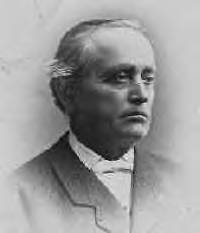
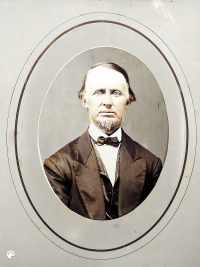
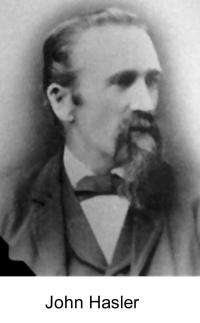
John Hasler was probably the most prominent musical figure in Central Utah from 1869 until 1887. He did most of his work in Mount Pleasant and the northern part of the county of Sanpete, although he by no means confined his teaching and selling activities to that limited territory as the following sketch will show.
The writer is indebted to one of Mr. Hasler’s daughters2 living in Mount Pleasant for much of these materials. Other sources include the author’s Masters Thesis3 and certain issues of the newspaper4 at the time of Mr. Hasler’s death.
John Hasler was born in Switzerland on April 17, 1839. He was a merchant, selling wines, liquors, and cigars by wholesale in his native country, and also a music instructor and prominent musician.
In 1869 he came to Mount Pleasant and was made leader of the band and instructor in music for pupils. He also became the leader of the church choir.
He returned to his native land on a mission in 1880, remaining two years during which time he composed music for the German hymn book, now in use.
He was vice-president of the Equitable Co-op store of Mount Pleasant. He was secretary of the High Priests quorum and an active churchman and musician. He had been selling musical instruments for many years.5
John Hasler and his wife Louise Thalman Hasler were converted to the Latter Day Saint Church in 1868 through the missionary efforts of Karl G. Maeser. They came to Utah in 1869 and settled in Mount Pleasant where they lived in a cellar for six years. This was no ordinary cellar, however, for there were three rooms and it was made cozy and home-like with pictures and curtains about the bed and windows.
Mr. Hasler was a member of the Swiss Cavalry Band before migrating to Utah in 1869. When he came, he brought with him much band music and several broken down horns he had obtained from the Cavalry Band. He also brought many slides, organ, and clarinet reed, etc. These he brought in preference to a fine mattress and some household treasures which his wife desired him to bring. After arriving in Mount Pleasant, he spent the evenings soldering these old instruments together, and they were used in the first brass band organized by Mr. Hasler with the following members: John Hasler, James Hansen, Bert Hansen, John Waldemar, Daniel Beckstrom, James Meiling, August Wall, Aaron Omen, Peter Syndergaard, Andrew Syndergaard, Soren Hansen, Lars (fiddler) Nielson, Jacob Hafen, Ulrick Winkler, Oscar Barton, Charley Hamshire, Paul Coates, and Olaf Rosenlaf.
Mr. Hasler also later organized bands in Fountain Green, Moroni, Payson, Pleasant Grove, and Spring City. The Spring City band was composed of these members: Henry L. Acord, Emil Erickson, George Hyde, Orson Hudson, S. Peter Sorensen, William Osborne, John Blain, Adolph Strate, Simon Beck, Christian Anderson, Christian G. Larson, Daniel Beckstrom, Carl Hansen, and Fred Strate.
Soon after arriving in Mount Pleasant, Mr. Hasler was appointed to lead the ward choir, which he did for twenty years. In the wintertime, he would start the fires with his own kindling wood, and also use his own coal oil for lights. He taught free of charge three girls to accompany the choir, namely Tina Morrison, Hilda Dehlin, and Gusta Dehlin. The only remuneration he ever received for directing the city band and the ward choir was ten acres of land, apportioned out to him by the bishop. To this day, that land is called the “brass band field.”
In 1869-1887, music was not so plentiful or so easily obtained as now, and Mr. Hasler would write all the music for band and choir by hand from one master copy which was usually played by the organist in the accompaniment.
A very interesting phase of Mr. Hasler’s activities was the founding of his Boarding School for Music Students. The students boarded and slept at the Hasler home for a term of six weeks, taking three lessons a day and practicing intensively between lessons. Among the many students registered at this school were Clair w. Reid of Manti, later on, the music faculty of Brigham Young University, John J. McClellan, later tabernacle organist in Salt Lake City, and Anthony C. Lund, later director of the Salt Lake Tabernacle Choir.
Mr. Hasler made it easy for students to study music at the Boarding School by accepting anything he could use, such as barrels of honey, cheeses, cedar posts, meat, milk and butter, and even clothing.
When students came from neighboring towns to register they were frequently accompanied by their parents, and sometimes the entire family. At times they would remain at the Hasler home for two or three days, eating and sleeping there, accepting the Hasler hospitality before returning home. Then after the six weeks, instruction period was ended, the family would return and the Hasler hospitality would be repeated.
The amount of work required of Mrs. Hasler in cooking and caring for these students and visitors, together with three organs going all day, caused her to have a nervous breakdown. This resulted in Mr. Hasler discontinuing the Boarding School, but not his music teaching. Instead of having the students come to him, he would travel to the different towns in the valley and in an open buggy drawn by a single horse. His territory included that from Pleasant Grove on the north to Wayne County on the south, and even east into Emery County. He not only gave lessons but he sold musical instruments. He would give free lessons with each piano or organ sold, enough to ensure the student played two pieces. Many homes in the out-of-the-way territories at that time would never have known the cultural influences of music had it not been for Mr. Hasler making it possible for them to have music in their homes.
On one of Mr. Hasler’s teaching tours in Emery County, he became lost for two days in a snow storm. On another occasion, Mr. Hasler became stranded in a blizzard near Thistle and arrived home with frozen feet and hands.
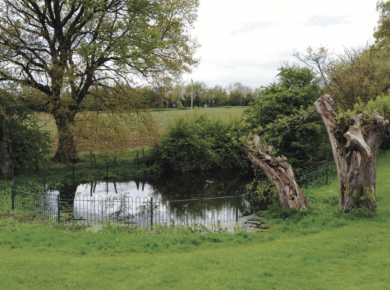
In 1871, two years after Mr. Hasler had migrated from Switzerland, he became sick with typhoid fever. In those days the church officials often re-baptized the saints for their health. So Hasler was taken to a pond and re-baptized, which nearly proved fatal. He took intense chills and became critically ill, partly of not wholly from the effects of the cold water. He lay on his back so long that bedsores developed and infection set in. He insisted that his wife take his razor to remove the infection, which she did. But in doing so she cut a cord of his leg which resulted in his being a cripple the rest of his life and using a cane while walking.
According to his daughters, Mr. Hasler was a crank on the matter of punctuality. He was never late for an appointment if he could avoid it. He was always very precise about having a place for everything and everything in its place. He could find anything he wanted in the dark. His word was as good as his bond. There was no halfway doing things. It was either right or wrong with him.
At the funeral of Louisa Hasler, wife of John Hasler, one of the speakers, W.D. Candland not only eulogized her but in referring to her husband John said in part:
“God did not bring John Hasler from his native Switzerland for the sole purpose of grubbing brush and breaking rock. Here was a young and growing community, out of the wilderness. They must not become wild and lawless. There must be some softening and refining influences disseminated which John Hasler supplied. What is more effective than music? Music was John Hasler’s middle name. Music radiated from his whole being. On coming here, he went to work immediately. Soon we had brass bands, string bands, choirs, concerts, and a singing school and soon the town was on a musical basis. No home was up to date with did not have one of Hasler’s organs. It seemed to me he directed the choir for half a lifetime.
And the choir practices were one place where we could go and see the girls we wanted to take home. As soon as one group was trained and grew up and became married, he started on a new group. My conviction is that John Hasler performed a most wonderful mission, one that was not fully realized.”
Sources:
1 – Lever’s History of Sanpete and Emery Counties, page 242, gives the following biographical sketch of John Hasler.
2 – Mrs. Mina Hasler Sorensen
3 – Choral Music in Central Utah. 1938, Brigham Young University Library. (Author’s name purposely omitted because of identification rule.)
4 – “Mount Pleasant Pyramid,” January 16, 1914.
5 – “Organization of the First Brass Band in Mount Pleasant, Under John Hasler”, Daughters of the Utah Pioneers in Mount Pleasant.


 Brother Joseph