0
0
 1
1
This article originally appeared in Vol.50, No.1 (2003) of Pioneer Magazine.
by Janet Peterson
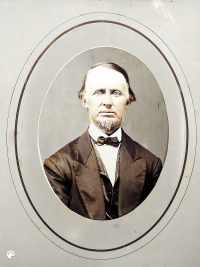
Named the “Chief Musician of the Church” by Brigham Young in 1865,1 George Careless’s lasting influence is evidenced by the singing of bis hymns every Sunday in a Latter-day Saint congregation somewhere in the world.
George Edward Percy Careless was born in London, England, on 24 September 1839, Typical of working-class boys, George was apprenticed at a young age to learn a trade. His mentors not only taught him to make baskets and shoes but also shared their love of music; his basketmaker mentor was an organist who recognized George’s musical talent and his shoemaker mentor loaned him a violin, which George taught himself how to play.2
George had a beautiful soprano voice and was offered a place in a London choir school* This opportunity for a musical and academic education could have paved the way to a sure musical career,3 but George turned it down when he met missionaries of The Church of Jesus Christ of Latter-day Saints and was baptized in 1850 at age eleven. Two years later when his father demanded that George give up music to learn a secure trade, George was compelled to leave home to pursue his musical training. He earned money playing the violin and attended the Royal Academy of Music in London, completing the four-year course in only three years. Professionally, he played the violin in London orchestras led by noted conductors. He also directed Church choirs and gave concerts for Church members* His London Conference Choir was so outstanding that they were invited to perform in various concert halls.
George’s life changed when a missionary related a dream he had about George. Elder William Staines told George that he “was wanted in Zion.” Obedient, George quickly made the decision to emigrate and departed for America in June 1864.4
An often-told story about George’s journey is of his organizing a choir on board the Hudson as he sailed to America. Not only did singing buoy up the Latter-day Saint passengers, but it also impressed the captain. As the ship docked in New York, the captain said to George, “I have admired your music so much that I want you to give me one of your tunes, as my family is religious and likes to sing hymns on Sunday evening,” George responded that he couldn’t give one to the captain as his music was packed and neither did he have any paper on which to write. The captain produced some paper, and George wrote music for Parley P Pratt’s text “The Morning Breaks, The Shadows Flee.” He then led the ship choir in singing it to the captain.5
The trek to Utah was difficult, and when George’s group finally arrived in November 1864, he was very ill and near starvation. Upon arriving in the Salt Lake Valley he was further disheartened to learn that there were enough music teachers already However, he secured students who usually paid him in kind.6
In 1865, Brigham Young called George on a music mission to lead the Tabernacle Choir and the Salt Lake Theatre Orchestra, As director of both musical groups (not always concurrently), George wrote much of the music they performed. He organized the Careless Concert Orchestra and the Careless Opera Company which performed Handel’s Messiah and the new operettas of Gilbert and Sullivan.?
One of his significant contributions was publishing The Utah Musical Times with David O. Calder. In each issue, they published new hymn settings since they felt that unique Church doctrines warranted new music.® Church members had been singing hymn texts to folk tunes and well-known Christian hymns, and previous Church hymn collections only included texts.
George retired as conductor of the Tabernacle Choir in 1880. A few years later, he served on the Church Music Committee to produce the first hymnal to include text and music, The Latter-day Saints’ Psalmody. George’s first wife, Lavinia Triplett Careless, was a fine singer, who soloed in the Messiah. She died in 1885, and several years later, George married fane Davis. George died in Salt Lake City on 16 December 1932.
Nine of his more than eighty hymns are included in the current hymnal:
- “The Morning Breaks”
- *”Arise, O Glorious Zion”
- “Though Deepening Trials”
- “Prayer Is the Soul’s Sincere Desire”
- “O Thou Kind and Gracious Father”
- “O Lord of Hosts”
- “Again Wc Meet Around the Board” (composer)
- “Behold the Great Redeemer Die” (composer)
- “He Died! The Great Redeemer Died” (composer)
Notes
- Gerald L. Homer, “George Careless, ” in Encyclopedia of Latter-day Saint History, ed. Arnold K. Garr, Donald CK Cumion, and Richard O. Cowan (Salt Labe City; Deseret Boop 2000}r 188.
- David Maxwell, ”*The Morning Breaks: George Careless, Musical Pioneer; ” Ensign, Feb. 1984, 47,
- Jane McBride Choate, “George Careless, Music Missionary■/* Friend, Sept. 1996f 46L
- George D. Pyper, “In Intimate Touch with Professor George Careless, ° Juvenile Instructor 59 (1924) ( 116.
- Spencer Cornwall, Stories of Our Mormon Hymns (Salt Lake City: Deseret Book 1975), 265.
- Maxwell, 48.
- Homer; 189.
- Maxwell, 50.


 Brother Joseph
 Pioneer John