0
0
 1
1
Sarah Ann Franks and George Padley: A Love Story
Submitted by Michael Jordan
- Born: 05/09/1832, Shepshed, Leicestershire, England
- Died: 01/31/1911, Murray, Utah
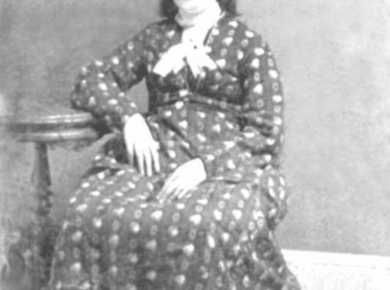
 Sarah Ann Franks was born 9 May 1832, at Shepshed, Leicestershire, England, to Joshua Franks and Sarah Stanley, the third of nine children. She was not able to receive much education as she had to work at a young age to help support her family. Sarah was a “very attractive girl with dark curly hair and dark eyes.”
At the age of 16 years, Sarah heard the preaching of the Mormon Elders and made the decision to be baptized a member of The Church of Jesus Christ of Latter-day Saints. She was baptized by Elder Henry Allgood in April 1848. Because her parents objected, she had to leave home. She began working in the Cotton Hosiery Factory in Leicestershire, saving money to emigrate.
When her father died in 1853, she returned to her family. Eventually Sarah helped bring her mother and sisters into the Church, though she was the only member of her family to emigrate in 1856. Ambitious, enthusiastic, and full of faith, she left Liverpool, England at age 24 with George W. Padley, age 20, and good friend, Ann Penn Malin, on 25 May 1856 on the ship Horizon.
George Padley was born 28 December 1835 in Gainsborough, Lincolnshire, England, the ninth child of John Padley and Mary Clark. George’s father and mother joined the LDS Church in England on 16 September 1849. George was baptized on 20 Dec 1850 by his father. He was ordained a Priest on 2 June 1853 by Charles Curtis and an Elder on 22 April 1855 by John Oakey. George worked as a tailor and met Sarah while attending church.
Sarah and George were engaged to be married when they left England. Four other couples who were emigrating together were married during the voyage. Sarah and George, however, were waiting to be married in Salt Lake City and were determined to wait to receive their endowments and eternal sealing in Salt Lake.
After arriving in Boston on 30 June 1856, Sarah, George, and Ann made their way to Iowa City, Iowa by wagon, ship, and train. Ann joined the Hunt wagon company where she was employed as a cook. Sarah and George joined the Martin handcart company. Sarah traveled with a family and their five children as a nanny.
Samuel Openshaw, a fellow traveler in the Martin company wrote in his journal;
“We started about 7 o’clock this morning [26 July 1856 from Iowa City] and traveled through a beautiful country, where we could stand and gaze upon the prairies as far as the eye could see, even until the prairies themselves seemed to meet the sky on all sides, without being able to see a house. I thought how many thousands of people are there in England who have scarce room to breathe and not enough to eat. Yet all this good land is lying dormant, except for the prairie grass to grow and decay.”
Sarah and George were known as the “sweethearts” of their company as they traveled along, doing much talking and planning of their future home in Salt Lake. When the company reached Fort Laramie the expected supplies were not there and rations were cut. When the company reached the North Platte river crossing in mid-October, winter storms halted the company at Red Buttes near present-day Casper, Wyoming. John Jaques of the Martin company wrote;
“On the 19th of October the company crossed the Platte for the last time. That was a bitter cold day. Winter came on all at once, and that was the first day of it. The river was wide, the current strong, the water exceedingly cold and up to the wagon beds in the deepest parts, and the bed of the river was covered with cobble stones. Some of the men carried some of the women over on their backs or in their arms. The company was barely over when snow, hail, and sleet began to fall, accompanied by a piercing north wind.”
George spent most of the day helping to ferry people and handcarts across the icy river and consequently developed hypothermia. Shortly afterward, Sarah became so weak and ill with chills and fever that she collapsed and had to be dug out of a snowdrift as reported by Thomas Dobson, an 18-year-old boy in the Martin company.
In the approximately 60 miles between the Platte River crossing and what is now Martin’s Cove, George struggled on but became very ill, developed pneumonia. He was carried across the Sweetwater River into the cove on 4 November 1856. Just prior to his death, George approached Mary Taylor, a 31-year-old widow in the company and said,
“Mary, I feel so weak. Will you make me a little gruel?”
She said that she would, but her feet were frozen so badly that the captain of their group insisted that George get his own fuel to make enough fire to prepare the meal. George did gather the fuel and Mary made him some gruel. George drank it and retired to bed and died sometime during that night.
Sarah was devastated on learning George died. She took her long-fringed shawl that her mother had given her as she left England from her own cold body and had the men wrap George’s body in it and suspend it from a tree. Here it was hoped George would be protected from wolves and hopefully buried by others when a deep enough grave could be dug.
Sarah, too weak to walk, rode in one of the rescuer’s wagons to Salt Lake, arriving on 30 November 1856. When she arrived in Salt Lake and learned that in the spring a party would be going back to retrieve supplies left behind, she asked them to find George’s body and give him a proper burial.
But, when they went back to the cove the only thing they found was the shawl in the tree, completely undisturbed, not torn or ruined. They brought it back to Sarah and her family has it still today. It was assumed that Sarah’s pleadings for the protection of her sweetheart’s body were answered with George being resurrected.
Sarah with frozen fingers and toes was taken to the home of Jacob Butterfield to convalescence. Jacob Butterfield along with at least ten other men including Thomas Mackay were called by Brigham Young to settle the west side on the Jordan River and develop an crop irrigation project. One day as Thomas Mackay’s wife Ann was making her regular visits, she called at the home of Jacob Butterfield and met Sarah Franks and heard of her illness and trials on the plains. Ann took Sarah into her own home and nursed her back to health. The following year on 19 April 1857, Sarah became the third wife of Thomas Sloan Mackay.

Sarah’s husband was a farmer, stock raiser, and although they experienced hardship, he was successful in building up one of the finest farms in West Jordan. Sarah became the mother of nine children, Elizabeth Ann, William, George, Emma, Samuel, Sarah Ellen, Daniel, Joshua Arthur, and Clara. Sarah and Charlotte’s (second wife) families lived together in a new adobe house on the west end of the farm near Redwood Road.
The first wife, Ann, remained in her own home with her children. They all loved each other as though they were full sisters. Thomas Mackay spent a great deal of time with sheep and cattle which were run on the open range. The families raised wheat, alfalfa, potatoes, corn, and various vegetables.
Sarah and Charlotte divided the work with Sarah assuming the responsibilities inside the home, such as the cooking, mending, sewing, and general housework. Charlotte took over the raising of the chickens, turkeys, pigs, and cows. Sarah often took her freshly churned butter, packed in a basket of fresh cool grass, or leaves, into Salt Lake City to regular customers, walking eight miles each way.
The children often told of how their father loaded up the wagon with potatoes, corn, wool. etc. and took it into the tithing office. Many times he exchanged his farm products for shoes, bolts of cloth and woolen materials for clothing. Sarah often related how she used to wash the grease from the wool and card it so that it could be spun into yarn, or made into quilts and clothing. During the winter months. Sarah and her daughters knitted the woolen yarn into mittens, socks, stockings, gloves, mufflers and underwear.
Sarah was a devoted and thrifty wife – very generous but never wasteful. Remembering the days of hunger while on the plains, she would often say to her children and grandchildren, “Waste not shall want not.”
After her husband’s death, the farm was divided. A brick home was built for Charlotte and her children. Sarah remained in the old home until all of her children were married and then moved in with her daughter, Elizabeth Ann Richardson, in the Grant Ward, south of Murray City. She was received as a member of the Grant Ward, March 16, 1902, where she became a member of the ward Relief Society. For many years, she visited with her children and grandchildren.
She was particularly interested in each child, and in greeting them she would raise up her hands and say “Good Lock-a-daisy! You are growing so big,” or “You are getting prettier each time I see you,” and then give a hug and kiss to each one. She always made one feel happy to be near her. One of the joys of her visits was prevailing upon her to cook, using her special English recipes.
She had many wonderful stories and experiences to tell of her early pioneer life. She would sing an old handcart song, “Some must push and some must pull as we go marching up the hill-until we reach the valley O”. As she spoke of her past, she never gave the impression that she would change any part of her life if it were possible to do so.
Sarah passed away at age 78 in the home of her daughter, Elizabeth, on 31 January 1911. She is buried in the Salt Lake City Cemetery.

The Rest of the Story
With Sarah’s death came the end of the story of Sarah and George for 80 years. In 1991, the people of the Riverton Stake in Wyoming were very busy doing the temple work for the pioneers of the Martin and Willie handcart companies; they called this project the Second Rescue. During this time the stake presidency received about 6000 letters from people and relatives concerning the work that was under way. It is through such a letter that the story of Sarah Ann Franks and George Padley was discovered.
The stake received a call from a woman in Rexburg, Idaho asking for their help in finding the name of the fiancé of her great-grandmother, Sarah Ann Franks. In searching the Horizon’s log, researchers found Sarah Ann Franks, a single woman traveling as a nanny but there was no information about a young man traveling with them.
Four weeks later Stake President Lorimer received a letter from a man in Johannesburg, South Africa asking about his relatives. Enclosed was a copy of four pages of his great-grandfather’s journal. As Lorimer read the pages a single line jumped out a him. It read, “Sarah Ann Franks is betrothed to George Padley.”
In 1997 President Lorimer and his counselors of the Riverton Wyoming Stake had a special visitor. President James E. Faust visited Martin’s Cove and was told the story of Sarah and George. Tears rolled down President Faust’s cheeks as he listened to their story. With a tear in his eye he said it had to be one of the great love stories of the western migration.
Finally he asked, “Did you seal Sarah Ann Franks to George Padley?”
President Lorimer said no, they couldn’t. She had been sealed to Thomas Mackay. She had children with him and they were sealed to her.
President Faust said, “You go back to the Logan Temple and seal Sarah Ann Franks to George Padley. You give her a choice.”
At that time, this sealing could not be done without special permission from the 1st Presidency. A woman could only be sealed to one man. It has been changed since then for certain situations.
The sealing was accomplished and Sarah is now sealed to Thomas and George. It is unknown how this will all work out in the eternities but President Lorimer said that he knows that Sarah loves George and that he loves her and her children. He knows that the only reason they were not sealed for eternity was because George gave his life to save the lives of other people in his company.
That was the end of the story again…for a while. In the year 2000, President Lorimer received another letter. It was a copy of Sarah Ann Franks Mackay’s Patriarchal Blessing.
In it was a tremendous promise. Sarah did not receive her Patriarchal blessing until she was 72 years old. She had raised a good family, she had been endowed and sealed in the Temple. There were no other temple ordinances that she could have received yet this is what the Patriarch told her in the blessing:
“Sarah, you will be allowed the privilege of returning to the House of the Lord and receiving the ordinance that awaits you.”
How could that Patriarch have known that 93 years after the blessing was performed, Sarah would be given the opportunity of being sealed to her first love, George Padley, in the Temple of the Lord?


 Brother Joseph