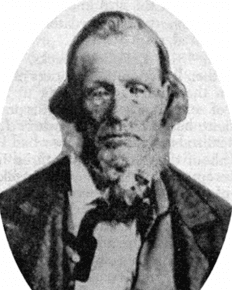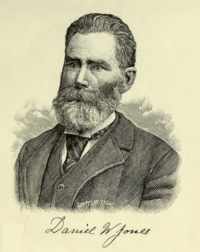
JONES, Daniel Webster

0 1
Read Time:2 Minute, 38 Second
This article originally appeared in Vol.60, No.1 2013 issue of Pioneer Magazine

Daniel Webster Jones was born August 26th, 1830, in Booneslick, Howard County, Missouri. Orphaned at the age of 12, he joined a group of volunteers to fight in the Mexican-American War in 1847.

While camped along the Green River in 1850, his pistol went off in his holster, piercing through 14 inches of his groin and thigh. His companions left him, lame, but alive, with a Mormon settlement in Provo. There, he studied Mormon doctrine and was baptized by Isaac Morley on January 27th, 1851.1 The next year he married Harriet Emily Colton, daughter of Philander and Polly Colton.

In the October 1856 general conference Brigham Young informed those gathered that a group of Latter-day Saint immigrants were stranded on the plains of Wyoming. These were the Martin and Willie handcart companies, as well as the Hunt and Hodgett wagon companies. The next day, about 25 men departed from the Salt Lake Valley to find the immigrants.

The company found the Willie Handcart Company near South Pass. After reaching Devil’s Gate, they still hadn’t found the other groups, and Jones, Joseph A. Young and Abe Garr were sent ahead to find the missing parties and help them in to the Devil’s Gate area. After assisting them to a spot now known as Martin’s Cove, it was determined that Jones, Thomas Alexander and Ben Hampton would remain behind with the goods cached at Fort Seminoe, together with 17 teamsters detailed from the Hunt and Hodgett wagon companies.

During that winter they endured terrific privations, which Jones later detailed in his autobiography.

In 1874, Jones was commissioned by Brigham Young to translate selections from The Book of Mormon into Spanish in preparation for a missionary expedition into Mexico. This he did, with the assistance of Henry Brizzee and Milton Trejo, a recent Spanish convert from the Philippines. Following the translation, the company, including James Z. Stewart, Helaman Pratt (son of Parley P. Pratt and father of Rey L. Pratt), Wiley C. Jones (Jones’s son), R. H. Smith, Ammon M. Tenney and Anthony W. Ivins (who would later become an Apostle and First Counselor in the First Presidency) departed for Mexico. The mission lasted from 1875 to 1876.

Upon returning, Jones was commissioned by Brigham Young to start a settlement in the Salt River Valley of Arizona. Originally called Jonesville, the settlement was later renamed Lehi and was eventually incorporated into Mesa, Arizona.

After some conflict with the other settlers, Jones moved to the Tonto Basin area, where his wife and youngest child were killed when a shed fell on them during a storm in 1882. In 1890 he published his autobiography, Forty Years Among the Indians. He died on April 20th, 1915, of gangrene after an accident and was buried in the Mesa City Cemetery.2 He was 84 years old.


Excerpts from “Daniel Webster Jones (Mormon),” Wikipedia, www.wikipedia.org

1 Daniel W. Jones, Forty Years Among the Indians, 1890.

2 Jim Walsh, “Mesa Cemetery preserves history one plot at a time,” Arizona Republic (October 5, 2010).

Happy
Happy
0 %
Sad
Sad
0 %
Excited
Excited
0 %
Sleepy
Sleepy
0 %
Angry
Angry
0 %
Surprise
Surprise
100 %
You May Also Like

MOLEN, Jesse: The Life and Struggles

Upon arrival in Salt Lake City they had very little food or other provisions. They were required to subsist on plant roots to supplement the little other food they had. The next year they experienced the cricket infestation and lost most of their crop. The rigors of the struggle to travel west plus chills and other conditions had taken their toll on Jess’s health.
View Post

JOHN, Thomas & Margaret Thomas

The first three nights on the trail were spent on the banks of the Elkhorn River, which was not far out of Winter Quarters. The river had many fish in it and some of the company fished a good deal while camped at that location. Others spent time harvesting grapes which were in abundance along the banks of the river. The company saw many buffalo herds and abundant antelope, deer, and elk along the trail. They only harvested one buffalo, but had many deer and antelope along the way. This journey was made before the white man exterminated the buffalo by shooting thousands and then leaving the carcasses to waste.This was not the end of the influence of the white man. Henry John documented the following: “The horse and the cow were soon to take the place of the buffalo; sheep were to replace the elk, deer and antelope. Domestic fowl claimed the place of the wild turkey; grouse and little prairie dogs were given wheat saturated with poison in order to move them out of the way so fields of grain could be raised. Wild plums and bending branches of wild fruit were to be rooted up and the more luscious fruits- peaches, pears, apples and others- were to take their place. The Indian wigwams were to be moved; white man’s cottages and beautiful residences were to take their places (2).” Henry Miller had a very stern reputation and lived up to that reputation on this journey as well. When the company came to the Green River, Captain Miller told them all to get out of the wagons and ford the stream on foot. The river was ice cold and one old man that had been very sick and worn out climbed on a mess box that was bolted on the back of a wagon. When Captain Miller saw this, he jumped into the river and pulled the old man off and threw him into the cold river. Twenty eight people died on the trip and many thought a good portion of those fatalities were attributable to Captain Miller’s harsh, unforgiving supervision
View Post

William Henry Adams, Sr.

William Henry Adams, Sr., was one of the first three settlers of Pleasant Grove on July 19, 1850 with Philo T. Farnsworth and John Mercer. He scouted the area along Provo River and came back with his report of straight logs for houses, and rocks for foundations. He surveyed the town site with these two assisting and set his own stakes for forty acres.
View Post

YOUNG, John Ray: Experiences

John R's mother was ill and stayed in Winter Quarters, but John R and his brother Franklin W ( 8 ) left soon after the advanced party, in the Jedediah M Grant Company. In his book John R. states that they were no ones responsibility, but everyones chore boys. It is heart renching to me to picture a sick mother sending a 10 year old son on a 1000 mile treck through wild country with an 8 year old in tow. One morning when they were camped on Hams Fork near Ft Bridger, in what is now Wyoming, a cow was sick and would not get up. John was left behind to try to get her up and bring her to the next camp site. It is terrible to think of the fear he felt as the last dust settled from the wagons as they faded from view. While tending the cow he saw an Indian across the river, and he decided to leave the cow and head for camp. The next morning several men returned to the previous camp site, and found that the cow had been butchered by Soux Indians 'on the war path after Shoshones', This band raided Ft Bridger, but left the Mormon train alone except for one sick cow.
View Post

ALLEN, Albern

A court-martial was held by the officers and priests, and without being heard in their own defense, the brethren were sentenced to be shot on Friday morning on the public square in Far West, in the presence of their wives and families. At this unprecedented action General Doniphan objected, saying he would have nothing to do with such cold-blooded actions, and he would draw off his brigade from the army. This probably saved the lives of the prisoners, as the sentence was changed and the prisoners were taken to Independence, Jackson County (3).”
View Post

FERRELL, Maggie Anna: A life history

At Pueblo they laid over for a day and a half to wait for another train to come through the mountains. The mountains were so steep that the only way to get the trains up over them was to put one engine on front and the other on back (one to push and one to pull) up the steep hills and then to hold them back as they went down the steep grades. Maggie was very frightened of the mountains and very homesick. When they were on the high ridges where Maggie could look down into the canyons she was very sure that they would fall down into them. The high mountains did not look very beautiful to the little fifteen year old from the low rolling hills of the Bluegrass country of Kentucky, and Tennessee and Illinois. She was very thankful when they reached Salt Lake City and the long trip was over.
View Post