TIDWELL, William Henry

0 1
Read Time:1 Minute, 1 Second
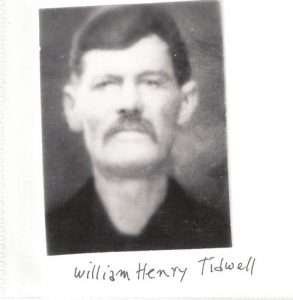
William Henry Tidwell
(1860-1928)

William Henry Tidwell, farmer, son of James H. and Emma, was born in Mt. Pleasant, July 18, 1860. His father came to Utah in 1851, crossing the plains in an ox-train, and located at Pleasant Grove. The family removed to Mt. Pleasant in 1859. Father took part in the Black Hawk war, being one of the home guard. He was one of the prominent men of Mt. Pleasant, and died while on a visit to his son in Carbon county, September 3, 1897. He was a consistent Latter- day Saint, having joined the church in Nauvoo. William H. removed to Wellington, Carbon county, May 10, 1894, and bought a farm of 120 acres, where he was engaged in farming, and was one of the representative citizens of the town. He was accidentally thrown on a circular saw, while running a mill, September 3, 1895, and sustained severe injuries, leaving him crippled in the left hand. Was married to Ana, daughter of Moses and Rachel Draper, born in Moroni, May 11, 1865. They have eight children: William H., Ada M., Myrtle, Mary E., Rachel, Dennis; James L. and an infant.

Happy
Happy
0 %
Sad
Sad
0 %
Excited
Excited
0 %
Sleepy
Sleepy
0 %
Angry
Angry
0 %
Surprise
Surprise
100 %
You May Also Like

HIOTT, John: An Overlooked Pioneer

As far as history is concerned he was a faceless cipher who passed through life leaving few tracks and no one to mark his grave. It is easy to overlook that John and thousands of other forgotten Utah pioneers like him were critical in settling the Intermountain West. They dug the irrigation ditches, herded the cattle, built the shelters, attended meetings, maintained the roads, cut fire wood, tended the ill, mostly followed orders, and buried the deceased without fanfare. The accomplishments of their famous leaders would not have been possible without the blood, sweet, and tears of humble people such as John Hiott.
View Post

BARLOW, James and Ann Crompton

Ann Crompton Barlow was an English Mormon Emigrant, who felt the desire to bring her three youngest children, John (17), Jane (15) & Joseph Smith (7), to the Utah Territory to gather in "Zion" with the Saints. She was a widow, with meager means, thus was chosen to use the Perpetual Emigration Fund by the leaders of the Manchester Branch.
View Post

BELLISON, James Thomas and Louisa

Before many days, an incident occurred which tells a lot about James' attitude toward draft animals. His granddaughter, Pearl Allen Read, tells of the company coming to a bog of mud in the trail which caused many wagons to get stuck. As each team came to the bog, the Captain standing there would join the drivers in whipping the animals to get them through.When it was his turn, James forbade the Captain. "These are my animals and no whip is to be used on them." Although James' team pulled through the bog successfully, the Captain was angry and thereafter continued to find fault with this independent member of his company.James Thomas' life-long insistence that his animals be treated well was admired by those who knew him and was learned and perpetuated by his children throughout their lives.
View Post

CUNNINGHAM, Elizabeth: True Grit

“My father was a miner by trade and being a man of weak constitution was badly adapted for such a laborious occupation. Consequently, this threw the management of affairs nearly entirely upon my mother, and to speak of her in [a] phrase, I cannot do it better than by saying she was a rustler in the greatest sense of the word.” Elizabeth was the foundation and matriarch of the family. She was the force that carried the Cunningham family from Scotland to Utah."
View Post

PICKETT, John – A Fully Converted Pioneer

In 1861 John and his family were called to move to Gunnison, Utah. Their first home was west of where Gunnison now stands. It was a dug-out near the Sanpitch River. It was located a little distance south of the “Rocky Point”. They soon found that the dug-out was not a good place to live. The first winter was a hard one with a lot of snow. The next spring when the snow melted the ground turned to deep mud. Some of the dug-outs filled with water and their chimneys collapsed. The whole place became a “Hog Wallow” and that is how that part of the valley got its name.
View Post

SMITH, Joseph Johnson

How happy they must have been to be in “Joseph’s City”. But the happiness didn’t last long. Within three months after arriving in Nauvoo, little Mercy became ill and died. Joseph’s wife, Mary, grieved with Joseph, but within two months, she and Joseph became excited again because she was going to have another baby. But again, the excitement was blunted by death as Mary died a week after her baby son, Joseph, was born and baby Joseph died twelve days later. Joseph now was left with just three year-old Caroline. His parents and two sisters and three brothers were still with him in Nauvoo, but how hard it must have been to have sacrificed so much in such a short time.
View Post

Life of James Kippen

Mr. Kippen was a firm believer in the teachings of his church regarding work for the dead, doing work along this line in the temple for members of his family who had died out of the faith of the Mormon Church, believing that by this means he would be able to save their souls. He passed all through the scenes of hardships and difficulties which the settlement of Utah made a matter of history, and during the Johnston Army troubles, he served as a guard in the Green River country and in Echo Canyon.
View Post

Elihu Marcellus Allen

Elihu and his family experienced severe persecution while living in Missouri because of their religion. Elihu executed an affidavit on 18 May 1839 in Quincy, Adams, Illinois itemizing a bill of damages against the State of Missouri for $1,000 for property lost and expenses incurred during the expulsion.
View Post

The Life Story Of Albert Clements And Ada Winchell

Taking the baby's hand from covering his mouth he asked eagerly – "Was President Rigdon there in his place and did he take up the reigns of government and start the good work speeding on with new force & vigor?" "Why do you ask a thing like that, Albert?" Ada questioned, with a look and in a tone that would indicate she almost felt it sacrilege for her husband to have given utterance to such thoughts. "Yes," she continued, "Sidney Rigdon was at the meeting, but he was no better prepared to take the leadership among our people than this baby of ours is.
View Post

ORR, Robert Ustain: A Short Biography

Robert Orr was quite the character on the stage, taking mostly comedy roles. Adept at showing the humorous side of life, he was a good pantomime and had plenty of chances to use his talent. When they were able to have a stage curtain made, he was in charge of running the curtain up and down and kept the coal-oil lamps all clean and filled. The first play they put on was called "Ten Nights in a Bar Room", which Robert had a part. This play was a favorite for many years and they played it at the opening of each season. They also took their plays over to Camp Floyd, Eureka and Tooele.
View Post