 0
0
 1
1
This article originally appeared in Vol.58 No.2 (2011) issue of Pioneer Magazine
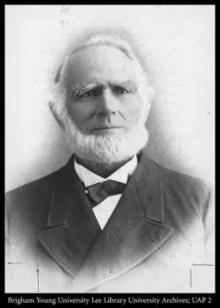
Abraham Owen Smoot was born on Feb. 17, 1815, in Franklin County (later Owen County), Kentucky. His father, George Washington Smoot, was a physician and attorney. His mother, Ann Rowlett, was from Prince Edward County, Virginia. [Abraham] was named after his mother’s uncle, Abraham Owen, an aid to General (and future president) William Henry Harrison. A. O. Smoot’s father died when Abraham was nine years old and his mother later married Levi Taylor.
In 1828 Smoot moved with his family to Benton County, Tennessee, where seven years later he became a member of the Mormon church. Soon he was placed in charge of a small LDS congregation, where he remained until February 1836. Later he accompanied Elder Wilford Woodruff on a short mission in Kentucky and Tennessee. After completing this mission, they traveled to Kirtland, Ohio.
In 1838 Smoot traveled with other Saints to Far West, Missouri. With a surveyor he laid out the town of Adam-ondi-Ahman. Angry mobs captured A. O. Smoot, and along with other Mormons he spent time in jail.
After leaving Missouri, Smoot moved to Quincy, Illinois and then Nauvoo. There he helped build the temple and was one of the first to conduct temple ordinances. He went on another mission in the South and prepared members for the trek west. Smoot led a company that left Nauvoo and traveled to Winter Quarters.
After arriving in Utah, he became the bishop of the Salt Lake Fifteenth Ward. He was named the first territorial justice of the peace. He held this position during the turbulent years of the California Gold Rush and thus heard many cases. He also captained a wagon train of supplies and merchandise to the Salt Lake Valley, the first to cross the plains for this purpose.
In 1852 Smoot was sent to England to bring the first party of Mormons from England using the newly formed Perpetual Emigration Fund. He arrived in the Salt Lake Valley in September 1852.
After the death of Jedediah M. Grant, the first mayor of Salt Lake City, Smoot succeeded him as mayor, serving 10 years without salary.
In Provo there were major problems by the beginning of 1868. Both the civil and Church administrations were in a “disturbed and weakened condition.” A good indicator of that disunity was the petition to the Territorial Legislature to divide Utah County into two counties. New leadership was needed. Thus on Jan. 31, 1868, Brigham Young nominated A. O. Smoot to be a bishop and mayor of Provo and president of the Utah Stake. He held the latter position for the remainder of his life. He was elected mayor of Provo on Feb. 10, 1868, and held that office until the end of 1881.
Mayor Smoot was responsible for many projects during his administration. One of his first undertakings was to build a road connecting Provo with Heber City. He organized the first cooperative mercantile store in Utah County in 1869 and later the Provo Woolen Mills. He was one of the organizers of the First National Bank of Provo and a principal stockholder in the Utah County Savings Bank. He sent many teams of workers to Lehi to aid in the building of a rail line from Lehi to Provo.

As president of the original trustees of Brigham Young Academy, Smoot rendered one of his most enduring contributions to Provo. For nearly 20 years he fulfilled Brigham Young’s request “to take hold of the school, help it with your influence and call upon people to patronize it.” BYU’s administration building is named after A. O. Smoot.

One of Utah’s most prominent business, political, educational,and Church leaders, Smoot died on Mar. 6, 1895.
Excerpts from David M. Walden, “Biographical Sketches of Former Mayors of Provo, Utah: A Report to the Provo Municipal Government,” Oct. 1, 1990, 27–30.


 Brother Joseph