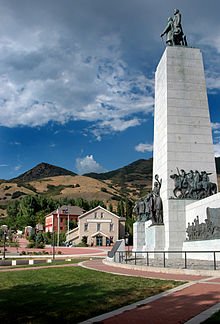
| As we near the usually time for the SUPer-DUPer Day at This Is the Place State Park, it is appropriate to review some history of the monument, the work of Mahonri Mackintosh Young, grandson of Brigham Young, around which the Park came to be and for which the park is named.
Mahonri Young was born in Salt Lake City on August 9, 1877. A few days later he was taken to his grandfather. President Young, who died August 29, 1877, gave him one of the last blessings he ever gave.
As a youth, Mahonri loved to draw, color, and carve. Being good at it, he left formal school early to study art with James T. Harwood, then he studied at the Art Students’ League in New York. Finally, he attended Julian’s Academy in Paris for four years.
Mahonri became proficient in all art mediums, but was most known as one of the best sculptures from the Intermountain West. Among his best-known works are several Latter-day Saint Subjects including: The Joseph and Hyrum Smith statues and the Sea Gull Monument on Temple Square in Salt Lake City and what he called “the Big Job,” the This Is the Place Monument.

President Heber J. Grant wrote to Mahonri July 21, 1920 saying the Church was considering a “Coming of the Pioneers,” monument to be placed at the mouth of Emigration Canyon. President Grant warned it may be some time in coming, but promised to do everything he could to assist Mahonri in securing the commission. That assurance was never forgotten by either man.
The project languished until 1929 when the Pioneer Trails and Landmarks Association was organized to promote a suitable monument. In 1933 a committee was appointed by Apostle, George Albert Smith to make preliminary plans.
Because the proposed location for the monument was to be on the Fort Douglas Military Reserve, application was made to former Utah Governor, George Dern, now Secretary of War, for permission, but only Congress could grant approval. When Congress voted yes, the project became probable.
Mahonri spent the summer of 1936 in Utah sketching and conducting historical research. Gradually a design took shape. Five months later he returned to his home in Connecticut, disappointed that “nothing” was being done.
The 1937 Utah State Legislature appropriated some money and a citizens committee was appointed to choose a design and artist. The choice came down to Avard Fairbanks or Mahonri. Mahonri’s design was more inclusive as he felt it would be wrong to limit it to a “Mormon Memorial.” He wanted to include the Donner Party, which pioneered the road through Emigration Canyon, Spanish explorers, William H. Ashley and fur traders, plus native-Americans and other early Utah visitors.
In January, 1939, the two competing models were shown to the committee. Mahonri’s monument was to be 60 by 80 feet, to contain seventy-four persons and one hundred and forty-four objects. The crowning group consisted of Brigham Young, Heber C. Kimball and Wilford Woodruff standing together. This was not historically accurate, but was symbolic and expressed the spirit of the occasion. President Grant defended the symbolism, saying, “We are not erecting a monument to a covered wagon.” Mahonri was granted the commission, but a provisional contract was not signed until June 28, 1941; the final contract for $50,000, until November 1945.
As he worked the model, Mahonri recognized an artistic problem. Seen from the rear, there were six legs with no relief and the legs looked as if it were six stove pipes. He proposed sea gulls flying in the background to avoid the repetition of six legs. Some argued that sea gulls were never seen that far from the lake. Eventually, the change was approved; on July 24, 1947, at the dedication and unveiling, Mahonri delighted in drawing attention to sea gulls circling the monument.
After a six-foot model in clay was approved the work in granite and bronze was begun. The monument was to be neither an LDS Church nor a Brigham Young monument; it was to commemorate the early explorations and first arrival in Utah of permanent Euro-American settlers and their meeting the indigenous people.
Although other phases of the monument were not complete, including the signage, the monument itself was finished, in place and ready for dedication July 24, 1947. Mahonri’s portion of the “Big Job” was done. He was, however, disappointed to have been left off the dedication program. He asked President George Albert Smith if he could speak. President Smith said, “yes.” He then said, “Make it short.” Mahonri replied, “five minutes?” President Smith, said, “no, shorter.” His speech was: “Next month, come the ninth of August I will be seventy years old. This is the greatest day of my life.” The This Is the Place Monument, remained the biggest commission Mahonri ever undertook and he always considered it his most important. |
 0
0
 1
1


 Brother Joseph