 0
0
 1
1

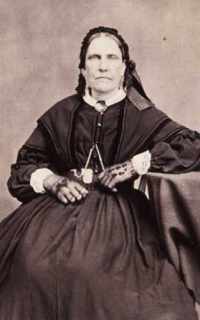
Amanda Melissa Barnes was born in Becket, Massachusetts, a town that saw the births of other early Saints including Eliza R. Snow, Sarah Cleveland, and Amanda’s first husband, Warren Smith. Each family moved independently to frontier villages in the “Western Reserve,” in present-day Ohio. In 1826, Amanda married Warren, and they had five children.
She joined a Disciples of Christ congregation led by Sidney Rigdon and Orson Hyde. In 1831, Amanda and Warren joined the restored Church, for which some family members and townspeople denounced them. The Smiths then moved to Kirtland, purchased property, and contributed to the Kirtland Safety Society and temple construction. They lost their land and possessions with the failure of the Kirtland Safety Society and left Ohio to join the Saints in Caldwell County, Missouri, in 1838. On their journey, a mob of armed men stopped the family and demanded their firearms. On October 30, the Smiths camped at Hawn’s Mill. Tragically, this was at the time of the infamous mob attack on the settlement. Amanda, her daughters Alvira and Ortencia, and her son Willard survived the attack unscathed, but her husband Warren and her son Sardius were both killed. Her younger son Alma’s hip was shot away. Desperate for help, Amanda prayed and received inspiration on how to create and apply a poultice to the wound. The joint was miraculously healed, and Alma made a full recovery.
In the aftermath of the massacre, Amanda and her surviving four children remained in the area, having lost everything to the mob. She and other Mormon women held daily prayer meetings until they were restricted from doing so by local antagonists. Every time Mormon opponents threatened Amanda, she verbally defended her family. On a few occasions, she received aid from mobbers, including a butchered hog as “a meat offering to atone for their repented intention” and later, 50 pounds of flour. They also allowed her to retrieve her own stolen horses when she and her family were ready to leave Missouri.
The Smith family made their way to Quincy, Illinois, where Amanda taught school. In 1839, she married Warren Smith (no relation to her first husband), a widower with five children. The blended family moved to Nauvoo where Warren worked as a blacksmith. During this time, Amanda bore three additional children. The marriage took a turn for the worse when Warren became abusive and was unfaithful to Amanda, fathering two children with another woman. She left him in December 1850, a few months after their arrival in Utah. Years earlier, Amanda had felt prompted by the Spirit to be sealed to Joseph Smith. After granting Amanda a legal divorce from Warren, Brigham Young stood as proxy in sealing Amanda to Joseph Smith.
Throughout her life, Amanda participated in numerous Church and civic activities. As a member of the Female Relief Society of Nauvoo, Amanda joined Emma Smith and Eliza R. Snow in 1842 to present a petition to the Illinois governor for Joseph Smith’s protection. In Salt Lake City, Amanda became involved with the Indian Relief Society in early 1854, assisting local Native Americans. She later served as a counselor in a ward Relief Society presidency in Salt Lake City from 1868 to 1879. During the 1870s and 1880s, Amanda was a vocal defender of the Church and an advocate of women’s suffrage. She was remembered as “an indefatigable laborer … among the poor and sick ministering to both their spiritual and temporal needs.”
Amanda lived the final years of her life in Salt Lake City, where she was praised for being a “veteran in Zion.” She took great satisfaction in the faithfulness of her children. Due to paralysis, she moved in with her daughter in Richmond, Utah, where she later died in 1886. Amanda described her life as a “checkered scene of joy and trouble. I have drank the dregs of the cup of sorrow and affliction, as well as partaken of the blessings of an all-wise merciful God.”


 Brother Joseph