 0
0
 1
1
This article originally appeared in Vol.62, No.1 (2015) of Pioneer Magazine.
by Pioneer Magazine

(1848 – 1932)
The following excerpts appeared in the March 1930 issue of the Instructor and were taken from an interview of historian Harold H. Jenson with Isabella Gray Park Kenner:
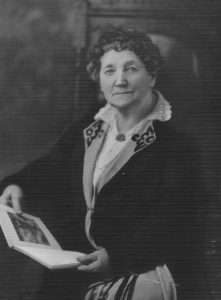
Here is a pioneer story that sounds too good to be true, yet the facts speak for themselves, for Isabella Park Kenner, a Pioneer actress of the old Salt Lake Theater days, holds the distinction of being possibly the only woman who ever took President Brigham Young to a Leap Year ball.
“I am not going to tell you my age, for personally I think that is my own business; but I will tell you a true pioneer story. My father was Hamilton G. Park and my mother Agnes Steele, and he, being an early day educator, gave us children every opportunity. I was particularly fond of dramatic art, music and dancing. I remember the dedication of the Salt Lake Theater, even though I was just a little girl. My parents took me. This gave me my first incentive for appearing on the stage.
“Some of the boys working for the Deseret News conceived the idea of getting up a show of their own and they called their organization The Thespians.’ A Frenchman traveling through stopped long enough to act as their first stage manager and coach. The first play was ‘Luke the Laborer.’ Another was ‘The Dutchman’s Boot.’ Finally, we became more ambitious and gave Shakespeare’s ‘Richard III.’ John T Caine and Hiram Clawson happened to hear about us and finding we were well patronized came to see our performance. They were on the lookout for new talent for the ‘Big Theater.’
“Brother Caine and Brother Clawson selected him and a few of us for the ‘Big Stage’ as we called rt. I played one of the witches in ‘McBeth’ as my first appearance there. finally they gave me ‘Madame De Dom Blue’ and I wore for this part a pink velvet dress and spoke several lines. Critics said of my work in a review that ‘Miss fork has considerable talent, and will make a mark.’
“While on the subject of the Salt Lake Theater, let me say President Brigham Young kept alive interest in dramatic art by lending every effort to it. Particularly was he careful to see that all the young ladies in the company were properly escorted home at night. Often he sent his private carriage for us, and many a time put it at the disposal of a visiting star. Often he would drop in at rehearsals and lend an encouraging word, lo him great credit is due.
“The Social Hall is also dear to my memory, for here is where the real thrill of my life occurred. A leap year ball was to be given there, and the ladies of Salt Lake had to escort the gentlemen and no wife was allowed to take her own husband. The committee consisted of Mrs. Joseph A. Young, Mrs. Brigham Young, Jr., Mrs. Amelia Folsom Young, Mrs. Charlotte Cobb, Mrs. William C. Staines and Mrs. Hamilton fork, my mother. They met in our parlor to plan the event. I heard them, after much consideration, say that Nellie Colebrook, who had just returned [from the] east and had gained popularity as a celebrity, would be the logical lady to escort President Young. In fact, they were in quite a quandary as to who should have this honor. They decided they would go as a committee and escort her to President Young. Tickets were to sell at $5.00, with extra gent 35 cents.
“From devilment or, I know not why, all of a sudden a mad desire seized me to ask President Young myself. I rushed out of the door and went to the Lion House, cutting off through the orchard, running as fast as my young legs could carry me. I arrived breathless at the door and Mrs. Lucy Young met me, and said, ‘What can I do for you Belle? you look like you must have something important on your mind?’
“‘I have,’ I responded, ‘I must see President Young immediately.’
“She ushered me in and the President said, ‘Well Belle,’ for he knew both me and my parents well, ‘what can I do for you?’
“‘I have come to invite you to the Leap Year Ball,’ I answered.
“‘Well Lucy, he said, ‘I’ve heard a lot about this ball and concluded I was going to be a wall flower. Bring your carriage young lady to my door and I will be ready.’
“The night of the ball arrived. Everyone was wondering who would be President Young’s partner, as he had firmly but politely stated in response to all inquiries, he had already accepted an invitation.
“We had no carriage, so President Young came with his. He asked my mother if she also was ready and who mother would betaking. She replied Brother Park, my father. Mother answered he would not go with anyone except her. ‘Well, leave him home, then,’ the president replied. At last, as an extra gent was allowed, he took my parents, who were speechless to think of what I had done, but they said nothing.
“You can imagine the feelings of a seventeen year old girl with this honor of escorting the president. I had never before worn kid gloves and said to President Young that I had never worn them, and was hoping he would suggest I didn’t need to. He replied ‘Put them on; you must learn to wear them if you are to be a lady.’ I did and enjoyed the evening of my life. All eyes were focused on us and the most surprised were the committee in charge. Brother Golightly was the chief for all Social Hall affairs and served an elaborate banquet, as, in those days, dinners shared equal honors with the dance. The wee small hours saw the close of the festivities, with President Young escorting both me and my parents home and thanking me for a very pleasant evening.
“He had learned what I had done to thwart the committee, yet he wisely said nothing.
“Several ladies had brought two or more gentlemen, so father felt better about it.
“This was not the case with my mother, for as soon as I was home, a juvenile court started. The party had been a big success and this, coupled with the fact of my youthful age, made forgiveness an easy matter with the rebuke I must never do it again and I promised I never would. I received a good scolding and the committee held an indignation meeting, but mother smoothed things over.
“Later I attended many balls, and President Young often joked about the young lady who had courage to do what she did.
“I attended ward schools in my youth and later my father’s school held where the Deseret News building now is. My early marriage cut short my stage career, but I was not sorry for my husband, Scipio Africanus Kenner, and my children doubly repaid me for my sacrifice.
I think a career is a good thing, but marriage is greater, for when one is old she can look back on one with joy while often on the other with only regrets.”
The writer must close with a personal visualization of the parting picture of this good old lady, who, in saying good-bye, picked a flower and put it in his button hole, with the statement “it is better to give the flowers before rather than after.” There is a lot of truth in this statement.
The perfect day ended with the last rays of the sun kissing the petals of the flowers in this old fashioned garden and reflecting a halo around the silver head of this Thespian of other days. When the final curtain falls for her it can well be said she played her part well and will justly deserve the praise that shall follow a useful life in devoting her talent for the service of others.


 Brother Joseph

 Pioneer John