 0
0
 1
1

I was just twenty-one when I volunteered at the call of Abraham Lincoln to keep open the line of communication between San Francisco and Omaha. Father was well to do and could furnish equipment for his sons at any time; therefore I was always ready to go to protect the people against the Indians. When we were at Fort Bridger, Gen. James Craig with three or four hundred regulars lay encamped there.
Col. Collins approached Captain Smith one day and said, Captain (Lot) Smith I would like to try a test and see whether your men or mine are best adapted to remain here in the West to protect the mail line.
Colonel Collins ordered a detachment of his men, double quick time up the side of a mountain and down again. The Eastern soldiers were unacquainted with Western life. They went up and came down in great confusion. The Lot Smith men came down in perfect order; we were used to just such places, we gave our Indian ponies the reins, and the horses of themselves avoided the sage brush and gopher holes.
Col. Collins remarked, “Captain Smith, I would rather have ten of your men than my whole regiment. We will send the Eastern men to the front.” When his men heard that they were to be sent back to the front, a number of them deserted and made their way towards the Pacific Coast.
During the Snake River expedition, twenty horses gave out because of the strenuous pursuit after Indians. Lot Smith commanded Lieutenant Joseph S. Rawlins to return to Fort Bridger with the twenty horses and their riders.
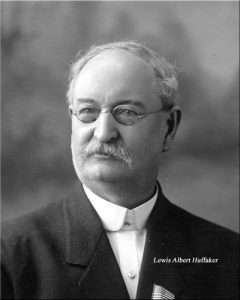
Louis A. Huffaker was with those who returned to Fort Bridger, whose horse had given out; Lieutenant Joseph S. Rawlins command. As we were returning the company decided they were lost. In telling of the incident, Louis A. Huffaker says, “The animal which I rode was a large, flat-footed horse who had been in the mountains with me for years. I could trust him to find his way. I gave him the reins and he immediately diverged from the path which we were taking.”
He went on for some time until I was finally overtaken by several of the company who declared they had orders from Lieutenant Rawlins to tell me that I was lost and must return to the company with them. That if I would not go willingly they were to bind and carry me back by force. I felt that the direction I was taking was the correct one and begged them to go on with me to the next clearing where we would doubtless discover our location. They complied with my request as it was not yet dusk. They followed me until we came to a clump of large, dry Cottonwood trees.
We recognized this place as the spot where we had previously camped. Here we discovered the remains of the beef the Indians, which we were pursuing, had so hastily abandoned. I rested on my saddle until my comrades returned, piloting the others to me. After this we progressed nicely and soon arrived at Fort Bridger.
One later afternoon while off duty, I was enjoying myself jumping and turning handsprings, when Lieut. Rawlins suddenly called to me and said, “Here, Huffaker, guard this prisoner until I return. I will be back in a few minutes. He gave me a gun cocked. “If he turns over in his bed, kill him. He is an escaped prisoner,” he said.
I was perspiring freely from my previous exertions, without coat or hat. The sun went down presently and it became very cold. It was one o’clock that night when Lieutenant Rawlins came back to relieve me. You can imagine the cold I caught.
After our release, Lieutenant Rawlins and I returned to Salt Lake City in company with each other. He was a large man. His horse gave out. He could not endure to walk. I walked and allowed him to ride my horse. Lieutenant Rawlins thanked me and said,
“If it had not been for you, my bones would have bleached upon the plains.”
One day, Sol Hale, a big, strapping giant, went up to Captain Smith and said, “I’ll bet you $5.00 I can throw you in the river, Captain. But you’ve got to give me three trials. The Captain sized Sol Hale up a moment and said, “Do you suppose I want to get thrown in the river three times, Solomon Hale?”
When the Lot Smith Company met the regular army near Fort Bridger we were given a portion of the liquor in their possession. We remembered the injunction of Brigham Young to leave liquor alone. We removed the corks from the barrels and allowed the liquor to run out on the ground. Col. Collins coming up and seeing what had taken place was much astonished. He said to Smith, “Aren’t you a drinking man?”
Lot Smith said, “No, Sir.” Col. Collins exclaimed, “Then take down your sign.”
Told by several of the comrades who explained that Lot Smith was of a sandy complexion with a florid face and somewhat red nose.


 Brother Joseph