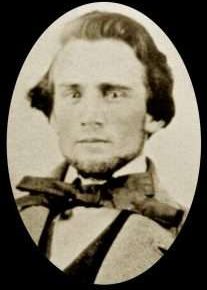
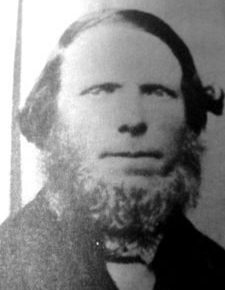
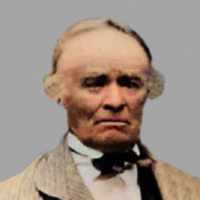
Submitted by John Elggren, Great-Great-Grandson of Benjamin Franklin Lewis
Sanford Bingham, first son of Erastus and Lucinda (Gates) Bingham, born in Concord, Essex, Vermont, 3 May 1821. He married (1) Martha Ann Lewis, daughter of Benjamin Franklin and Joanna (Ryon) Lewis and (2) Agnes Ann Fife, daughter of Adam and Ellen (Helen) (Sharp) Fife. Martha Ann, whom he married near Grand Island, Nebraska, 18 July 1847, gave Sanford 15 children; Agnes Ann, whom he married in polygamy in Salt Lake, 10 October 1863, gave him 13.
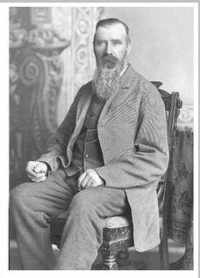
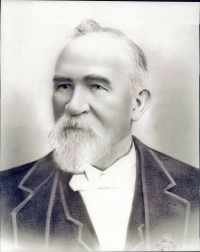
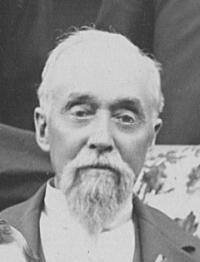
Sanford Bingham, circa 1897
In 1833 at the age of 12, Sanford, along with his parents and siblings, was among the earliest converts to “Mormonism” in Vermont. In 1836, when Sanford was 15, the family began the trek west. They spent the summer near Kirtland, Ohio, then, in the fall, continued to Caldwell County, Missouri. In 1838, after Governor Boggs issued his infamous extermination order, the Bingham’s moved to Hancock County, Illinois. Then, when the exodus from Nauvoo began in the spring of 1846, the family followed the main body of the Church into Iowa and Nebraska (near Omaha), where Sanford’s brothers, Erastus and Thomas, and his brother-in-law, Elijah Norman Freeman, joined the Mormon Battalion. The remainder of the family spent the winter on the Missouri River, 150 miles north of Winter Quarters, then resumed the journey west the following spring. The head of the family, Erastus Bingham, Sr., was captain of 10 wagons in Daniel Spencer’s Hundred. This group, the second company of pioneers to leave the staging area at Elkhorn, started across the plains in June of 1847.
Sanford was born with clubfeet and lived with this condition until he was 24 years old when he commenced to have them straightened, and it was two years or more before he could walk without crutches or a cane. For this reason, Sanford, at age 26, made the trip on horseback, driving the loose cattle. Whether before leaving Elkhorn, or shortly after, he was smitten by an orphaned lass of 14, Martha Ann Lewis, whose uncle, Beason Lewis, was a member of Erastus’s Company of 10. Apostle Parley P. Pratt joined the couple in holy matrimony, a little above Grand Island, Nebraska, on July 18, 1847. Their wedding dinner was cooked over the heat of burning buffalo chips, as there was no wood in that part of the country.
The bride and groom completed the journey to Salt Lake on the groom’s horse. Years later, when other young couples planned their honeymoons, Martha Ann spoke of hers, “as a trip of a thousand miles riding behind her husband over mountains, hills, and plains.” From the cattle they herded, Sanford and his bride supplied the company with milk and butter. Martha Ann explained that they put surplus milk and cream in a churn and tied it to the back of a wagon in the morning, before the start of the day’s journey; then, when they camped at night, they had butter ready for their supper. The Bingham’s reached the Great Salt Lake on September 19, 1847. Said William C. Lewis:
“If my memory serves me right, Sanford Bingham and his bride, my sister, Martha, and Thomas Bingham on horses, and my Uncle Beason Lewis, with his team, led the company into the valley.”
The Bingham brothers and others who arrived on September 19 drew lots in the Second Ward. The Bingham lots were situated in the Northeast Block (commonly known as the Gallacher Block). In the spring of 1848 and again in 1849, Sanford and his brother, Thomas, herded cattle for their family and the public into a canyon southwest of the city in what is now known as Bingham Canyon, named for Sanford and his brother, Thomas. Sanford and his wife spent their summers there, in a little cabin at the mouth of the canyon, tending the cattle and horses. (This cabin has been preserved and is now located in Lagoon in Pioneer Village.) They spent their winters in the Second Ward, with John M. Lewis, Martha Ann’s brother.
Though the Bingham’s discovered several rich mineral deposits in the canyon while tending their herds, Brigham Young discouraged prospecting, for fear that significant “finds” would bring on hordes of infidels. Pres. Young also said it wasn’t time to mine the ore because they needed to continue farming and raising stock, for the people were dependent on these industries. The Bingham family obeyed the prophet. Now known chiefly as a source of copper, the main products of Bingham Canyon from 1868 into the 1890’s were gold, silver, and lead.
In July of 1849, Sanford and his family moved back to Salt Lake. The family remained in Salt Lake until April 9, 1850, when they moved to Lynn, or where Ogden is now, their first home located between 22nd St. and 28th St. They raised grain and potatoes here and Sanford also served as a schoolteacher.
In the spring of 1851, they moved northwest about two miles to Bingham Fort to about 2nd St., which later became North Ogden, for protection from the Indians who were on the warpath at that time. While here, they had a farm, part of which was tillable, and the rest was meadowland. Their farm implements were very crude, and they used ox teams in building irrigation ditches to carry water from the Ogden River to their land. While on the farm, they had some sheep and Sanford would clip the wool from the sheep and Martha Ann would wash, cord, spin, and weave the wool yarn into make clothing for the family.
Sanford was prominent in the early history of Weber County for his service as Constable, Justice of the Peace, and School Trustee. In 1856, the county court appointed him Assessor and Tax Collector for Weber County and Ogden City. Money was scarce and some people paid their taxes with gold dust. He always carried small scales for weighing the gold dust. He rode horseback at his work, sometimes being gone from home for a week, and during that time he would collect quite large sums of money. This he carried on his person and always went unarmed, trusting in his Creator for protection. After the railroad came west and much rough element with it, his wives, fearing for his safety, asked him to get a gun. He did so and carried it with him on one trip, but when he returned home, he put the gun away and never took it again. He continued with this office until the end of 1873.
Because Johnston’s Army was coming, the call came in the spring of 1858 for the Saints to move south. The Bingham’s went south and suffered many hardships along with others. Sanford was sent back after grain that had been left in Weber County; however, they were able to return to their home the first part of August.
In 1862, Sanford relocated with his wife and children to Riverdale, Weber, Utah, a few miles south of Ogden. Here, at the age of 42, he took as his second wife, 17-year-old Agnes Ann Fife, whose father, Adam Fife, had served in Riverdale as first president of the branch church. Sanford himself was named President of the Branch in 1868. To their union, 13 children were born.
In 1868-69 Sanford was Deputy U.S. Collector for the Counties of Weber and Box Elder under R. T. Burton as U.S. Collector for Utah Territory. When Sanford was 55 years of age, he was called on an LDS mission to the Southern States where he served from October 1876 to September 1877.
When the Riverdale Ward was organized in 1877, Sanford was named Bishop, an office he held until released, owing to age and infirmities, on 20 January 1902. At that juncture, having been succeeded as Bishop by his son, Adam A., Sanford was ordained a patriarch of the Weber Stake.
The Riverdale Ward in its early days appears to have been something of a domination of Bingham leadership: Sanford’s wife, Martha Ann, was first president of the Relief Society (organized 1872) and the Primary Association (organized 1879); his son- and brother-in-law, Joseph Fife, was first president of the Young Men’s Mutual Improvement Association (organized 1876), and his daughter, Martha Ann (Bingham) Fife, was first president of the Young Ladies Mutual Improvement Association (organized 1879).
In July of 1897, Martha Ann and Sanford celebrated their Golden Wedding Anniversary by having a family reunion at their home in Riverdale. All of their living children were in attendance, also a great number of their grandchildren and friends.
When the Golden Jubilee of the Church of Jesus Christ of Latter-day Saints was held in 1897 in commemoration of the arrival of the saints in the valley of the Great Salt Lake, both Sanford and Martha Ann, along with other pioneers of 1847, were guests of honor. Every pioneer who arrived in that year was presented with a beautiful gold pin called a Jubilee Badge with their names inscribed.
Sanford lived a good, long, and useful life leaving this earth at the age of 89-1/2 years with a strong testimony of the Gospel of Jesus Christ on November 21, 1910, in Riverdale, Weber, Utah.
(As reported by Mary’s Daughters Mary-Ann McNeil, Alice Gatliff, and Rose Rasmussen,) Submitted by DeLoy F. Johnson About 4 July 1857, William took his four year old daughter, Mary-Ann and…
A canal ran between and divided the 5 acre farm from that of Joseph's father, William. A pleasant pastime of the children was to watch the horses as they pulled the loads of freight and coal in boats along the canal. Locks were located near by and it was such fun to see the boats raised and lowered as they proceeded on the journey to the big cities.
"The usual method of disposing of the dead was to weight the bodies and dump them overboard. When others and I asked the privilege of removing our dead and burying them on land, the Captain was hateful and mean about it. All of my dear ones except Samuel's wife I had to perform this last earthly service for. Others of the party had sustained like losses, and were as anxious as I to bury them as decently as possible. The Captain at last agreed to wait and we hired a Negro to help dig a trench big enough to put them in all together. We removed the dead from the boat and began our heart¬breaking task, but had it only partly done when the boat whistle blew and the boat began to get underway. All ran hastily back except the Negro, one woman and myself. She and I stood at the grave site of our dead and watched them go. What bitterness of spirit I experienced only God knows. Was this what I had come to America, the home of the brave, for? Here I was with two strangers standing beside the open grave of a group of strangers. Our common interests were all lying before us or fast receding from sight, subject to the whim of a heartless thing in human form. "Surges of emotion swept over me, sorrow, anger, love, fear, and despair, but my nearest duty was to protect these rapidly decomposing dear forms of mine from the ravages of wild beasts, heat, and other elements. Perhaps I had been blessed and spared to perform this last service. If! were dead with them our bodies would rot together. So I urged on my companions the need for work. I felt responsible for seeing this thing through.
Born in 1857, B.H. Roberts became a historian, and politician, and would serve as President of the First Council of Seventy. But every famous man was also once a boy,…
[This article originally appeared in the Mar/Apr 1970 issue of Pioneer Magazine.] By Harold Jenson ELIZABETH JANE RUSSELL was born April 28, 1862, in Coventry, England, to Henry and Elizabeth…
One of the first missionaries of the Restoration The earliest missionary of the Church to publicly teach about the Book of Mormon may very well have been Solomon Chamberlain. Even…
A Master Plasterer and his son John Burt Submitted by Alan Turner Many are the inspiring and interesting stories that come through our pioneer ancestors trials and experiences. William Burt…
By Richard D. Kirkham Source: FamilySearch John Brown was a member of Brigham Young’s Vanguard company that entered the Salt Lake Valley on July 24, 1847. He was born on…
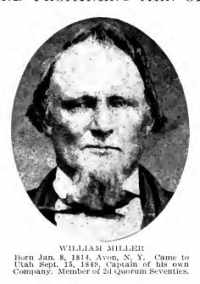
William Miller was born Feb. 8, 1814, at Avon, New York. He started for Kirtland, Ohio, Oct. 12, 1834; remained there three weeks conversing with the Prophet Joseph Smith and…
from History of Utah, Volume IV, by Orson F. Whitney UTAH’S Representative in Congress from March 1901, to March 1903, was the Hon. George Sutherland, of Salt Lake City. He…
Edith Hamlin was born in 1902, in Oakland, California, where she later studied art at the California School of Fine Arts, and she then studied at the Teachers College at…
December 25, 1885. I wish I could have had the privilege of spending Christmas with you at home, but it is our lot to spend it apart. I hope you have spent it in a different way from what I have. We had a good dinner. The warden did the best he could to make the prisoners happy, but when a man’s liberty is gone, he can’t be happy when he has a family at home. I have thought of home the whole day long and so I do every day. I shall never be a happy man if I cannot enjoy the society of those that are my own flesh and blood which my family is. Things look dark to me, but I must hope for the best. God is at the helm
Thomas and his family wanted to go to Utah with the saints, but he didn’t have the money to do so. Thus, their pioneer pilgrimage began on their destitute little farm in Wales with an effort to save money for the journey. It took until 1868 for them to save enough to send Brigham and one of his older sisters to Utah. They sent them off with instructions to save money and help the rest of the family to come. Brigham sailed to the states on the steamship Colorado. If his sister traveled on the same ship with him, it was Elizabeth because she is the only one to closely match name and age (5). The ship carried 600 saints bound for Utah, and was the last of the year. It departed Liverpool on 14 July, 1868 (6), and arrived at the Castle Garden Immigration center of New York on 7 August, 1868 (7) They traveled by train to Florence, Nebraska (another account says the train took him to Wyoming), then walked the last 800 miles from there to Utah because the rail hadn’t been completed to Ogden yet. Records record him arriving in Utah in 1869, so he must have been delayed en-route. Brigham would have been one of the last of the pioneers to walk to Utah before the Golden Spike was driven in Ogden.
In conversation with Bishop Maughan they were advised to try to find a suitable location on the Logan River, and accordingly set out again the 5th of June. They next formed a camp near the site of the old Brigham Young College and here they decided to remain. A survey of the land was immediately begun and the brethren cast lots for their locations. This was the beginning of our beautiful city of Logan, June 1859. Although John Pannell Wright was a member of the second group to locate on the site of Logan in June 1859, he is generally given credit by old historians as having been the father of our city. Apparently it was he who did the first surveying here and who designated the little settlement by the name of Logan. Apparently after Brother Wright and his son had surveyed a few blocks of land, which they did by only measuring with a tape or chain, there was a drawing or lottery for the purpose of acquiring home sites. ) They also helped build a bowery under which they held their meetings. They harvested their grain on Summit Creek (Smithfield). They often carried their guns in one hand and their shovels in the other. They succeeded in yielding good crops, as high as forty bushels of wheat to the acre. Mr. Wright left his tracks in the snow while cutting the last of the grain.
This pioneer history was submitted by Cailyn Bringhurst, a student at Washington Elementary School in Washington, Utah. I was lucky to be able to learn about my heritage through my…
 0
0
 1
1


 Brother Joseph