HARWOOD, James Taylor: Utah Artist

0 1
Read Time:1 Minute, 30 Second

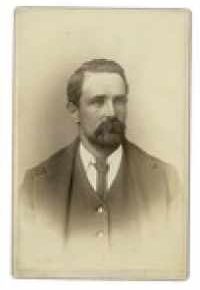
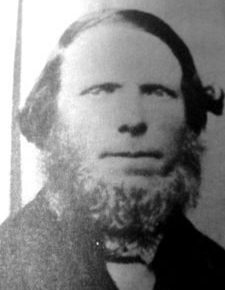
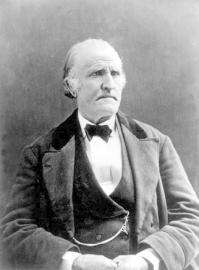
James Taylor Harwood was bom in Lehi, Utah, in 1861, and somehow amid the hard work common of the pioneer life, he nurtured an instinctive love of and talent for art. “During those early years, my pencil worked industriously at every opportunity,” he wrote in his autobiography.

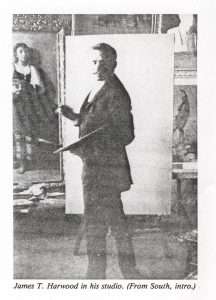
James T Harwood (1861-1940) in his studio.

He felt a need to study and learn, and in 1885, he traveled to San Francisco and enrolled in the California School of Design. In order to be accepted, he had to submit a painting; his submission was a bunch of grapes that his teacher called the “best piece of work every presented there by an applicant.”

After studying for one year in California, Harwood returned to Utah where he opened the Salt Lake Art Academy, In June 1888, Harwood held an auction (he auctioned off more than 100 oils and drawings) and raised money for his training in Europe, By September, he had arrived in Paris, where he enrolled in the Julian Academy, one of the most influential and successful private schools in France, Harwood spent two years studying and learning in Europe before returning back to Utah, where he once again opened a studio in Salt Lake City.

His reputation quickly drew talented and skilled students, some of whom would become the second group of Utah artists to go to France for further education. Thus he led the way for Utah artists to further hone and polish their skills; collectively these early artists left a rich legacy of beautiful pieces that have lasted more than a century and inspired scores of artists to pursue their dreams.


Christ Calling Peter and Andrew, by J.T. Harwood
Happy
Happy
0 %
Sad
Sad
0 %
Excited
Excited
0 %
Sleepy
Sleepy
0 %
Angry
Angry
0 %
Surprise
Surprise
100 %
You May Also Like

MITCHELL, James Jr. & Anne Hull

Up north in the Upper Snake River Valley, the virgin soil was bringing forth bounteous crops. This land could be had almost for the asking, so James took advantage of the pre-exemption rights of the Homestead Act and secured 360 acres of virgin soil just two miles north of Shelley, Idaho. So it was that in 1885, James came to Idaho.
View Post

HINTON, James Maurice: Life Story

I herded those sheep through what they call the Bear Hole. I’d start them through the East side and it would take them ten days to go through. I herded sheep four years for Wilts Imlay on Kolob in the summer and on the Arizona Strip in winter. The wages were $40 a month and board. I’ve got more to show for those four years than any other time in my life.
View Post

WOOD, George Lymer: An Incident in the Life

"The usual method of disposing of the dead was to weight the bodies and dump them overboard. When others and I asked the privilege of removing our dead and burying them on land, the Captain was hateful and mean about it. All of my dear ones except Samuel's wife I had to perform this last earthly service for. Others of the party had sustained like losses, and were as anxious as I to bury them as decently as possible. The Captain at last agreed to wait and we hired a Negro to help dig a trench big enough to put them in all together. We removed the dead from the boat and began our heart¬breaking task, but had it only partly done when the boat whistle blew and the boat began to get underway. All ran hastily back except the Negro, one woman and myself. She and I stood at the grave site of our dead and watched them go. What bitterness of spirit I experienced only God knows. Was this what I had come to America, the home of the brave, for? Here I was with two strangers standing beside the open grave of a group of strangers. Our common interests were all lying before us or fast receding from sight, subject to the whim of a heartless thing in human form. "Surges of emotion swept over me, sorrow, anger, love, fear, and despair, but my nearest duty was to protect these rapidly decomposing dear forms of mine from the ravages of wild beasts, heat, and other elements. Perhaps I had been blessed and spared to perform this last service. If! were dead with them our bodies would rot together. So I urged on my companions the need for work. I felt responsible for seeing this thing through.
View Post

AVERETT, Elisha – A Pioneer and His Fife

HE WOULD MAGNIFY HIS MASONARY GIFTS AND TALENTS. ORSON HYDE CALLED ELISHA TO SETTLE DIXIE AND HIS FAMILY ANSWERED THE CALL AND WOULD CONTINUE TO FOLLOW & MOVE WHERE HE WAS NEEDED…. ELISHA AND TWIN ELIJAH WORKED IN CONSTRUCTING ST. GEORGE, MANTI, AND SALT LAKE TEMPLES AND WERE ALSO INSTRUMENTAL IN BUILDING COVE FORT, KANAB FORT, DIXIE COTTON MILL (IN WASHINGTON, UT.), PIPE SPRING FORT,ARIZONA, HEBER TABERNACLE, AND MANY OTHER HISTORICAL SITES.
View Post

REES, Thomas: Poor Welch Immigrant

Thomas and his family wanted to go to Utah with the saints, but he didn’t have the money to do so. Thus, their pioneer pilgrimage began on their destitute little farm in Wales with an effort to save money for the journey. It took until 1868 for them to save enough to send Brigham and one of his older sisters to Utah. They sent them off with instructions to save money and help the rest of the family to come. Brigham sailed to the states on the steamship Colorado. If his sister traveled on the same ship with him, it was Elizabeth because she is the only one to closely match name and age (5). The ship carried 600 saints bound for Utah, and was the last of the year. It departed Liverpool on 14 July, 1868 (6), and arrived at the Castle Garden Immigration center of New York on 7 August, 1868 (7) They traveled by train to Florence, Nebraska (another account says the train took him to Wyoming), then walked the last 800 miles from there to Utah because the rail hadn’t been completed to Ogden yet. Records record him arriving in Utah in 1869, so he must have been delayed en-route. Brigham would have been one of the last of the pioneers to walk to Utah before the Golden Spike was driven in Ogden.
View Post

HILL, George Washington: Stalwart Convert and Missionary to the Indian People

The missionaries were "to labor among the Indians in Oregon country." They were instructed leave their homes and families and " to settle among the Flathead, Bannock or Shoshone Indians….teach the Indians the principles of civilization; teach them….to live in peace with each other and with the whites;….to settle down….to build houses…" (7) This mission became known as the Salmon River Mission.
View Post

CHURCH, Margaret – Still Giving Her Life

Despite their full-time family and farming commitments, the couple accepted teaching and leadership responsibilities in nearly every church position possible. Further, they encouraged each one of their children in educational pursuits. By 1978 their nine sons and seven daughters had completed a total of 67 years of college. After sending eight of their children on missions, Marge and Lathel accepted a call in 1977 to the Rapid City South Dakota Mission. It was during this service that she was chosen as Utah's Mother of the Year. Following are quotes written for that occasion by two of her daughters:
View Post