WOOLSEY, Thomas

0 1
Read Time:3 Minute, 59 Second

This article originally appeared in the Jan/Feb 1990 issue of Pioneer Magazine

by Thomas A. Woolsey, a great-grandson

It was a sharp, cold winter day in Winter Quarters – Monday, February 15, 1847. President Brigham Young called members of his family and seven of the Quorum of the Twelve to an important meeting in his home. It lasted most of the day. He spoke of the dangers of jealousies, how some members of the church thought the Lord loved them less than other members, how some wondered if the Lord was displeased with them because they hadn’t been given an “important” calling in the church, how many had fallen away from the church because they had fears, uneasiness and jealousies.

He spoke of many things that day – encouraging love and harmony among church members.

Toward evening, tables were set for a feast of thanksgiving. Just as the meal was served, two rough looking men came to the door and asked for an interview with President Young. Their beards were long, their clothing was worn and torn. Their cheeks were palid. But the glow of victory shown from their sunken eyes.

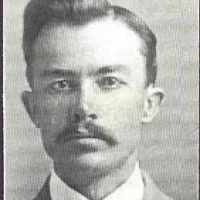
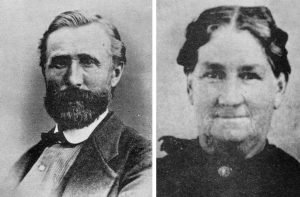
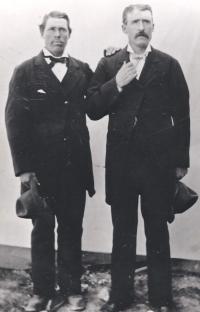
John Tippets, left; Thomas Woolsey, right

They introduced themselves as Thomas Woolsey and John H. Tippets, two of the Mormon Battalion, who had been commissioned in Pueblo to carry messages and money from Battalion members to their families and church leaders in Winter Quarters.

The journey, through freezing wind, drifting snow, and sub-zero days without food or shelter, had covered 600 miles and taken fifty- five days.

A short recounting of this journey gives an insight into the heart and soul of Thomas Woolsey, one of the original pioneers who came to the Salt Lake Valley with Brigham Young in July, 1847.

Two days before Christmas, 1846, Thomas and John left Pueblo, alone and without a guide.

The second day they passed Pike’s Peak. When they awoke in the morning they were under six inches of snow.

The fourth night they camped on Cherry Creek, near where Denver is now located.

On arriving at the South Fork of the Platte River, they decided to follow along the bank, and passed an old deserted Indian village. An east wind blasted their faces and the temperature plummeted. They were forced to take shelter under the bank of the river, where they slept on the ice. The weather was so cold that six inches of the tail of one of their mules was frozen.

Another day in the unmarked wilderness and they found wood. The fire they were able to kindle kept them alive for three days of blizzard and cold.

They killed a buffalo and feasted like princes while waiting for the storm to subside.

When the blizzard abated they continued their journey. The first evening after setting camp, they started for water, but were driven back by a belligerent buffalo who was guarding the water for his herd.

They followed the river to Grand Island, where a group of Pawnee Indian braves attacked them, captured them, and took them to their camp.

The next day the Indians decided to scalp and kill them. Fortunately, the Indian Chief returned to camp and ordered his braves to release them. Thomas Woolsey, in gratitude, later did the temple work for this Indian Chief in the Manti Temple. Shethmalan was the name of the Pawnee Chief.

They crossed the river on the ice below Grand Island, then continued eastward to the Elk Horn River. They packed sand in their blankets and threw it on the ice to keep the mules from slipping, and crossed the thin and treacherous ice in safety.

They were stopped by a band of Omaha Indians. A white man was living among them. Brother Tippets asked him if he spoke English. When he answered ‘yes’, the weeks of deprivation, loneliness and hunger spilled over, and he cried, “For God’s sake, tell us where we are!”

They were sixteen miles from Winter Quarters, where they arrived at dark at President Brigham Young’s home.

There were few such journeys of sheer courage and endurance recorded in the history of the Church. To travel alone, in the dead of winter, and follow a blind trail for six hundred miles was a hard and hazardous challenge.

Thomas Woolsey, in the years that followed, remained true to his trust. He was a member of the Mormon Battalion, a scout for Brigham Young, helped settle Southern Utah, fought and fed the Indians. If he had been asked why he went through all these trails, his actions boldly and humbly would have reflected more than any words could adequately express, “For the Glory of God and the heritage of my family!”

Happy
Happy
0 %
Sad
Sad
0 %
Excited
Excited
0 %
Sleepy
Sleepy
0 %
Angry
Angry
0 %
Surprise
Surprise
100 %
You May Also Like

DURFEE, Edmund

The mob told them to go back. Edmund Durfee hesitated and pleaded for them to allow him to put out the fire and the mob shot him down. They took his body and set it up against some hay and three or four of the mob shot him to make sure he was dead.
View Post

COX, Orville Sutherland

Being successful in disposing of their chairs, and securing loads of bacon and corn, they were almost home when an Iowa blizzard, or Hurricane, or cyclone, or all in one, struck them. Clouds and Egyptian darkness settled suddenly around them. They had no modern "tornado cellars", to flee into and no manner of shelter of any kind. The cold was intense; the wind came from every direction; they were all skilled backwoodsmen and knew they were very close to their homes; but they also knew that they were hopelessly lost in that swirling wind and those black clouds of snow. They and their oxen were freezing, and their only hope of life was in making a fire and camping where they were.
View Post

COOLEY, Andrew Wood: A pioneer devoted to family

December 25, 1885. I wish I could have had the privilege of spending Christmas with you at home, but it is our lot to spend it apart. I hope you have spent it in a different way from what I have. We had a good dinner. The warden did the best he could to make the prisoners happy, but when a man’s liberty is gone, he can’t be happy when he has a family at home. I have thought of home the whole day long and so I do every day. I shall never be a happy man if I cannot enjoy the society of those that are my own flesh and blood which my family is. Things look dark to me, but I must hope for the best. God is at the helm
View Post

ALLSOP, Thomas Hill

STORY COPIED FROM FILES IN SUP LIBRARYWhen more people came to Sandy, Mr. Allsop sold some of his land. Later he donated land for the Church site and cemetary. He gave Sandy a big bowery where large parties could go and dance and have weenie roasts. The bowery, the reservoir and Allsop's Lane was known to all the people of Sandy and surrounding communities.
View Post

JOHNSON, Benjamin Franklin

Every house was a hospital, but without nurses. There were hardly enough men to bury the dead. As Benjamin had cared for the sick at the Kirtland Poor Camp, he knew what should be done and was immediately called upon by Joseph to help. He reported: “I had come to Nauvoo on horseback and as the houses of the brethren were scattered for some distance up and down the river, I kept my horse under the saddle and rode from house to house giving medicines and caring for the sick, and for six weeks did not take off my boots or coat for one night of sleep.”
View Post

Elihu Marcellus Allen

Elihu and his family experienced severe persecution while living in Missouri because of their religion. Elihu executed an affidavit on 18 May 1839 in Quincy, Adams, Illinois itemizing a bill of damages against the State of Missouri for $1,000 for property lost and expenses incurred during the expulsion.
View Post

MAUGHAN, John Harrison & Sarah Mariah Davenport

Mariah learned midwifery from her mother-in-law, Mary Ann Weston, the second wife of colonizer, Peter Maughan. She was set apart for her midwifery duty by Peter Maughan and spent many successful years in this service. She earned little pay except hearty thanks, and brought almost all her patients safely through their ordeal. It was expected that a midwife might be available for other medical service. During a winter epidemic of boils, which seriously afflicted both children and adults, Sarah Mariah had a dream one night in which she saw a blue mold under rose bushes. The next day she and John went to an area where wild roses grew abundantly, scraped away the snow and found the blue mold. They collected a quantity of the substance, brought it home and made poultices which, when applied, completely cured the boils. Later, people wondered if this might have been a form of penicillin. But without question, it was a giftof Divine Providence.
View Post

CHURCH, Margaret – Still Giving Her Life

Despite their full-time family and farming commitments, the couple accepted teaching and leadership responsibilities in nearly every church position possible. Further, they encouraged each one of their children in educational pursuits. By 1978 their nine sons and seven daughters had completed a total of 67 years of college. After sending eight of their children on missions, Marge and Lathel accepted a call in 1977 to the Rapid City South Dakota Mission. It was during this service that she was chosen as Utah's Mother of the Year. Following are quotes written for that occasion by two of her daughters:
View Post

SAVAGE, David Leonard: Indian Peacekeeper

In twenty minutes, he was decked out in war paint and feathers and riding through Cedar Fort giving his terrifying war cries and soon the mountains rang with the death call of these desperate people. They were on the war path for sure, assembling their forces they hid in a ravine near Lehi. When the stage coach passed, the driver and all the passengers were massacred.
View Post