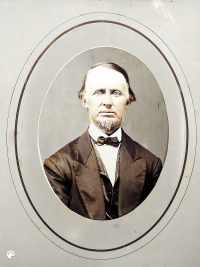
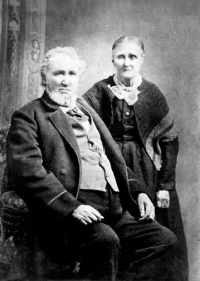
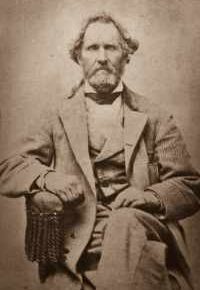
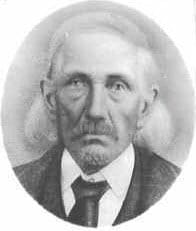
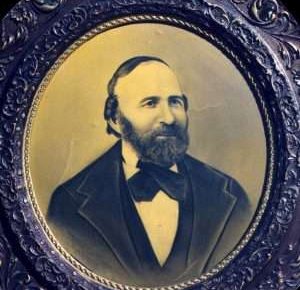
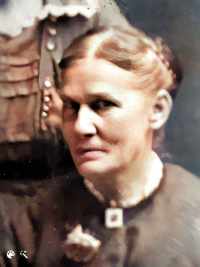
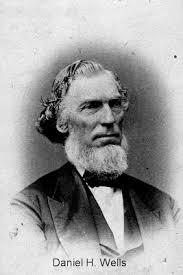
Born October 27th, 1814 in upstate New York, Daniel H. Wells was the grandson of two veterans of the American Revolutionary War. Both his fathers and mothers families emigrated from England to Massachusetts colony in 1635. Daniel received formal education and followed in his father’s footsteps as a farmer. Before reaching the age of 21 Daniel felt the urge to expand his world from the family farm in New York. His father had passed and Daniel along with a younger sister and his mother traveled west, nearly 1000 miles to Hancock County, Illinois. Here he bought land, built a home and farmed. He quickly prospered and within a few years had married, fathered a son and established himself as one of the leading citizens of the new town of Commerce. Born October 27th, 1814 in upstate New York, Daniel H. Wells was the grandson of two veterans of the American Revolutionary War. Both his fathers and mothers families emigrated from England to Massachusetts colony in 1635. Daniel received formal education and followed in his father’s footsteps as a farmer. Before reaching the age of 21 Daniel felt the urge to expand his world from the family farm in New York. His father had passed and Daniel along with a younger sister and his mother traveled west, nearly 1000 miles to Hancock County, Illinois. Here he bought land, built a home and farmed. He quickly prospered and within a few years had married, fathered a son and established himself as one of the leading citizens of the new town of Commerce.
In 1838 life changed for Daniel as it did for all the residents of the town of Commerce and Hancock County. Driven from Missouri, members of The Church of Jesus Christ of Latter Day Saints or Mormons as they were called began arriving as refugees into western Illinois where they were welcomed and helped by those living in the area. The town of Commerce soon became known as Nauvoo and became the central gathering place for thousands of Latter Day Saints. Daniel H. Wells was one of Nauvoo’s business and civic leaders. He subdivided his farm, sold lots to new arrivals on easy credit and quickly became the area’s most prominent “non-Mormon” citizen.
Daniel became a strong supporter of the Latter Day Saints and Joseph Smith and soon after the arrival of the saints to Nauvoo had gained a testimony of the restored gospel but did not get baptized for two reasons. First he felt he could be more useful as a neutral negotiator between the Latter Day Saints and those opposing them in Hancock County. The other reason for his delay was personal. His wife was vehemently opposed to Mormon doctrines and practices and refused to accept the new religion.
As late as August 1846 he was still trying unsuccessfully to persuade her to embrace the restored gospel. Daniel’s wife refused to join the church or to leave her home leaving him with the heart wrenching choice of abandoning his testimony or leaving his home, family and all of his worldly possessions.
On August 9th, 1846 as an armed force prepared to invade Nauvoo and drive the remaining Latter Day Saints out, Daniel Hanmer Wells was baptized and confirmed a member of The Church of Jesus Christ of Latter Day Saints. In so doing he became an outcast from his family, none of whom would ever follow his example. He also became a hunted man, a principal target of the anti-Mormons who would shortly seize the city that he had helped to build. Within days he was driven at gunpoint across the Mississippi river to seek refuge with the Mormon exodus. He left behind his wife, his son, his home and all his land and business interests.
Daniel H. Wells traveled west with the saints and settled in Salt Lake City. He kept busy until his death in 1891. Just a few of roles that he played in his life from New York to the Utah Territory and beyond includes: He was a farmer in New York, Ohio and Illinois and owned farms in Pleasant Grove and Salt Lake county Utah. He taught school in Ohio and Illinois, was Regent of the University of Nauvoo and of the University of Deseret, and Chancellor of the University of Deseret for nine years.
In Nauvoo he served as Constable, Justice of the Peace, and Alderman. He was a member of the Legislator of the State of Deseret and Attorney-General; a member of the legislative Council in the Utah Territory during many sessions, and a member of four Constitutional Conventions. He was Mayor of Salt Lake City for ten years and a member of the City Council for many more years.
He was a military leader in Illinois and in Utah; Major-General and Lieutenant-General of the Nauvoo Legion 1850-1877. He protected the territory many times against intruders and attack and strategically held back Johnston’s Army until a peaceful solution could be reached.
He had interests in manufacturing, mining, and real estate. He established the first gas works in Salt Lake City and was director of the Utah Central Railroad.
Daniel H. Wells served as president of the European Mission twice 1864-1865 and 1884-1887. He was an apostle of Jesus Christ, second counselor to President Brigham Young for twenty years and was President of the Endowment House for nine years. He dedicated the St. George Temple in 1877 and was President of the Manti Temple from 1888 until his death in 1891.
“AND IT IS INTERWOVEN IN MY CHARACTER
NEVER TO BETRAY A FRIEND OR BROTHER,
MY COUNTRY, MY RELIGION
OR MY GOD”
Daniel Hanmer Wells
|
 0
0
 1
1



 Brother Joseph