BAMBROUGH, Annie

0 1
Read Time:1 Minute, 15 Second
Submitted by Paul Bambrough
Joseph Bambrough and Margaret Charlton were coal miners in Northumberland England.  They heard about opportunities in America and in 1864 arrived in Pittsburgh, Pennsylvania.

Annie was born July 3, 1866 – a couple years later, two elders met with the Family – were baptized 1868. The coal company fired Father Joseph and kicked them out of the company’s housing –  thinking the “Mormon’s” were members of a cult.  The family ended up in St.  Louis and joined a wagon train for Utah. Father Joseph and Mother Margaret took turns walking – while Annie’s brother Matthew (Paul’s Grandfather) who was 6 years old walked almost the whole way to Utah.

However – Annie at 2 years old had  never been able to walk and had to ride the whole way in the wagon.  Elders promised Her parents if they came to Utah they would be blessed and Annie would walk.  They arrived July 2, 1868 at Pioneer Square, in Salt Lake City.  Annie was put down on the ground – stood for a few minutes and took her first steps.  The Bambrough’s settled in South Weber, Utah.

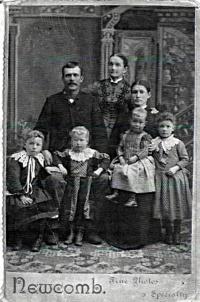
The William and Annie Jones family

Annie married William H. Jones on July 10, 1883. They had 12 Children  – raising 11 to adulthood.  Annie and William remained active in the Church – they were noted for their integrity, honesty, courage, faith and loyalty.

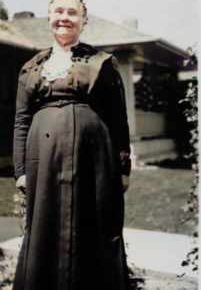
Annie Bambrough Jones died August 12, 1939 – age 73 – Buried in Pioneer Cemetery , Rigby, Idaho.

Happy
Happy
0 %
Sad
Sad
0 %
Excited
Excited
0 %
Sleepy
Sleepy
0 %
Angry
Angry
0 %
Surprise
Surprise
100 %
You May Also Like

JACKSON, Elizabeth Horrocks: Handcart Pioneer of 1856

“It will be readily perceived that under such adverse circumstances I had become despondent. I was six or seven thousand miles from my native land, in a wild, rocky, mountain country, in a destitute condition, the ground covered with snow, the waters covered with ice, and I with three fatherless children with scarcely nothing to protect them from the merciless storms. When I retired to bed that night, being the 27th of October, I had a stunning revelation. In my dream, my husband stood by me and said, 'Cheer up, Elizabeth, deliverance is at hand'. The dream was fulfilled.”
View Post

PICKETT, John – A Fully Converted Pioneer

In 1861 John and his family were called to move to Gunnison, Utah. Their first home was west of where Gunnison now stands. It was a dug-out near the Sanpitch River. It was located a little distance south of the “Rocky Point”. They soon found that the dug-out was not a good place to live. The first winter was a hard one with a lot of snow. The next spring when the snow melted the ground turned to deep mud. Some of the dug-outs filled with water and their chimneys collapsed. The whole place became a “Hog Wallow” and that is how that part of the valley got its name.
View Post

Elihu Marcellus Allen

Elihu and his family experienced severe persecution while living in Missouri because of their religion. Elihu executed an affidavit on 18 May 1839 in Quincy, Adams, Illinois itemizing a bill of damages against the State of Missouri for $1,000 for property lost and expenses incurred during the expulsion.
View Post

HIOTT, John: An Overlooked Pioneer

As far as history is concerned he was a faceless cipher who passed through life leaving few tracks and no one to mark his grave. It is easy to overlook that John and thousands of other forgotten Utah pioneers like him were critical in settling the Intermountain West. They dug the irrigation ditches, herded the cattle, built the shelters, attended meetings, maintained the roads, cut fire wood, tended the ill, mostly followed orders, and buried the deceased without fanfare. The accomplishments of their famous leaders would not have been possible without the blood, sweet, and tears of humble people such as John Hiott.
View Post

HASKELL: George Niles

President Young told the men; "There would be no death from fighting befall you, if you keep the Lords Commandments. "There shall be no fighting except with wild beasts." The wild beasts turned out to be wild bulls of which there were several injuries and mules gored. The Battalion shot over twenty bulls before they quit charging the men, mules, and horses. George Niles Haskell enlisted at the age of 49. They journeyed on to Winter Quarters where he took his wife, one girl and a son and proceeded on to Kegs Creek, where he left them with friends and acquaintance. Malinda had married prior to this time. The men then left for Fort Leavenworth where they received their gear and proceeded toward Mexico. The family was to await the return of George Niles Haskell and the military pay from the Army was used to help to support them. President Young made arrangements with the Army and Govt. to remain here on Indian Land for the duration. George was Private #46 of Company B. Many of the Mormons traveled to the Missouri River with the enlisted men. He had enlisted for a year, 16 July 1846 to 16 July 1847.
View Post

WALLACE, George Benjamin

July 4 Sunday – Rain this morning. Public meeting. Elders P. P. Pratt, Taylor and Father Smith spoke against growing cold and careless, and neglecting to pray. They urged all to give thanks to God, who is blessing us all the time. They also spoke against swearing and taking the name of God in vain. They gave strong warning and spoke of some of the law which will be put in force hereafter. They exhorted to union, obedience, etc. and exhorted the fathers concerning their children, how to bring them up, etc. They said if we forgot God it would go with us as it did with the Lamanites, etc. We must not set fire to the prairie for it is a signal for the Indians to gather together. We have now come 175 miles. The conclusion is to travel each company of 50 by itself and to have it encamp and herd by itself.
View Post

ASHCROFT, Henry

In those days, the Saints in each settlement were instructed by the General Authorities to have dramas and other amusements for entertainment. In the field of music and drama, Henry was especially gifted. He was a member of the first dramatic organization of Hyde Park. He, Rachel Seamons (Hancey), and Eliza Seamons (England) received much praise for their stage work. Henry had a wonderful bass voice and sang in the choir.
View Post

PORTER, Sanford: A Visionary Man

The last night there came a Voice–clear, audible, and distinct, "There is a God, and He has known the desires of your heart this number of years. I will instruct you three times this night the way that is right- -that you need never again doubt, but shall be satisfied in your mind concerning God.”
View Post