LEE, Roland L.: Modern Day Pioneer

0 1
Read Time:2 Minute, 9 Second
This was originally published in the December 2018 issue of the Cotton Mission Chapter Newsletter.
(If your chapter has honored modern-day pioneers, please email admin@suponline.org to have them included on SUP Online!)
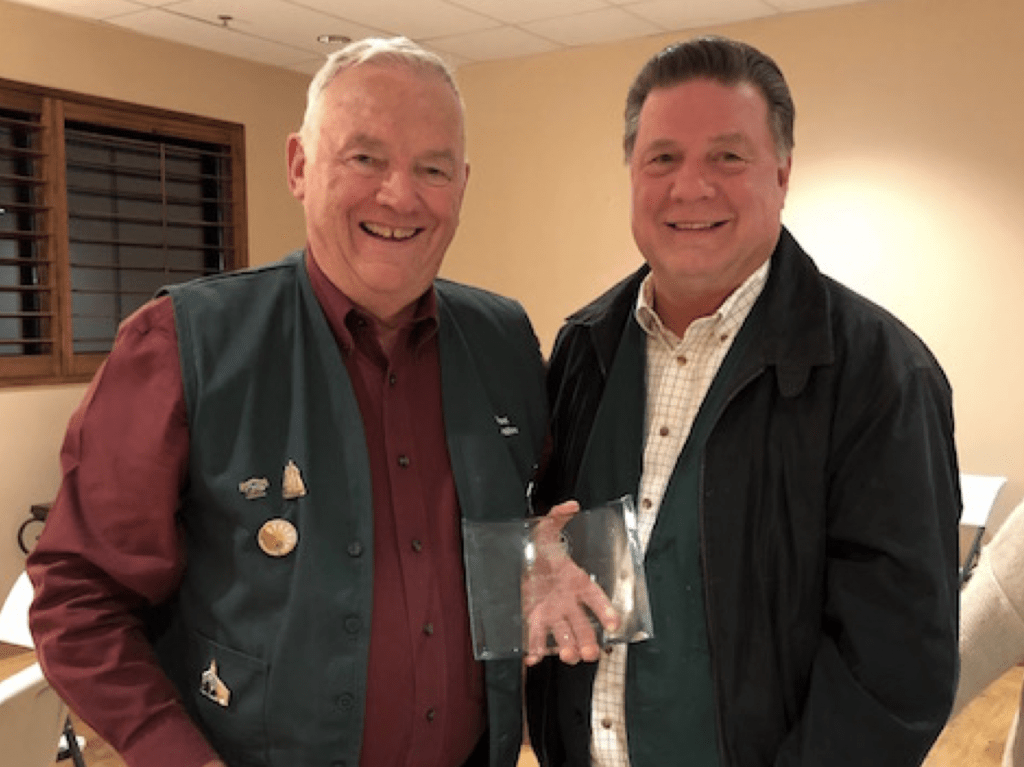
Roland Lee (right) receives Modern-Day Pioneer Award by Cotton Mission Chapter

Roland L Lee is recognized as a Modern Pioneer for his many contributions to the Church of Jesus Christ of Latterday Saints, his family and ancestors, the community of St. George and Washington County, and the Cotton Mission Chapter and National Sons of Utah Pioneers organizations. As the father of five children and 29 grandchildren Roland would be the first to say that his family comes first.

Many of us individually and as a community have benefitted from this unique interest and the result of his forty year career as a renowned artist that continues to this day. Roland has a deep interest in history and uses his art to share his love for his pioneer ancestors that were among the original pioneer settlers of Utah. He and Nellie continue to share the history of ancestors by research and digitizing histories that are provided to their extended families.

Roland has served as bishop several times and he and Nellie also served a Mission in Fresno California from January 2003 to July 2004.

Roland’s service in the Cotton Mission Chapter of the Sons of the Utah Pioneer’s spans more than twelve years. He has served in various positions including membership chairman, President, and was Chapter President in 2010 when the National SUP Convention was held in St. George.

He is serving as the Cotton Mission Chapter Newsletter Director and has done for the past 7 1/2 years. Roland also serves on the National SUP Trail Marker staff where he compiles other chapter monthly reports for publication in the Trail Marker.

His list of goods deeds is long and varied and he has touched the lives of many in so many different areas it is hard to imagine how he has found the time and energy to accomplish so much. He has done so many things in a silent, even anonymous manner that no one even knows about. Many have been the recipient of his “last dollar” or dedicated moment of his time.

He is to be commended for doing much more than he has ever been asked to do without seeking any recognition or reward of any kind.  His is truly a living example of Christlike” service and a modern day pioneer.

Happy
Happy
0 %
Sad
Sad
0 %
Excited
Excited
0 %
Sleepy
Sleepy
0 %
Angry
Angry
0 %
Surprise
Surprise
100 %
You May Also Like

RIDING, Christopher Lister: Tinsmith

Christopher's skills were needed in St. George because the temple was under construction there and he was the only sheet metal worker in the Dixie mission at that time. However, there was not enough business in St. George to provide him work, so he secured a little four-wheeled cart and an ox. He loaded the cart with tin ware and tools and visited all the towns in southern Utah, exchanging his ware for flour, potatoes, butter, cheese, etc. He made most of his wares from waste cans as it was difficult to ship in sheet tin. People saved empty cans and metal ware of all kinds for him. His store of wares consisted of buckets, milk pans, tin cups and plates, lamps, canteens, coffee pots, wash boards, etc. The ball on the St. George temple and the one on the St. George tabernacle are Christopher Riding's work, as is the metal work on all the public buildings erected before his death. The tin-covered sphere on the temple remained until October 25, 1994, when it was replaced with a fiberglass model as part of a renovation project. Christopher was a loyal member of the church although he was never active in public affairs due to the fact that his work kept him away a great deal of the time. He was a great reader, spending every evening in this way.
View Post

TAYLOR, William & Elizabeth Patrick

After the surrender of the city, the Taylors returned to their home, a distance of eight miles. There they found that about 7,000 of the mob had camped for two nights at or near their place, turning their horses into the Taylor’s cornfield. The mob ate or destroyed about 300 bushels of potatoes, 75 geese, 100 chickens, several head of cattle, 40 head of hogs, 20 stands of bees; also, they had burned about one mile of rail fence in their campfires.
View Post

COOLEY, Andrew Wood: A pioneer devoted to family

December 25, 1885. I wish I could have had the privilege of spending Christmas with you at home, but it is our lot to spend it apart. I hope you have spent it in a different way from what I have. We had a good dinner. The warden did the best he could to make the prisoners happy, but when a man’s liberty is gone, he can’t be happy when he has a family at home. I have thought of home the whole day long and so I do every day. I shall never be a happy man if I cannot enjoy the society of those that are my own flesh and blood which my family is. Things look dark to me, but I must hope for the best. God is at the helm
View Post

JOHNSON, Benjamin Franklin

Every house was a hospital, but without nurses. There were hardly enough men to bury the dead. As Benjamin had cared for the sick at the Kirtland Poor Camp, he knew what should be done and was immediately called upon by Joseph to help. He reported: “I had come to Nauvoo on horseback and as the houses of the brethren were scattered for some distance up and down the river, I kept my horse under the saddle and rode from house to house giving medicines and caring for the sick, and for six weeks did not take off my boots or coat for one night of sleep.”
View Post

ALSON, Thomas

At the time there were no free schools held in Utah, so students were required to pay tuition, which was rather difficult to provide; while attending with Peck, my tuition became considerable in arrears, therefore, he proposed that I assist him with classes at a salary of $1.00 per week and my tuition, (in all about $1.35 per week) the $1.00 per week to apply on deferred payments.I engaged to teach the Hoytsville School early in January 1876, at a salary of $45 per month. The school house consisted of one log room about 30 by 40 feet, heated by a stove in the center. The teacher was also the janitor etc.
View Post

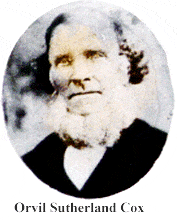
COX, Orville Sutherland

Being successful in disposing of their chairs, and securing loads of bacon and corn, they were almost home when an Iowa blizzard, or Hurricane, or cyclone, or all in one, struck them. Clouds and Egyptian darkness settled suddenly around them. They had no modern "tornado cellars", to flee into and no manner of shelter of any kind. The cold was intense; the wind came from every direction; they were all skilled backwoodsmen and knew they were very close to their homes; but they also knew that they were hopelessly lost in that swirling wind and those black clouds of snow. They and their oxen were freezing, and their only hope of life was in making a fire and camping where they were.
View Post

HIOTT, John: An Overlooked Pioneer

As far as history is concerned he was a faceless cipher who passed through life leaving few tracks and no one to mark his grave. It is easy to overlook that John and thousands of other forgotten Utah pioneers like him were critical in settling the Intermountain West. They dug the irrigation ditches, herded the cattle, built the shelters, attended meetings, maintained the roads, cut fire wood, tended the ill, mostly followed orders, and buried the deceased without fanfare. The accomplishments of their famous leaders would not have been possible without the blood, sweet, and tears of humble people such as John Hiott.
View Post

CUNNINGHAM, Elizabeth: True Grit

“My father was a miner by trade and being a man of weak constitution was badly adapted for such a laborious occupation. Consequently, this threw the management of affairs nearly entirely upon my mother, and to speak of her in [a] phrase, I cannot do it better than by saying she was a rustler in the greatest sense of the word.” Elizabeth was the foundation and matriarch of the family. She was the force that carried the Cunningham family from Scotland to Utah."
View Post

William Henry Adams, Jr.

In 1853 when the grasshoppers took the crops, he and his family subsisted on boiled thistles, mushrooms, or any kind of roots or segos. He apprenticed as a stone and brick mason with his father. They built an adobe house in Pleasant Grove, as well as many other buildings there.
View Post