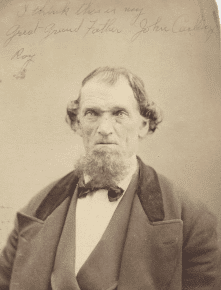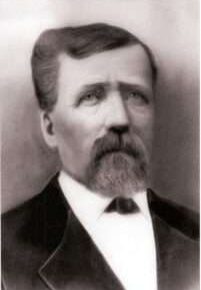
CHRISTENSEN, Alten

0 1
Read Time:2 Minute, 10 Second
by McKay Ellis
Note: This pioneer history is one of the winning 4th-grade student essays submitted to the Cotton Mission Chapter in it’s annual Essay Contest.
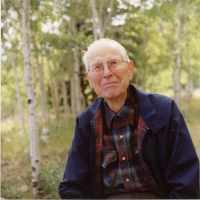
Alten Christensen (1906-2004)

My great grandpa Alten Christensen was a pioneer in the retail industry of southern Utah. He was also a pioneer with his faith.

The Store

In 1929, Alten opened Christensen’s Department store in Richfield, Utah. It took a lot of courage to open a store at the beginning of the Great Depression. Banks did not have money to loan to new businesses, so he had to finance it himself. He lived on very little; in fact, he lived on the top floor of the store in a little apartment. He put all his profits back into the store.

Initially the store sold shoes, overalls, and fabrics. It was 20 ft x 30 ft or 600 square feet. After a year and a half, they moved to a bigger location. The store still thrives in Richfield today along with a location in Cedar City and St. George. My grandpa Clark and his two brothers continue to run these stores.

Faith

Alten was a member of the Church of Jesus Christ of Latter-day Saints. In the window of Christensen’s, he would put a couple copies of the Book of Mormon. Next to those copies there was a sign that said,

“You are in Mormon Country, come inside for a free copy of the Book of Mormon.”

Through his efforts, he gave over 100,000 copies of the Book of Mormon during his lifetime! He
would give the Book of Mormon copies to hotels if allowed and put a copy in each room! In each Book of Mormon he donated to these hotels he would put a self-addressed envelope inside with a note.

The note read, “If you want to learn more about the Book of Mormon, mail this back to (my great grandpa’s) address.” Once he got his envelopes, he sent them to the Missionary Headquarters where the  missionaries then taught them more.

He had a map of the United States with push pins showing where all of those people who had
responded lived. There was at least one push pin in every state.

Conclusion

I know my grandpa was a very kind and generous man. He worked hard to provide a better life for his family. His faith brought him so much joy that he felt it was important to share with others. I am grateful for his pioneering examples.

Happy
Happy
0 %
Sad
Sad
0 %
Excited
Excited
0 %
Sleepy
Sleepy
0 %
Angry
Angry
0 %
Surprise
Surprise
100 %
You May Also Like

BARNEY, Lewis

He discovered that the Mormons were a religious people, however, at that time he cared nothing for religion. “The Methodists and the Presbyterians had been trying to convert me to their faith. I came to the conclusion that religion of every kind was a hoax, and that none was right, and that all preachers of religion were hypocrites, and were preaching for money and popularity.”
View Post

ALLEN Jr., Daniel: A Life of Consecration

Having completed their assignment, Daniel and his committee returned to Nauvoo, only to find buildings burning, mobs raging, and the saints gone. Daniel hurried to his home to find that his family was still alive, but his wife Mary Ann had just had a new baby and was very ill. He pled with the mob to let him stay a few days so his wife could recover, but they said they would kill them all if they weren’t gone by the next day. They hurriedly loaded what they could in the wagon and made a bed for Mary Ann and the baby. The Allen wagon was one of the last three to leave Nauvoo. They traveled together for a short distance, but couldn’t keep up because of Mary Ann’s grave condition. Being left alone with only one other wagon, they trudged through the mud and snow as best they could until they reached the head of Soap Creek (it looks like this might be less than 100 miles from Nauvoo). Mary Ann had struggled so valiantly, but could endure no more, so she whispered her last words to her loving husband…”We’ll meet again dear love in a better world and I shall wait your coming”. She died on the trail in May, 1846, along Soap Creek, Davis County, Iowa with no one but her family and the angels in heaven to mourn her passing.
View Post

WRIGHT: John Pannell

In conversation with Bishop Maughan they were advised to try to find a suitable location on the Logan River, and accordingly set out again the 5th of June. They next formed a camp near the site of the old Brigham Young College and here they decided to remain. A survey of the land was immediately begun and the brethren cast lots for their locations. This was the beginning of our beautiful city of Logan, June 1859. Although John Pannell Wright was a member of the second group to locate on the site of Logan in June 1859, he is generally given credit by old historians as having been the father of our city. Apparently it was he who did the first surveying here and who designated the little settlement by the name of Logan. Apparently after Brother Wright and his son had surveyed a few blocks of land, which they did by only measuring with a tape or chain, there was a drawing or lottery for the purpose of acquiring home sites. ) They also helped build a bowery under which they held their meetings. They harvested their grain on Summit Creek (Smithfield). They often carried their guns in one hand and their shovels in the other. They succeeded in yielding good crops, as high as forty bushels of wheat to the acre. Mr. Wright left his tracks in the snow while cutting the last of the grain.
View Post

MAUGHAN, John Harrison & Sarah Mariah Davenport

Mariah learned midwifery from her mother-in-law, Mary Ann Weston, the second wife of colonizer, Peter Maughan. She was set apart for her midwifery duty by Peter Maughan and spent many successful years in this service. She earned little pay except hearty thanks, and brought almost all her patients safely through their ordeal. It was expected that a midwife might be available for other medical service. During a winter epidemic of boils, which seriously afflicted both children and adults, Sarah Mariah had a dream one night in which she saw a blue mold under rose bushes. The next day she and John went to an area where wild roses grew abundantly, scraped away the snow and found the blue mold. They collected a quantity of the substance, brought it home and made poultices which, when applied, completely cured the boils. Later, people wondered if this might have been a form of penicillin. But without question, it was a giftof Divine Providence.
View Post

HIGGINS, Nelson: Through it All

Prior to leaving Nauvoo, Daniel Allen, Nelson Higgins, and Samuel Shepherd were called as a committee to sell properties belonging to the saints in the Bear Creek area. They were successful in collecting a good deal of money for the saints, but when they returned, the mobs had hit Nauvoo and the exodus had already begun (4). This is the first thread we find that ties the families of Nelson Higgins and Daniel Allen in their dedicated struggle for survival. Their relationship must have been a close one because Daniel’s daughter, Diantha, married Nelson’s son, Alfred. We know Daniel was one of the last three families to leave Nauvoo, so there is a good possibility that the other two wagons were those of Nelson & Samuel. Also, Daniel went to Manti to set up a tannery in 1854, and the two children were married in 1858, so their friendship must have lasted a lifetime.
View Post

CARLING, John Witt

Wagons for Fleeing SaintsJohn Carling and his son Isaac worked at making and mending wagons for the Saints who were being driven from Nauvoo. The mob violence became so intense that the Carling family decided to leave with the main body of saints. Brigham Young sent Heber C. Kimball to inform John that if he would stay until all of the Saints had been provided with good outfits, not a hair of their heads would be harmed. They remained as requested, though some wives complained that they would all be killed. “The morning they were to leave, they were counseled to get to the ferry boats before the mobs were astir, and upon arriving at the ferry, the captain hurried them onto the boat and admonished them to be quick because they could see the mobs coming. Some were on horses, and others were running, but all with guns in their hands, and they were cursing. As the saints left the shore, they could hear the leader of the mob ordering his men to shoot. But as the men came to the shore, they stood still. It is told by some that two shots were fired but they missed the people in the boat.”
View Post

BARLOW, Oswald: History of a St. George Pioneer

Oswald Barlow was a member of Utah's first Martial Band, directed by Professor Thomas. Not only did he play the fife and drum, but he was also an expert dancer. So, in 1859, Oswald opened up his own school of dance. Many of the Saints were glad to receive instruction from him, and cultural arts were strongly encouraged by Brigham Young. In fact, several of Brigham's daughters were among the first pupils at his school. Oswald also had a splendid bass voice and was a good entertainer; therefore, many people loved to hear him sing.
View Post