 0
0
 1
1
“THIS LAND IS FREE”
By Colen H. Sweeten, as told to his son, Colen Jr.

It was March, 1901. Three years had passed since our family had begun homesteading in Curlew Valley in Southern Idaho. Other families were now rapidly settling the neighboring land. Some said the land was free, others said they had bet $16.00 (the filing fee) against 160 acres that they could live on the land five years without starving. On this particular afternoon I was walking behind the hand plow on my father’s homestead. My younger brother Warren stopped the horses. “Well, look at that!” He said.
I turned my eyes to the road which ran along the north end of the homestead. A young boy, Peter Nielsen, came running down the hill, past the end of our clearing, and disappeared to the west, still running like a scared rabbit. About this time we noticed a man approaching us through the tall sage. He also ran in desperation. As he neared, we could tell he was one of the Briggs brothers who were digging a well about a mile east of us. He staggered into our arms, trying to get enough breath to speak.
“What is it, John?” I asked.
“Horse’s down the well on Ray,” he gasped.
I looked at Warren. The color left his face and he started to unhook the horses. A few minutes later, Warren was on his way to Rock House Ranch, about seven miles north of our place. There Dolph House raised some hay, and he was sure to have cables and ropes.
I took John on the other horse and started back to the well.
As we rode through the tall sagebrush, John told me that the well was about sixty feet deep. They were just starting to strike water when the horse which was being used to pull the bucket up out of the well became excited and backed into the well. The horse had wedged in the hole just below the surface, but when Ray climbed up the rope to squeeze past the horse, they had both fallen to the bottom together. I knew there was no hope for the man.
Soon after we arrived at the well, John became hysterical and tried to go down the well on a rope. I reasoned, pleaded, and finally had to drag him back from the spot. While struggling, we saw a rider coming from Wood Canyon east of us. As he neared the well, he sensed trouble and kicked his horse into a run. I could see that the rider was Eph, the oldest of the Briggs brothers. Eph set his horse up in front of us and stayed in the saddle.
“What’s up?” He almost whispered. “What happened?”
“The horse fell down the well on Ray”, I blurted out. There just didn’t seem to be anything else to say. Eph made a sort of a groaning sound and toppled from his horse like a dead man. He lay in the dust in a state of shock.
A little later when he was able to get to his feet, I found my troubles growing. I now had two men who wanted to climb down the rope.
It was about sundown when Warren returned from the Rock House Ranch. He had plenty of equipment and, to my great relief; I saw that he had brought my oldest sister’s husband, Heber Holbrook. I was barely out of my teens and the other fellows even younger that I. Heber Holbrook, with years of experience and plenty of determination, was exactly what we needed.
As dusk fell, Heber outlined our task, and we prepared the equipment. We were no longer alone. Ed Robbins and Jesse Bradshaw, on their way to Malad had stopped their wagons to help. Janus Nielsen, a neighbor, was there, and a sheep man named Price.
Heber was a little hard of hearing; he put his hand on my shoulder and in the half darkness I could feel the seriousness of his gaze.
“Colen, I can hear you and we understand each other. I’m going down that well on one condition, and that is that you will be at the top and check everything that goes up or down. Promise you won’t leave this hole till I’m back on top.”
“All right,” I said. I felt my responsibility was as great as his. He stood in the well bucket, took a coal oil lantern, an axe, and a long knife, and we lowered him into the darkness. Finally, I heard his muffled voice calling from the bottom of the well. He said that the horse filled the entire hole. There was just about enough mud and water to cover the horse. He could not find anything of the man or the shovel.
“Colen, are you there?” Heber’s voice seemed to tremble a little.
“Yes, I’m right here,” I said.
“There’s only one thing to do. I’ll have to cut the horse up and send it up piece by piece, so I can find the bottom.”
“Whatever you say,” I called back. “Do you need some help?”
“No,” shouted Heber, “there isn’t any room. I’m using my knife to shorten my axe handle and then I’ll get to work.”
The men stood around a sagebrush fire and waited in silence. “Pull the bucket up,” shouted Heber. I stood by the pulley ready to take the bucket while the others grasped the rope and pulled it up. When the bucket came to the surface, I carried toward the fire a few feet to get some light and emptied the bucket on the ground. The sight of the steaming horse’s head in a half bucket of blood was too much for me. I was sick from that time on. When I started to lower the bucket again, there was no glow from the lantern. “Are you all right?” I called into the darkness.
“Yes, I’m OK. The blood and body heat have made such a thick fog in here that the lantern won’t burn. Pull it up; I can’t spare the oxygen anyway.”
By this time, the stench had reached the top of the well. I wondered how much Heber could stand. He had never been known to turn back from anything, but I wondered if there would be enough oxygen for him to finish the job.
Next came the front quarters of the horse one at a time, then the entrails came up in the bucket. It was a grim little group around the fire.
“Now let the cable down,” called Heber. 1 wondered how he could even talk down there. We pulled him up in the bucket. Mud and blood had dripped on him until he wasn’t a very encouraging sight. When the remainder of the horse had been pulled out on top with the cable and a team of horses, Heber prepared to go back.
“You’ve done your share,” 1 said. “I’ll go down.”
Warren jumped to my side. “No, you won’t go down,” he said. “You run this end.”
Heber brushed us both aside. “Let me down again.” He said. For a long time after he reached the bottom, all was quiet.
Then the startling words came. “It’s empty, fellows, there’ nothing here.”
1 can’t attempt to describe the feeling that 1 experienced in that awful moment. The small group of men huddled around the well in silence. No one moved. No one seemed to have anything to say. Morning was approaching. After what seemed an eternity there came the words, “I’ve found a broken shovel handle. Mud sure is thick.” Then later, “I can feel a hand.”
I shuddered and looked around; how thankful I was that the older men who had stopped their wagons had taken the two brothers for a long walk away from the well.
“I have an arm out,” called Heber. “He sure is smashed into the mud.” He struggled for a while longer and then shouted, “Pull me up, I’m running out of air.” We brought him to the surface and someone built up the fire.
“I have the cable around his waist,” said Heber, “but he is still stuck.”
Everyone pulled steady on the cable. We felt the suction of the mud break loose and pulled the body to the top of the well. I don’t know what I expected to see, but the sight of the young man bent double backwards where the cable encircled his body was a shock to all of us. We later heard a rumor that his hair had turned white, but that was not true. However, I sometimes wonder why some of us didn’t turn grey during that night of horror.
Now, nearly sixty years later, I drive along the highway almost every day and pass within a few hundred feet of that well site. Sometimes I look out in the field at that well-remembered spot, even though there isn’t as much as a weed to mark the exact location. I think of young Peter Nielsen running toward the west that day. He is the only one who was there that day, except me, who is still alive. I think of Eph Briggs falling from his horse like he’d been shot. I think of a lot of other families who paid such a high price that we might have a community. Yes, I think of Ray’s shoes still stuck in the mud sixty feet below the smooth field of wheat.
How could anyone have ever said, “The land is Free.”
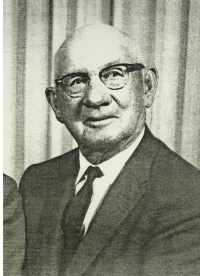
NOTE: Colen H. Sweeten was born in Mendon, Cache Co. Utah, on July 31, 1881. When he was about 17 years of age his family went into the Curlew Valley of Southeastern Idaho to homestead in a small farming community which was called Holbrook, named after his oldest sister’s husband.
The above incident happened when they had been there about three years, and it remained vivid in his mind for the rest of his life. He told us about it often during the years and showed us about where it happened. His oldest son, Colen Jr. decided it should be written down while his father was still alive to verify the facts. He did such about 1960, when his father was about 80, ten years before his death.
Colen Jr. sold his story to a magazine called True West, and it was published in the October Edition, 1961. Colen has a letter of permission from True West magazine, authorizing him to use this story any way he wishes.


 Brother Joseph
 Pioneer John