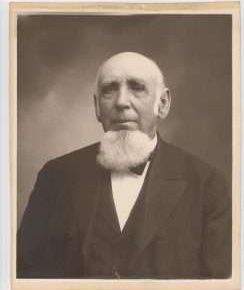
BOOTH, Edwin: “Most Dependable Horseman”

He was always the first one into the saddle if there was trouble. This included the handcart rescue, two Indian wars and as an aide to Lott Smith in harassing Johnson’s Army by Fort Bridger.
0 1
Read Time:1 Minute, 33 Second
Edwin Booth
(1833-1906)


Edwin Booth was born in the English town of Blackly Lancashire on September 12, 1833. His parents joined the “Mormon” Church and migrated to Nauvoo in 1840. At the age of 14 Edwin signed on as a cabin boy on a riverboat that operated between St. Louis and New Orleans. Two years later he returned to find his father had died and his mother, a brother and a sister had joined the exodus and gone to the Salt Lake Valley. He bought a horse and rode it to the valley.  He arrived in 1851.

He was always the first one into the saddle if there was trouble. This included the handcart rescue, two Indian wars and as an aide to Lott Smith in harassing Johnson’s Army by Fort Bridger. It was noted in Lott’s biography, “I needed to get a special dispatch to Brigham so I chose my most dependable horseman, Edwin Booth. Following his service with Lott Smith, he rode with the Pony Express for one year. 

He married Ann Maria Mosely September 9, 1855.  They lived in a home in Nephi which is still occupied.  Here their 9 sons and 1 daughter were born and raised.  His occupation was related to the sheep business.

In his later years, he was always very active in church and civic affairs. During this time his hobby was drama in local theatres, preferring comic roles.

One year he took the train to Chicago to visit a relative. While the train was delayed at an Arkansas station, Edwin struck up a conversation with a local man and gave him a Book of Mormon. After exchanging several letters between the two, the man joined the church.

Edwin Booth died in Manti on May 10, 1906 at the age of 73.

Happy
Happy
0 %
Sad
Sad
0 %
Excited
Excited
0 %
Sleepy
Sleepy
0 %
Angry
Angry
0 %
Surprise
Surprise
100 %
You May Also Like

HILL, Heamon Alison

During that time their father and baby Jasper died. They were so poor that they did not have enough money to bury their father and baby brother. “The Lord blessed us, for a man came to see us and seeing our plight, took us to his farm, gave us one room in his home, put our cattle in his pasture and buried our father and baby brother on his burying ground.
View Post

GREEN, Elizabeth Jane

Candace asked Hamilton about his mother’s pictures and he answered “I don’t know, I’ve never touched them.” Candace asked if she could get them and he gave his consent. She went into the other room and came out with some pictures carefully wrapped in tissue and brown paper. It was such a thrill to find a picture of Elizabeth Jane Green as a young mother and five of her sons, a picture of my grandfather James Copeland Orr, taken before he left on a mission, a picture of Charley, Walter, Richard and Earnest. Some of these pictures had been taken up at Mercur, probably when the boys had taken some produce to market or gone up to Mercur on a date or to a dance. Mercur at this time was one of the biggest towns in Utah and the people of Clover and St. John sold nearly all of their produce at Mercur.
View Post

DAVENPORT, James and Almira Phelps

In this spring of 1847, James Davenport was recruited as a blacksmith for the first company to leave with Brigham Young for the Great Basin of the West. They would generally follow the Oregon/California Trail along the Platte River. But they deliberately chose the opposite side of the river from the well-traveled side. Part of the mission of that first company was to identify the best route for the trail and the best sources for feed for the livestock, and to improve the road for the thousands that would follow. There were worrisome encounters with Indians, whose intentions were not well-know at the time, but no serious troubles occurred.
View Post

HASKELL: George Niles

President Young told the men; "There would be no death from fighting befall you, if you keep the Lords Commandments. "There shall be no fighting except with wild beasts." The wild beasts turned out to be wild bulls of which there were several injuries and mules gored. The Battalion shot over twenty bulls before they quit charging the men, mules, and horses. George Niles Haskell enlisted at the age of 49. They journeyed on to Winter Quarters where he took his wife, one girl and a son and proceeded on to Kegs Creek, where he left them with friends and acquaintance. Malinda had married prior to this time. The men then left for Fort Leavenworth where they received their gear and proceeded toward Mexico. The family was to await the return of George Niles Haskell and the military pay from the Army was used to help to support them. President Young made arrangements with the Army and Govt. to remain here on Indian Land for the duration. George was Private #46 of Company B. Many of the Mormons traveled to the Missouri River with the enlisted men. He had enlisted for a year, 16 July 1846 to 16 July 1847.
View Post