MEEKS, Mary Jane McCleve

0 1
Read Time:1 Minute, 44 Second
This pioneer story was submitted by Acacia Barney, as part of the Cotton Mission Chapter’s 4th Grade Student Essay Contest.

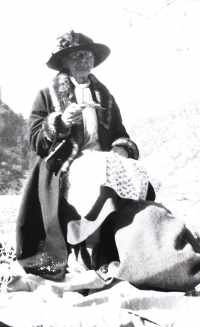
Mary Jane McCleve Meeks is my great, great, great, great grandmother. She was born on August 21, 1840. She was born in Belfast, Ireland.

Mary Jane lived in Ireland until April 19, 1856. She left because she was a member of the Church of Jesus Christ of Latter-day Saints and her family wanted to be with other people in the same religion. When Mary Jane left, her boyfriend gave her a pretty scarf. She knew she would never see her boyfriend or Ireland again.

Mary Jane arrived in Boston later in 1856. From there she went on a train to Iowa. From Iowa, her family joined a handcart company that was going to Utah. For most of the trip, Mary Jane carried her two year old brother on her back. She also helped carry another little boy on the way. In Wyoming, Mary Jane’s dad died. He died two days before they arrived in the Salt Lake Valley.

They arrived in Utah on September 26, 1856. Mary Jane was 16 years old by then. A couple of months later, Mary Jane met Dr. Priddy Meeks. They married the day after they met. He was 61 years old and she was 16 years old. After they married, Mary Jane moved to his home in Parowan.

Mary Jane was Priddy Meeks’ third wife. The other two wives were nice to her. Mary Jane and Priddy Meeks had ten children together. Mary Jane helped her husband a lot with his doctor work. She was a midwife and delivered nearly 1000 babies. Mary Jane and her family moved to the United Order (now it is called Orderville) in 1877.

After her husband died she continued being a midwife. Mary Jane died on January 19, 1933. She was 92 years old. She was buried in Orderville where my grandpa and grandma live. I liked it when her boyfriend gave her the scarf. I liked learning about Mary Jane McClever Meeks.

Happy
Happy
0 %
Sad
Sad
0 %
Excited
Excited
0 %
Sleepy
Sleepy
0 %
Angry
Angry
0 %
Surprise
Surprise
100 %
You May Also Like

HINTON, James Maurice: Life Story

I herded those sheep through what they call the Bear Hole. I’d start them through the East side and it would take them ten days to go through. I herded sheep four years for Wilts Imlay on Kolob in the summer and on the Arizona Strip in winter. The wages were $40 a month and board. I’ve got more to show for those four years than any other time in my life.
View Post

HIOTT, John: An Overlooked Pioneer

As far as history is concerned he was a faceless cipher who passed through life leaving few tracks and no one to mark his grave. It is easy to overlook that John and thousands of other forgotten Utah pioneers like him were critical in settling the Intermountain West. They dug the irrigation ditches, herded the cattle, built the shelters, attended meetings, maintained the roads, cut fire wood, tended the ill, mostly followed orders, and buried the deceased without fanfare. The accomplishments of their famous leaders would not have been possible without the blood, sweet, and tears of humble people such as John Hiott.
View Post

HILL, Heamon Alison

During that time their father and baby Jasper died. They were so poor that they did not have enough money to bury their father and baby brother. “The Lord blessed us, for a man came to see us and seeing our plight, took us to his farm, gave us one room in his home, put our cattle in his pasture and buried our father and baby brother on his burying ground.
View Post

ROBERTS, Owen: Welsh Convert

On Friday, May 20th, they started on the railroad for St. Joseph, Missouri where they arrived safely; from thence they proceeded on their way up the Missouri River on the steamboat “St. Mary”. Here they were treated roughly by the crew and others. They had no where to sleep or sit, but were almost constantly compelled to stand on their feet night and day until May 26th where they landed on the banks of the Missouri River below Florence, Nebraska at which place they lodged for a while so they could fit up their teams and baggage to cross the plains to the Rocky Mountains.
View Post

ALLSOP, Thomas Hill

STORY COPIED FROM FILES IN SUP LIBRARYWhen more people came to Sandy, Mr. Allsop sold some of his land. Later he donated land for the Church site and cemetary. He gave Sandy a big bowery where large parties could go and dance and have weenie roasts. The bowery, the reservoir and Allsop's Lane was known to all the people of Sandy and surrounding communities.
View Post

BINGHAM, Sanford

Submitted by John Elggren, Great-Great-Grandson of Benjamin Franklin Lewis      Sanford Bingham, first son of Erastus and Lucinda (Gates) Bingham, born in Concord, Essex, Vermont, 3 May 1821. He married…
View Post

ROBERTS, Levi

After travelling over the mountains one day we met with some of our brethren from the Valley. This was a time of rejoicing. Captain Brown who left us at Santa Fe with the sick which went by the way of Fort Kearney and a few brethren with him from the Valley, brought news that we were not to go to the Valley, and told us we had better stay another year in California. So the company divided right where we met each other; some went on to Winter Quarters; some to the Valley, and some turned back. Daniel Browett, Slater, Cox, Levi Roberts and myself turned back to Sacramento and went to work for Mr. Sutter who treated us very kindly. I sent a mule to my wife with Brother Harris, which she got…. We all went to work at the same place for Captain Sutter. We took the work of cutting a millrace. Brother Browett went [p.379] to work with the millwright, this was in September and later on in the fall, I and two others took sick with the bilious fever. We were so sick we couldn't help each other to a drink of water. We lay under some ties and had to crawl around with the sun to keep from making us chill…. Our appetites were very poor, and our food was flour, water and squash. Had it not been for the thoughts of my wife and family I could have died, but we all three recovered after awhile and went to work on the millrace again and worked all winter. Sometime in the winter two of the brethren who were working for Mr. Sutter in the mountains found gold in a tailrace they were making. Mr. Sutter let me see the first gold they found before sending it to San Francisco to get it tested. In May 1848 some of the brethren and myself made a trip in the mountains to try and find a road over (instead of going down Truckee River, as we had to cross it about 20 times) but when we got in the mountains we found so much snow we had to return, and on our way back I stopped at what we called the Mormon Island, where there was some of the brethren at work getting gold, Brother Sidney Willis and his brother; also Brother Hudson. I stayed here for a short time and got some gold.
View Post

WARNICK, Anders Peter: Stalked by Cholera in 1866

From 1863 to 1875 cholera swept through Europe. The Austro-Prussian War in 1866 accelerated its spread. That fateful year 250 thousand people died from the lethal disease in Prussia and Austria, 90 thousand perished in Russia, and 113 thousand succumbed the next year in Italy. Hungary, Holland, and Belgium were similarly hard hit by the disease. Little wonder, then, that the virulent bacteria made its way on board the ship that the Anders Peter Warnick family boarded in Hamburg, Germany on June 1, 1866.
View Post

HINTON, John Nock: Furniture Maker

This story is told by Edith Alice Hinton Gibson and Wilhelmina B. Hinton. They were respectively John Nock’s daughter and daughter-in-law, and had 1st hand knowledge of him. This short history is located in the Archives and Special Collections area of the library at Utah State University in Logan, Cache, Utah.
View Post

WOOLSEY, Thomas: Mormon Battalion Volunteer

On 15 Jun 1856 they left their all to overtake the first covered wagon train of Mormons, to cross the plains that year. The oldest daughter was sick with chills and fever when the journey began, and had to be carried from the house to the wagon. Her father's brother who did not belong to the LDS church and was opposed to their leaving their home, predicted she would not live to go far, but Elder Hickerson promised her she would not have another chill, and she never did.
View Post

GLEASON, John Streator: The Martyrdom of the Prophet

“The scene through which I have been called to pass since I arrived in this place from the East has almost alienated me from my country. Almost one continual round of mobocracy by night and by day. When I contemplate the scene it almost makes me shudder, and my blood run cold in my veins. I have been an eye witness to almost the whole scene from the beginning. My life has been exposed—threatened from time to time. . . when they were filled with wrath …. About a week before the assassination of Joseph and Hyrum Smith I was arrested—marched to jail by a band of the desperate and could not even lay there in peace—was aroused about 12 o’clock by a rush of men into the yard and a loud rattleing [sic] and hallooing at the door of the jail. One of our men went down and opened the door, when they rushed up stairs and caroused about a while, and left us.”
View Post