 0
0
 1
1
The Final Architect of the Salt Lake Temple
This article originally appeared in Vol.66, No.2 (2019) of Pioneer Magazine.
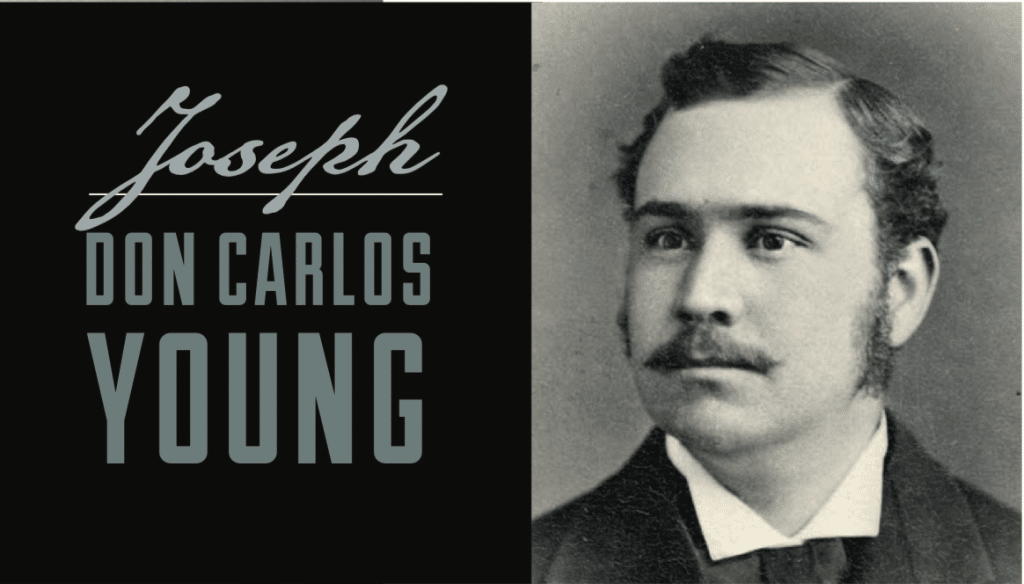
 The striking image of the Salt Lake Temple is instantly recognizable to most residents of the United States and many more worldwide. The exterior of the great building was the product of the minds of Brigham Young and the man who was sustained as the first Church Architect, Truman O. Angel Sr. But Truman Angell died in 1877, six years before the temple was completed, and many aspects of the exterior and interior design of the temple had not been finalized. The architect who received responsibility for the completion of the temple was Joseph Don Carlos Young, a son of Brigham Young and Emily Dow Partridge.
Bom in 1855 in Salt Lake Qty, only eight years after the arrival of the Latter-day Saint pioneers in 1847, Don Carlos Young was raised in the austere conditions of the new settlement, but with high expectations from his mother. He was Emily’s only son to live to adulthood, and before his death in 1938 he was the last living son of Brigham Young. Don Carlos was named by his mother for Joseph Smith’s infant son for whom she had been a nanny during the boy’s brief fourteen-month life. After showing himself to be an unremarkable student at Brigham Youngs private school for his children, Don Carlos at age twelve went to work as a teamster for the Church’s public works department, driving a mule team and hauling materials from City Creek Canyon to the site of the new tabernacle being constructed on Temple Square. He returned to school in 1868, agreeing with his father that hard work is as good an education for a young man as is learning from books, but realizing that he was perhaps more suited to a different line of work,’
In 1870 Don Carlos began to attend the University of Deseret, which offered a curriculum that was comparable to a high school education. In 1873 he planned to leave and attend the University of Michigan along with several of his half-brothers, but Brigham intervened, deferring to advice of his counselor, George A. Smith, who believed that young Latter-day Saint men educated at eastern institutions would likely be led away from their faith and fail to return home, thus withholding horn their Church and community the benefits of their educations. Brigham reached an agreement with Don Carlos and three other sons that if they stayed at the University of Deseret for two more years, they would be allowed to further their education at an eastern university. Two of Brigham’s sons met the terms of the agreement on time, Don Carlos and Feramorz Young.
 Don Carlos left in 1875 to attend the highly regarded Rensselaer Polytechnic Institute in Troy, New York, to study engineering. His friend William Sharp, son of Utah’s John Sharp, joined Don Carlos at Rensselaer. Feramorz entered the US Naval Academy, also with the intention to study engineering, but after two years he left the Academy and joined Don Carlos at the Institute in New York. Willard Young, an older brother, had entered West Point Academy in 1871, and pursued an engineering career in the US Army.
That Don Carlos and his brothers chose engineering as a course of study might have been expected. Brigham Young, a carpenter and tradesman himself valued the building trades. Some of his oldest sons had been involved in the construction of the transcontinental railway, and some continued as rail builders. Don Carlos would have been a firsthand witness to the construction of many public and private buildings in the Salt Lake Valley, as well as that of roads, bridges, and waterworks.
Don Carlos’ choice of Rensselaer in New York is also not surprising, as Brigham Young and many other family members were from that state. Don Carlos’ influential brother-in-law, Hiram B. Clawson (at that time head of ZCMI, was also a native New Yorker. Don Carlos’ decision likely had unanimous support at home.
While Rensselaer was the only school of advanced learning in 1870s America whose focus was entirely on the sciences, the only degree offered to its students was civil engineering. The school intended to produce graduates with a broad, scientific understanding of engineering. Classes included physics, metallurgy, chemistry, mathematics, English, French, theory of mechanics, surveying, and more. There were classes on building construction and stone cutting as well as classes introducing the new sciences of dec- tricity and magnetism. Every quarter, students were required to take classes in drawing and drafting, with concentrations in landscape, topography, mechanical drawing and illustration. Young seems to have devdoped a strong interest and ability in using each of these stalls. Architecture, however, was not a discrete subject taught at Rensselaer at the time.2
First in 1876 and then again in subsequent summers, Young had opportunities to visit New York City where he made sketches of prominent buildings. He also visited Philadelphia, Boston, and Chicago, and made a conscious study of the buildings and bridges of those cities. In 1877 Brigham Young died in Salt Lake Qty, but before he passed away he admonished his student sons not to return to Utah for his funeral, but to remain focused on their studies.
Don Carlos Young, Feramorz Young and William Sharp all graduated in 1879 and returned home to Utah. During the next few years, Don Carlos worked short-term jobs as a civil engineer for railroad projects in southern and central Utah, designed a meetinghouse for the small town of Deseret, and managed the family dairy farm in Salt Lake City. His interest in engineering was waning, but his desire to work in building design and architecture was growing. He set up an elaborate drawing studio in his office, established a personal library of architectural source books, and subscribed to professional architectural publications. He was educating himself in the subject he now realized was his greatest interest
In the 1880s there were a handful of self- described architects in Salt Lake Qty, but none had the formal education and skills that Don Carlos had acquired. Well-connected through friends and the Young family, Don Carlos received several commissions to design new buildings, and as his stalls became known, his contracted projects were increasingly important He was the architect for the Bear Lake Tabernacle in Paris, Idaho, and he did the landscape design for the Logan Temple. Perhaps his most ambitious project was the architectural design for the central building at Brigham Young Academy in Provo in 1884. Young also began to teach at the University of Deseret where—in 1885—he was designated Professor of Mechanical drawing and Architecture.
Don Carlos Young married Alice Naomi Dowden in 1881. Since the Edmunds Act prohibited polygamists from holding government office, and since Don Carlos had only one wife in 1883, he was encouraged to run for election to the Utah Territorial Legislature. He won and served two terms. In January of 1887, however, and at the encouragement of his mother and perhaps others, he married his second wife, Marian Penelope Hardy. He did not seek reelection.
On October 18,1887, Church Architect Truman O. Angell Sr. died, leaving incomplete the finishing of the upper exterior and much of the interior of the Salt Lake Temple. Don Carlos was soon involved in the work of completing designs for the temple. He redesigned the towers of the temple to be built of stone rather than of wood. Working closely with Church leaders and construction managers, he carefully laid out the floor plans for the temples interior, specifying the materials, decorations, and furnishings to be used in each of the interior rooms. He was sustained as Church Architect during the April 1889 General Conference and served in that position until the temple was completed in 1893, after which he was released and the position was eliminated. In 1895, at forty years of age, Young served a mission to the Southern States, returning to Salt Lake City in 1897.
Young continued to do public work as an architect, designing many buildings for The Church of Jesus Christ of Latter-day Saints. He also did private work for family members and Church leaders. Throughout his career Young was not active in civic and social organizations and did little to network with the non-Latter-day Saint business community in order to gain commissions for architectural work. As a result, most of his later work was related to growth of the membership of the Church. Among the most visible examples of such work is the Church Administration Building at 47 East South Temple, completed in 1914. The project was overseen by his own architectural firm, which numbered his son, Don Carlos, Jr., among its architects.
At his death in 1938 Joseph Don Carlos Young was survived by his first wife, Alice, and by thirteen living children. Another son who followed in his father’s footsteps, George Cannon Young, became the architect for the Church Office Building on North Temple in Salt Lake City. Of his fathers professional standards, George wrote:
I trained under my father, a very practical man. He had a fine sense of scale and proportion and design…. He said, “The costs are soon forgotten on a project. But if you have one crippled step, they never forget it.”He had experience in that, where heti tried to save, and in saving he had to sacrifice, and his clients never forgot what was left out.”Never sacrifice hardware. Get the best hardware you can buy” The Salt Lake Temple hardware was put in there about 1892 and is still serviceable today [1973].3
1 J. H. Adamson, Tore word,* in Dean C. Jessee, Letters of Brigham Young to His Sons, xi-xx.
2 P. Bradford Westwood, “The Early Life and Career of Joseph Don Carlos Young (1855- 1938)rMA thesis. University of Pennsylvania, 18-9.


 Brother Joseph