 0
0
 1
1
From Whitney’s History of Utah, Vol. 4

“THERE were giants in the earth in those days.” Scarcely more apt were these words in the days described in Genesis than to the days of George A. Smith and his fellow founders of Utah.
Seldom have so many great spirits been grouped in any one triod as were gathered around the Prophet Joseph Smith and President Brigham Young, assisting the former in the establishment of a new religion, and the latter in the building up of a new commonwealth. Among these none loomed grander, in mature and later years, and none were humbler and more unassuming, than the beloved and revered “George, A.” whose name, thus affectionately abridged, remains a synonym for all that is upright noble and good in the lexicon of the Latter-day Saints.
A big-hearted, broad minded philanthropist, a giant in intellect and almost a giant in physique, he was for many years the historian and general recorder of his Church, holding simultaneously the Apostleship, and during the last seven years of his life he was one of the council of the First Presidency.
George A. Smith was born at Potsdam, St. Lawrence county, New York, June 26, 1817. His father, John Smith, and his mother, Clarissa Lyman Smith, were both natives of N. Hampshire. His first American ancestor came from England early in the seventeenth century. John Smith was uncle to the Prophet Joseph and the Patriarch Hyrum Smith. Consequently George A. was first cousin to those worthies. He bore the same relation to Judge Elias Smith, was second cousin to President Joseph F. Smith, and father to John Henry Smith, the Apostle.
Among the best known of his descendants are his daughters Mrs. Clarence Merrill and Mrs. William N. Williams, his grandson, George A. Smith and his granddaughter, Mrs. Alice Merrill Horne, all residents of Salt Lake City.
In early life, checkered more or less with perils and mishaps through which he passed without any permanent evil results, was spent under the immediate watchcare of his parents. They were members of the Congregational church, and he himself was strictly trained therein until he was fifteen years of age; but he was an independent thinker and soon broke away from the churches and creeds of his time.
His father being an invalid, the son was under the necessity of laboring constantly to supply the needs of the home. His opportunities for education were therefore limited, but he valued knowledge and made every effort in his power to obtain it. He early showed signs of a superior intellect, and his memory, as he grew older, became phenomenal. Though genial and humorous in disposition, he was old-fashioned in his ways, caring little or nothing for the company of children of his own age, so far as their fun and frivolity were concerned, and preferring and asking the society of older people.
He was a great favorite with his grandfather, Asael Smith, a veteran of the Revolution and the War of 1812, and would climb upon the old man’s knees and listen spell-bound to his thrilling narrations of his experience while fighting for liberty and independence.
In the year 1828 came to this branch of the Smith family the news of the discovery by the kinsman Joseph Smith, at Manchester, Ontario county, of the famous golden plates, from which he translated the Book of Mormon. A copy of this book was brought to them two years later by Joseph Smith, Sr., and his son, Don Carlos, a younger brother of the Prophet.
George A. read the book very carefully, and after thorough inquiry and investigation, accepted it as an inspired record. A wealthy and influential Presbyterian in his neighborhood offered to send him to college as a preparation the Christian ministry if he would promise not to become a Mormon, but he declined the offer, and on the 10th of September, 1832, joined the Church of Jesus Christ of Latter-day Saints. He was baptized by Elder Joseph H. Wakefield, and confirmed by Elder Solomon Humphrey.
In May 1833, he removed with his parents to Kirtland, Ohio, and during the summer of that year quarried and hauled rock for the building of the Kirtland Temple. The 5th of [illegible], 1834, found him on his way to Missouri as a member of Zion’s Camp. He walked the entire distance to Clay county—where most of the Saints expelled from Jackson county had gathered—in forty-five days; a distance of a thousand miles. His outfit consisting of a musket, a blanket and a knapsack. During the last three weeks of the journey he was the Prophet’s personal attendant or “armor bearer.”
Sleeping in the same tent with Joseph and Hyrum, and present at most of the councils held, he acquired much information that afterwards proved invaluable to him, regarding the Prophet’s manner and method of governing men and settling difficulties. He returned to Kirtland early in August of the same year.
When the time came to ordain the Twelve Apostles and the first Seventies of the Church, he was ordained a Seventy under the hands of Joseph Smith, Sr., Joseph Smith, Jr., and Sidney Rigdon, the last named being mouth. The date of his ordination was March 1, 1835. He was set apart as a member of the first quorum of Seventy.
Between May, 1835, and April, 1838, he fulfilled three missions, the first in company with Elder Lyman Smith in Ohio, Pennsylvania and New York; the second in Ohio, and the third in southeastern Ohio and northwestern Virginia. In the intervals he attended school at Kirtland. While upon the third mission he taught grammar classes, thereby earning means to purchase clothing.
This mission was a very arduous one. He met with much opposition, held public debates with ministers of various denominations, and suffered for six weeks with inflammatory rheumatism, caused by exposure and privation while traveling through all kinds of weather and experiencing all sorts of treatment in a wild and sparsely inhabited region. While thus occupied he met the lady who was destined to become his wife—Miss Bathsheba W. Bigler, of Harrison county, West Virginia.
The summer of 1838 found him located at Adam-Ondi–Ahman, Daviess county, Missouri, where on the 28th of June he was ordained a High Priest and set apart as a member of the High Council of that Stake. In the fall of the year, with his cousin, Don Carlos Smith, he went upon a mission through Kentucky and Tennessee.
During his absence the Prophet and many of his brethren ‘were made prisoners and various atrocities were perpetrated by the Missourians upon the Mormon settlers. George A. and Don Carlos, while on their way home, were pursued by a mob and came nigh perishing in a storm on the prairie.
On April 26, 1839, George A. Smith was ordained an Apostle, to fill a vacancy in the quorum, caused by the apostasy of Thomas B. Marsh. His ordination took place on the Temple cornerstone at Far West, then all but deserted by Latter-day Saints, who had been driven from Missouri into Illinois.
He was ordained under the hands of Brigham Young and several other Apostles, Heber C. Kimball being mouth. He soon set out with a majority of his quorum upon their mission to Great Britain, and though suffering much sickness, steadily held on his way, preaching through Illinois, Indiana, Ohio, Pennsylvania, New York, Massachusetts’ and Connecticut.
April 6, 1840, was the date of his landing in England. He labored in the counties of Lancaster, Chester, Stafford, Warwick, Worcester, Hereford, Gloucester, Essex and Middlesex; and with Heber C. Kimball and Wilford Woodruff built up a branch of the Church in London. It required a strong effort to introduce Mormonism in the Metropolis, and much street preaching bad to be done. Apostle Smith there injured his left lung, which troubled him during the remainder of his life and finally caused his death.
At Nauvoo, to which place he returned early in July, 1841, he married, on the 25th of that month, Miss Bathsheba W. Bigler, who as Mrs. Bathsheba, W. Smith has long held a prominent place among the women of Utah. In February, 1842, he was elected a city councilor, and a year later an alderman of Nauvoo. He was successively a chaplain and Quartermaster General of the Legion, also a trustee of the Nauvoo House Association.
In 1842, 1843 and 1844 he did considerable ministerial work in Illinois andin states farther east. He was in Michigan when his kinsmen, Joseph and Hyrum Smith, were murdered in Carthage jail.
When the time came to evacuate Nauvoo, George A. Smith was one of the first of the Mormon leaders to set out for the West. An anecdote aptly illustrating his character finds its place at this point. At a council where the subject of the exodus was being considered, a great many discouraging views were expressed, when George A., after listening intently to the pessimistic sentiments, and it coming his turn to speak, arose and said:
“Well, brethren, if there’s no God in Israel, we’re a sucked in set of fellows; I’m going to cross the river.”
A general laugh followed, hope was kindled in every heart and the spirit of gloom that had rested upon the assembly was at once dispelled. Short speeches and shorter prayers were characteristic of George A. Smith, and his utterances were always pithy and to the point.
He accompanied the vanguard of the migrating Church across Iowa to the Missouri river, where, after many hardships and delays, caused by wet weather and bad roads, they arrived about the first of July, 1846. He had five men to assist him in building bridges, constructing ferry boats and driving and caring for teams, but when the Mormon Battalion was called for, these men all enlisted, leaving him with the teams on his hands.
At Winter Quarters he constructed by his own labor five cabins of logs and earth for the use of his family. At the expiration of six months they were compelled by government officers to remove to the east side of the river. There he built four cabins, which were occupied by his family until June, 1849. While on the west side, one of his wives, Nancy Clement Smith, and four of his children died from scurvy, superinduced by a lack of vegetable diet. As a cure for this disease, which was prevalent, he urged upon the people the cultivation of the potato, visiting their camps for that purpose. This caused him to be called “the potato Saint.”
During the pioneer journey of 1847 he walked a distance of seventeen hundred miles, and was for six weeks without bread; but was better off than most of the company, for he had about twenty-five pounds of flour locked up in his trunk, unknown to any one.
This he issued by cupfulls to the sick, some of whom attributed to it the preservation of their lives. He entered “the Valley” on the 22nd of July, two days before the arrival of President Young, and states in his journal that he planted the first potato put in the soil of Salt Lake valley. A cabin built by him as a portion of the Old Fort was occupied by his aged sire, “Father John Smith,” who was in the immigration immediately following the Pioneers and became president of the first Stake of Zion organized in the Rocky mountains.
Having returned with President Young to the Missouri river, our Apostle had charge, after the departure of the First Presidency in 1848, of the emigration at Kanesville, or Council Bluffs, and in the last of the westbound companies of 1849, he set out with his family for Salt Lake valley. His heavily loaded teams encountered severe storms, the cattle were stampeded, and at South Pass seventy of his animals were frozen. He arrived at his journey’s end on the 27th of October.
Hon. George A. Smith was a member of the Senate of the Provisional State of Deseret, and reported the first bill printed for the consideration of the General Assembly. It was a bill for the organization of the Judiciary. He also reported a bill relating to the construction of a national railroad across the continent. The Assembly having provided for the organization of Iron county, of which he was appointed “Chief Justice,” with “power to proceed,” he raised a company of one hundred and eighteen volunteers, and in December, 1850, accompanied by about thirty families, started southward to plant a colony in the vicinity of the Little Salt Lake. The expedition after crossing five ranges of mountains, located on Centre Creek, where they unfurled the stars and stripes and organized the county of Iron.
During that winter he taught school, having thirty-five pupils, to whom he lectured on English grammar around the evening campfire.
At the first Territorial election in August, 1851, he was elected to the Council of the Legislature. In the following October he was commissioned Postmaster of Centre Creek, by Postmaster-General Hall. In November he was commissioned by Governor Young as Colonel of Cavalry in the Iron military district. He was afterwards placed in charge of the militia throughout Southern Utah, and instructed to take measures for the defense and safety of the inhabitants against Chief Walker and his blood-thirsty bands, who had begun to rob and kill the settlers. In 1852 he was appointed to. preside over Church affairs in Utah County and to exercise a general supervision over all the colonies in the southern part of the Territory.
Possessed of a legal and statesmanlike mind, he early turned to the study of law and constitutional principles. In October, 1851, while yet a tyro in the profession, he defended in the district court at Salt Lake City, Howard Egan, one of his fellow Pioneers, who was on trial for slaying James Monroe, the seducer of his wife. Parts of the notable speech delivered by him on that occasion, and which brought a verdict of acquittal from the jury.
It should be stated that George A. Smith practised law for the pure love of justice and the legal science. His services were given free, not only to the defendant Egan, but to all his other clients as well. He was admitted to the bar of the Supreme Court of Utah and received his certificate as an attorney and counselor at law and solicitor in chancery, February 2nd, 1855.
At the General Conference of the Church in 1854, he was elected Historian and General Recorder, and immediately went to work compiling the documentary history of Joseph Smith. Assisted by four clerks, he compiled and recorded the Prophet’s history from February 20, 1843, to the date of his death, June 27, 1844, and also supplied from memory and other sources blanks in the record compiled by President Willard Richards, his predecessor, who had written on the margin “To be supplied by George A. Smith.”
He was a member of the Constitutional Convention of March, 1856, and was elected by that body one of two delegates to proceed to Washington and present the proposed State Constitution and its accompanying Memorial to Congress. The other delegate was John Taylor, who was editing “The Mormon” in New York City. This political mission was given to Apostle Smith as a respite from his too close application to the Historian’s office.
The only response vouchsafed to Utah’s appeal for statehood was the stopping of the mails and the setting of an army in motion for the invasion of the Territory. Our Apostle was absent in the East for about eleven months, during which time, besides attending to his duties as a delegate, he preached in nine States of the Union. He returned in time to take part in the general preparations for defense made by the people of Utah at the approach of Johnston’s army.
In the fall of 1860 he suffered a terrible shock in the tidings brought to him of the murder of his eldest son, George A. Smith, Jr., who was killed by Navajo Indians, about thirty-five miles north of the Moguls villages in New Mexico, now Arizona. It was many months before he fully recovered from the effect produced upon him by this lamentable tragedy.
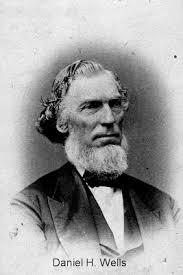
In 1866, owing to the incursions of Indians upon the southeastern settlements, he organized the militia of the Iron military district into a brigade of three regiments, embraced in the counties of Iron, Washington, Kane and Beaver, and established posts to prevent the inroads of Ute and Navajo Indians. He was then an aid-de-camp of Lieutenant-General Wells. He received a commission as Brigadier-General from Governor Charles Durkee on April 11th of the same year.

For many years George A. Smith had charge of the extension of settlements in Southern Utah, embracing the cotton districts in Washington and Kane counties. He was known as the father of the Southern Utah settlements, the chief of which, St. George, was named after him. He was elected every two years to the Council of the Legislative Assembly, and up to 1864 served as a member of every session except one. From 1864 to 1870 he was President of the Council.
At the October Conference in 1868 came his elevation to the First Presidency, to fill the vacancy caused by the death of President Heber C. Kimball, first counselor to President Brigham Young. The selection of George A. Smith for this important position gave universal satisfaction.
In October, 1872, President Smith set out upon a special mission to Palestine, to bless the land that it might be redeemed from sterility, and to dedicate it for the speedy restoration of the tribes of Israel. The members of the party were George A. Smith, Lorenzo Snow, Paul A. Schettler, Feramorz Little, George Dunford, Thomas W. Jennings, Eliza R. Snow and Clara S. Little.
From Genoa, George Dunford returned and Albert Carrington took his place, completing the tour. After leaving England they passed through Holland, Belgium, France and Italy, thence sailing to Egypt and Palestine. An interesting incident of the journey was a call upon President Thiers of the French Republic.
President Smith much enjoyed the tour, especially of the Holy Land. Having accomplished his mission, he returned by way of Constantinople and Athens to Trieste, and visited the principal cities of Austria and Germany. May 18th, 1873, found him and his party in London, and on the 28th of that month they sailed for home, arriving at Salt Lake City on the 18th of June.
During President Smith’s absence, he had been appointed Trustee-in-trust for the Church, which office he held until his death. After his return from abroad he spent considerable time in his namesake city, St. George, encouraging the building of the Temple at that place.
A zealous advocate of the United Order, which President Young sought to establish, he preached much upon that theme in various parts of the Territory.
While returning from St. George to Salt Lake in February, 1875, either while journeying or soon after his arrival here, he was attacked with a severe cold, which settled upon his lungs, depriving him of the use of his voice. This affliction, combined with a very peculiar manifestation of insomnia, which prevented him from sleeping except in an upright posture, and then only at short intervals, finally caused his death, September 1st, 1875.
President George A. Smith possessed great qualities of mind and heart. Humble as a child, he was every inch a man; prudent and wise, yet fearless as a lion. He was a counselor par excellence, respectful to authority, but no cringing sycophant. When asked for his opinion he gave it candidly, whether or not it agreed with opinions already expressed. If his counsel was rejected—a very rare occurrence—he was not offended, and if opposite advice prevailed, he stood one with his brethren in carrying out the policy agreed upon.
A great economist, he dressed plainly, lived within his means and zealously advocated home manufactures. Public-spirited and generous, his acts of benevolence and charity were many, but entirely without ostentation. He was a man of few words, but his speeches abounded in apt anecdotes and illustrations.
He was noted for his good judgment, his capacious and retentive memory, and his sound, common sense.
President Young said at his funeral that he had known him for forty-two years, had traveled and labored with him in the ministry during much of that time, and believed him to be as faithful a boy and man as ever lived. He added these telling words:
“I never knew of his neglecting or over-doing a duty. He was a man of sterling integrity, a cabinet of history, and always true to his friends.”


 Brother Joseph