 0
0
 1
1
This article originally appeared in the Summer 2001 issue of Pioneer Magazine.
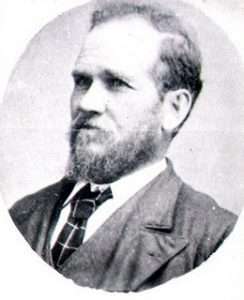
At only 14 years of age (much like the Prophet Joseph Smith himself), Edward MacGregor Patterson heard about the gospel and recognized truth. Those early stirrings of the Spirit led Edward throughout his life—a life devoted to obeying and serving the Lord.

Edward MacGregor Patterson was born on October 28, 1841, in Heaton High Pit, England, Although details of his childhood are sparse, he was working alongside his father in the coal mines by the time he was 10 years old.
In about 1853, Edward’s uncle John Bowman visited the family, eager to tell them about a new religion he had heard about. Edward listened intently. Shortly thereafter, the family learned that the mines would soon close and they would have to look elsewhere for work. Edward later wrote in his journal;
“Hearing [Uncle John] speak of those things, became very much interested and wished to learn more about the Gospel, and having to leave there as the mines were about to shut down and being very desirous to learn more about this new religion, I used all my influence to get my parents to move to Seaton Burn, where Uncle John resided. There had been a branch of the Church of Jesus Christ of Latter-day Saints organized there.”
Apparently Edward’s family made the move, because he began attending Church meetings with his uncle’s family in 1856. Despite vast persecution and disapproval from many, Edward joined the Church on May 26, 1858, as soon as he received permission from his parents. Once baptized, he began feeling a strong pull to gather with the Saints in Utah,
Ultimately the establishment of the Perpetual Emigration Fund made it possible for Edward and his uncle’s family to realize their dream; they left for the United States on May 12, 1862.
“Father accompanied me about one mile while Mother stayed to mourn my absence,” Edward recorded in his journal. “My brothers, William, Robert, and Joseph Soulsby, accompanied me almost to Newcastle-on-Tyne, a distance of six miles. Then I took my last farewell of Father’s family for how long I knew not.”
The family boarded the William Tapscott and sailed from Liverpool, England, on May 14, arriving in New York on June 25, 1862. From there, the group traveled by train and by water to Florence, Nebraska, arriving there on July 7. The Civil War was in full action, and Edward’s journal records the caution they used as they traveled.
Edward and his company crossed the plains fairly uneventfully and arrived in Salt Lake City on October 16, 1862. “[Company leaders] report that they had an exceedingly prosperous journey,” reported that day’s Deseret News.
“That there was but little sickness and no deaths in the company, and their losses in cattle were inconsiderable… We were informed that the immigrants in this company were more strict In their devotional exercises than some others have been and generally held meetings every evening, during the entire journey.”
After camping for a few days in Salt Lake City, Edward and his uncle’s family headed to Franklin, Idaho, where Edward worked for a local farmer. The next year, another of Edward’s uncles, Robert, and his family, including Edward’s grandmother, emigrated from England, and in the spring of 1864, Edward joined Robert’s family in settling the Bear Lake Valley. The family would end up living in Bloomington where, except for a two- year mission period, Edward would spend the rest of his life.
Joyously, only a few years later, Edward’s father, mother, and siblings arrived in Utah. They had joined the Church in England and emigrated to the United States. Edward’s family lived for a few years on the East Coast before arriving in Utah, but once they arrived, they too ended up in Bloomington.
The Pattersons were now together, and by every account, the family enjoyed incredibly dose ties. Edward’s journals are full of family gatherings and events; the family worked together, played together, and worshiped together.
It wasn’t until 1868 that Edward married. Mary Thompson had come from a family of 13 boys. At the age of nine she left her home to work for a family in Brigham City. She worked away from home for over five years and finally returned to live with her family, who since moved to Bear Lake Valley in 1867. Mary was only 15 when she married 27-year-old Edward.
Reading from Edward’s journal:
“In October I took [my] sister Jane to see her husband, J. Soulsby, in Weber Canyon who was working with Bn Wm. V Roberts in the tunnel on the U.P.R.R. as I went to Salt Lake City with Mary Thompson where we were married in the Endowment House Oct. 31, 1868.”
The entry was characteristic of the time, without a lot of sentiment or emotion. But the pair appeared to he deeply committed. The Endowment House was a fairly distant journey for those times, and it was not easy to make the trip for the sealing. But the Pattersons wanted their marriage to begin right.
Edward spent the first few years of his marriage working wherever he could find a job, which often meant he was away from home. He worked on early irrigation projects, and he and his Uncle Robert helped dig a ditch across the mountain from Ogden to the Weber River. He spent the fall of 1871 on a survey team that ran a boundary line between Utah and Idaho. The next fall he went to Rock Springs, Wyoming, to load railroad cars; this time, however, he was able to bring his wife and young daughter along. The three lived in Rock Springs for one year before returning to Bloomington.
Although he’d begun his life as a miner, Edward had numerous skills. When he first arrived in Bloomington, Edward helped his Uncle Robert build the family’s first home; he later would build two homes for his own growing family—a one-room log cabin that in later years would prove to be a wonderful playhouse and theater for the Patterson children and a larger home that was years in the making. Edward began hauling logs for the home in 1876, and in September 1877, he was still finishing it up. Not only was he skilled in construction, but he was a fine craftsman and an artist. In 1874, he started the Bloomington Dramatic Association and painted all the scenery, banners, and theater show cards for some 20 years.

On June 15, 1882, Edward married 15- year-old Sarah Thompson, his first wife’s younger sister. The two sisters loved each other and agreed to live in polygamy (His biography notes that the two women lived side by side; the family ate at the same table, lived in the same home, and everyone felt as if they were brothers and sisters. There were no feelings of being two “separate” families.)
Edward began expanding his second home to make room for his wives to live together. This renovation project took years as he painstakingly added fine details and master craftsmanship to almost every room.
In addition to these home-building projects, Edward spent a great deal of time constructing important buildings in the community, including the new YMMIA hall, the Co-op Store, and the Church meetinghouse. He also kept busy repairing his farm equipment, making coffins for the dead, serving on the grand jury, attending to his farm chores, and working in the Church. Edward’s Church callings included serving a mission in England and serving in the Bloomington bishopric.
In 1897, Edward and his sons Edward T. and William opened a carpentry shop. The skills Edward had gained through the years had become legendary and his work was greatly desired. His sons shared his interest, and the three kept busy building furniture, making coffins, and creating fancy paneling and wainscoting for homes.
On November 25, 1909, Edward MacGregor Patterson died after being in ill health for about two years. He apparently suffered from dropsy or Brights disease, and although he continued to help with farm work and Church and public service, he tired easily. Surviving him were his wife, Mary (Sarah had died three years earlier), and 14 children.
His obituary in the Paris Post read:
“He was a good citizen, a devoted church member, beloved by all who knew him, He filled a two-year mission to England. He was a member of the Bishopric from October 27, 1895, until his death, and was also ward clerk for many years. His trade was that of a carpenter and many arc the comfortable homes which are monuments of his industry and good workmanship.”


 Brother Joseph