 0
0
 1
1
Endure to the End
by Richard D. Kirkham

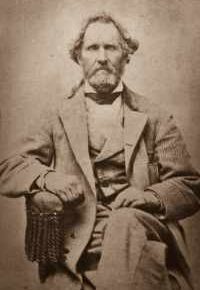
At the age of 26, Isaac Morley served in the War of 1812 holding the position of captain in the Ohio militia. That same year Morley married his first wife, Lucy Gunn, with whom he eventually had seven children.
Morley was an early settler in the Western Reserve wilderness area of northern Ohio and created a productive farm in the region near Kirtland, Ohio. While in this area, he joined the reformed Campbellites, under the ministry of Sidney Rigdon. Eight additional families joined in 1830. The society was sometimes called the “Morley Family,” as Rigdon caused a row of log houses to be built on Morley’s farm, where a number of the society’s members could live periodically.
On November 5, 1830, Isaac was baptized into the newly organized Church of Christ by Parley P. Pratt. He had been introduced to the teachings of Joseph Smith when Oliver Cowdery and several other missionaries passed through Ohio. He was ordained an elder shortly after his baptism.
When the Latter Day Saints began to settle in Kirtland, Morley opened up his home to them. Joseph Smith and his family lived with Morley when they first came to Kirtland. Morley later built a small house for them on his farm, where Joseph’s and Emma’s twins, Thaddeus and Louisa, were born and died only three hours later on April 30, 1831. Isaac’s daughter, Lucy, and her elder sister kept house for Emma while she was ill.
Isaac was ordained a High Priest on June 4, 1831, by his friend, Lyman Wight, and was immediately selected for a leadership position. He was ordained on June 6 as First Counselor to Bishop Edward Partridge and served until Partridge’s death in 1840.
On June 7, 1831, Issac was asked to sell his farm and act as a missionary while traveling to Independence, Missouri with Ezra Booth (D&C 52:23). Morley and Booth were chastised for lack of obedience three months later (D&C 64:15-16). In Missouri, Morley faced the violence generated by disagreements and misunderstandings between Church settlers and Missouri residents. In July 1833, a mob of about
500 men demolished the home and printing office of William W. Phelps at Independence and tarred and feathered Bishop Partridge. Morley and five others stepped forward and offered themselves as a ransom for these men. After negotiation, peace was granted as the Saints agreed to move to Clay County.
Returning to Kirtland in early 1835, he attended the Temple dedication and was among the first to receive the washing and anointing ordinances. In 1835, Isaac served a mission with Partridge to the Eastern States. The revelation came through the Prophet:
“Behold I am well pleased with my servant Isaac Morley and my servant Edward Partridge, because of the integrity of their hearts in laboring in my vineyard, for the salvation of the souls of men.”
Isaac returned to Missouri with his family in early 1836 and helped establish the city of Far West where he was called as the patriarch of Far West and ordained by Joseph Smith, Sidney Rigdon, and Hyrum Smith. After the expulsion of the Saints, Morley was called as president of the Lima Stake in 1840; and later a member of the Council of Fifty. However, because of persecution, the Morleys fled to Nauvoo with the Saints and from there to Winter Quarters, and on to the Great Salt Lake Valley. Morley settled in what is now the Sanpete Valley and established a winter camp into the south side of the hill on which the Manti Utah Temple now stands. When supplies ran low, the Utes helped settlers haul food on sleds through the snow. The settlers and members of the Ute Sanpitch tribe referred to him affectionately as “Father Morley.” He supervised the building of the first schoolhouse and the first gristmill as Manti became known as a prime agricultural area.
Isaac Morley served as a senator in the general assembly of the provisional State of Deseret. He represented Sanpete county in the legislative council of the Utah Territory from 1851 to 1857. During his last years, Morley spent most of his time on his calling as a patriarch, conferring priesthood blessings on thousands of church members. He died at age 79 on June 24, 1865, in Fairview, Utah.


 Brother Joseph