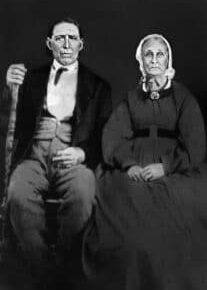
THOMSON Jr., Moses

Combined with the guarding that was surely required of Moses, we also learn from George Thomson’s biography that “Moses pushed and pulled on a handcart with a sick man in it for many days. Their rations got slimmer . . . When they got to the Sweetwater [River] near Devil’s Gate, Moses died with seven others the same night. . . . they were buried in shallow graves and covered with snow. This tragedy was a terrible blow to George and he did not get over it for years.”
0 1
Read Time:3 Minute, 53 Second

MOSES THOMSON, JR.

Born: 5 Feb. 1834 Kincardine, Perth, Scotland

Died: November 1856 on the Sweetwater River near Devil’s Gate

(Possibly at Martin’s Cove)

MARTIN HANDCART COMPANY – Age 22

Moses Thomson was the 5th of 8 children of Moses and Janet Steel Thomson. It appears that Moses and his two older brothers, George and Thomas Hyslop Thomson, were baptized members of The Church of Jesus Christ of Latter-day Saints, but their parents and five sisters were not. George was the first of the Thomson boys to join the Church, being baptized on April 7, 1847, at the age of 17. This so enraged his brother, Thomas, that he held George by force while his mother whipped him. (The boys’ father had died two years previously in 1845.) Nevertheless, Thomas also was later baptized.*

Moses had worked in the coal mines of Scotland, along with his father, brothers, and other male relatives, as soon as he was old enough to carry a candle for the miners to see to work. He also carried a little bucket of water for them to drink. The boys were paid a small wage for this service. They assumed heavier duties in the mines by about age 15.

George was also the first of the three Thomson boys to emigrate to America with the Saints. He came in 1851 aboard the ship Ellen, paying his passage with a full year’s savings. After making his way to Council Bluffs, Iowa, he contracted with Joshua Grant to drive a freight wagon to Utah. He traveled with only 11 other men and a young woman, Joan Bee, who cooked for this company. George and Joan were later married.

George first lived in the Sessions settlement, or present-day Bountiful, Utah. He married and worked hard and saved his money again. Some of it was earned by traveling back to Council Bluffs to bring other Mormon pioneers to Utah. When he had saved enough money, he sent to Scotland for his younger brother, Moses, to come to Utah.

Moses traveled from Glasgow, Scotland, to Liverpool, England, to emigrate with the other Saints aboard the ship Horizon in May of 1856. The President of this group was Edward Martin who also became the Captain of the Handcart Company in which Moses would travel toward Utah from Iowa City, Iowa. President Martin’s two counselors aboard ship were George P. Waugh (age 68) and Jesse Haven (age 42). Elder Waugh was a native of Scotland and both men, Waugh and Haven, were returning to Utah from missions; Waugh in Scotland, and Haven in South Africa and as well as a few months in Scotland. Most of the other Saints known to be from Scotland aboard the Horizon did not continue on to Utah with the Martin Handcart Company. (Some of these family names were Queen, Miller, Dow, Camp and Cain.)

Like other strong young men in the company, Moses would have been assigned to help those less able with their handcarts. He would have also been placed on guard duty at night. These shifts would typically last several hours and took their toll on those like Moses who sacrificed much-needed rest. Fellow traveler Benjamin Platt (age 23) wrote of this:

“ . . . we had to herd at nights and pull handcarts all days and many times I have been kept up until midnight and then stood guard until morning and then started again and it was this everlasting guarding that killed the people.”

Combined with the guarding that was surely required of Moses, we also learn from George Thomson’s biography that

“Moses pushed and pulled on a handcart with a sick man in it for many days. Their rations got slimmer . . . When they got to the Sweetwater [River] near Devil’s Gate, Moses died with seven others the same night. . . . they were buried in shallow graves and covered with snow. This tragedy was a terrible blow to George and he did not get over it for years.”

*According to family accounts, Thomas Hyslop Thomson immigrated to America in 1859 or 1860 with his wife and two children. He went as far as St. Louis, Missouri, obtained work, and remained there until the Civil War broke out and he was drafted into the army. “His wife heard from him once in awhile and then his letters stopped. She never did know whether he was killed or what became of him. George corresponded with her for two or three years and then she married again and moved to Dakota and he lost track of her. Nothing was ever heard of Thomas again.” (Biography of George Thomson)


Happy
Happy
0 %
Sad
Sad
0 %
Excited
Excited
0 %
Sleepy
Sleepy
0 %
Angry
Angry
0 %
Surprise
Surprise
100 %
You May Also Like

STEPHENS, Evan

This article originally appeared in Vol.50, No.1 (2003) of Pioneer Magazine. by Janet Peterson Evan Stephens‘s philosophy of Mormon music, “that which breathes optimism and not pessimism, “1 permeates the…
View Post

CHAPMAN Julia Ann

Other than for Julia's health, Isaac was well equipped to travel. In the heat of the late spring, Julia gained some weight and felt pretty well. Deciding that they could safely make the trip, Isaac loaded the wagon, making a special bed for his wife. At first she did very well, cheerful that at last they could go west and be with their relatives. But as the trip continued, the strain began to tell. Some mornings she was unable to get up. When they crossed Loup's Fork they again pulled out of the line, getting one of the Elders who lived at the Fork, Isaac and he administered to her. She seemed to relax and feel better, but during the night she lapsed into her last long sleep. After they buried her, Isaac was so grief stricken that he sat for days, staring in front of him, felled by his tragedy. One evening James Walsh came to his fire and said, "I have seen many tragedies along the trail, and I respect you for your grief, but life must go on. Now you owe your little ones an even greater responsibility than before. Now you must be both father and mother to them. Crying tears of anguish over your lost wife is right and proper, but you must never allow your grief to immobilize you. What would Julia want you to do? You have begun a great quest, which, unfortunately, she was too weak to finish. Now you must finish it for her." Out in the night Isaac walked for hours, asking why? Why? But with the coming of midnight, a peace enveloped him like a cloud. His beliefs taught him that although her body was dead, she, herself was still alive and would wait for him. He must not fail her. The next morning, 10 July 1852, he gathered a bunch of wild flowers and placed
View Post

PETERSON, Charles Sreeve

Mr. Powell, tried to persuade him to give up his faith or otherwise he would have to surrender his work position. He flatly told him no, as to deny his knowledge that he had received would be the greater sin. In his words, “I knew it would be a great sacrifice to me to give up my employment and the comfortable home which I appreciated so much, but to give up the principles which I had received and which I knew to be true would be a far greater sacrifice, and of the two I would choose the lesser … no position, wealth or earthly honor could move me from my convictions and purposes at that time…”
View Post

WOOLSEY, Abigail Shaeffer

John D. Lee had been ill with a heavy fever, probably the 'rocky mountain fever' and he was just starting to mend when Abigail, "Momma", came down with that same "rocky mountain fever", and soon went into a coma. Lee called for a stop here on the Sweetwater, where her family gathered around her and her daughters desperately tried to care for her. But to no avail. Abigail opened her eyes, looked lovingly on her worried, sad family and then died around midnight on the third of September 1848.
View Post

ANDREWS, Amos Betts

They were surrounded by an armed cavalry of vigilantes who asked for the leader of the group. Amos Andrews stepped forward. The leader of the vigilantes asked if they were Mormons and Andrews confirmed his question. The leader then told them to prepare to die. Andrews looked around and saw that they were out-numbered and out gunned. Andrews then requested if he'd be permitted to sing a song. He sang the whole song to "A Poor Wayfaring Man of Grief "then sang another song and another. Andrews wife, Keturah, was nursing an. 18 month old baby, the baby stopped nursing and joined its father in singing the song. Overwhelmed with emotion at seeing the baby do such a thing, a member of the mob lowered his rifle, and swore an oath saying, “They all can sing, even the child at the breast." The mob removed their hats and rode away. The story is an example that "the hymns of the righteous are a prayer unto me."
View Post

BELLISON, James Thomas and Louisa

Before many days, an incident occurred which tells a lot about James' attitude toward draft animals. His granddaughter, Pearl Allen Read, tells of the company coming to a bog of mud in the trail which caused many wagons to get stuck. As each team came to the bog, the Captain standing there would join the drivers in whipping the animals to get them through.When it was his turn, James forbade the Captain. "These are my animals and no whip is to be used on them." Although James' team pulled through the bog successfully, the Captain was angry and thereafter continued to find fault with this independent member of his company.James Thomas' life-long insistence that his animals be treated well was admired by those who knew him and was learned and perpetuated by his children throughout their lives.
View Post

NIELSEN, Ane: A Self Sufficient Pioneer

Ane was a hard worker. She had to work more like a man than a woman. She did a lot of work in the fields and with the animals. When anyone in the family needed help or advice on the farm, they would ask her. She could fix a broken harness as well as any man. She had quite a few sheep that her boys would care for. She would shear her sheep, then wash the wool and spin it into yarn. Following this preparation, she would weave it into beautiful cloth.
View Post

POND, Stillman Pond

On February 2nd 1846 the migration west began. Stillman and his family remained in Nauvoo until after the battle of Nauvoo in September 1846 when they were driven at the point of a bayonet across the river. Tribulations and hardships were many as the winter set in early and the Mormon refugees were without the proper food, clothing and shelter. The camp was ravaged by malaria, cholera, and consumption. The Pond family fell victim of all of these diseases. Stillman’s wife, Maria, became consumptive and all the children were afflicted with malaria. Snow fell early on the plains of Iowa and along the way Stillman and Maria buried their son Lowell Anson in September of 1846 on the plains of Iowa. Maria’s body wracked with pain and bowed down with grief for the loss of her son; was unable to walk and was confined to her bed in the back of the wagon with the fever of malaria. In this condition she gave birth to twin boys Joseph and J. Hyrum, the later part of September and the twins died a few days later and were also buried along the trail in Iowa.
View Post

ALLRED, Isaac

He promised them that they would not have to shed the blood of their fellowmen, but that this added affliction heaped upon them in this hour of their trials would turn out as a blessing upon their heads. Several of the young Allred boys joined the "Mormon Battalion" and performed with that Battalion in the longest march of foot soldiers in length of miles ever traversed by any army in the history of time.
View Post

KILLIAN, Captain John

When the Elders administered to me, Brother Killian being mouth, I was in bed. He poured the oil on my forehead and I jumped right out of bed and put on my clothes. On hearing that Robbins was going to Quincy in the morning, I walked up to his house, three-quarters of a mile, and went with him in his carriage to Quincy, remained all day and returned with him at night.”
View Post

DAVENPORT, James and Almira Phelps

In this spring of 1847, James Davenport was recruited as a blacksmith for the first company to leave with Brigham Young for the Great Basin of the West. They would generally follow the Oregon/California Trail along the Platte River. But they deliberately chose the opposite side of the river from the well-traveled side. Part of the mission of that first company was to identify the best route for the trail and the best sources for feed for the livestock, and to improve the road for the thousands that would follow. There were worrisome encounters with Indians, whose intentions were not well-know at the time, but no serious troubles occurred.
View Post