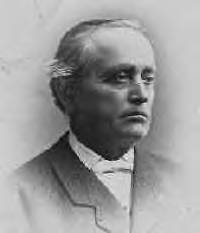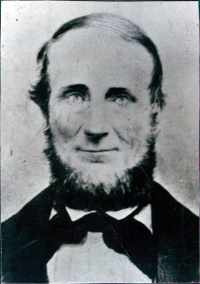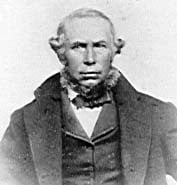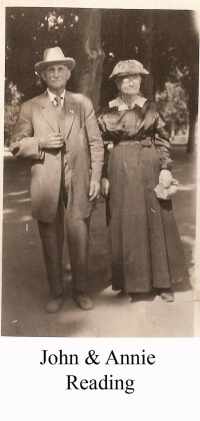
READING, John

0 1
Read Time:1 Minute, 17 Second

This article originally appeared in Vol.60 No.2 of Pioneer Magazine

By Ronald W Andersen

John Reading joined the Church on July 3, 1853, and married Mary Ann Brown on May 29, 1856. She was nine years his senior and had been a member of the Church for almost 10 years. The year they married, they came in a wagon company to Utah.

John was a horticulturist and set about building a nursery. According to Andrew Jenson, Reading’s nurseries and flower gardens consisted of five large greenhouses covered with 7,000 square feet of glass, the most extensive nursery of its kind in Utah at the time.

An advertisement appearing in one of the old Salt Lake City directories read as follows:

JOHN READING
Nurseryman—Seedman
Florist—Evergreens—Fruit Trees
Ornamental Trees
Full stock of Field, Garden, and Flower Seeds
Bouquets, Wreaths, and Crosses for Weddings and Funerals—A SPECIALTY

The ubiquitous Lombardy poplar, seen everywhere in Utah, is native to Italy and other Mediterranean countries. John Reading is credited with introducing it into Utah in 1862.

On January 28, 1874, the Horticultural Society of Utah met and discussed the codling moth question. All were of the opinion that a united effort on the part of the owners of orchards in the infested districts would be necessary in order to destroy or even check the insect. John Reading stated that he was corresponding with gentlemen in the east who were qualified to give information that he would lay before the society as soon as received.

Happy
Happy
0 %
Sad
Sad
0 %
Excited
Excited
0 %
Sleepy
Sleepy
0 %
Angry
Angry
0 %
Surprise
Surprise
100 %
You May Also Like

MOLEN, Jesse: The Life and Struggles

Upon arrival in Salt Lake City they had very little food or other provisions. They were required to subsist on plant roots to supplement the little other food they had. The next year they experienced the cricket infestation and lost most of their crop. The rigors of the struggle to travel west plus chills and other conditions had taken their toll on Jess’s health.
View Post

PICKETT, John – A Fully Converted Pioneer

In 1861 John and his family were called to move to Gunnison, Utah. Their first home was west of where Gunnison now stands. It was a dug-out near the Sanpitch River. It was located a little distance south of the “Rocky Point”. They soon found that the dug-out was not a good place to live. The first winter was a hard one with a lot of snow. The next spring when the snow melted the ground turned to deep mud. Some of the dug-outs filled with water and their chimneys collapsed. The whole place became a “Hog Wallow” and that is how that part of the valley got its name.
View Post

CROSS, Benjamin

Benjamin Cross, was chosen to be the first bishop of Peteetneet Creek ….October 26th, 1854 there was an article in the Deseret News of Israel Calkins having raised produce on nearly an acre belonging to Bishop Cross: 150 bushel of beets, 150 bushel of potatoes, 3 bushel of onions, 130 good cabbage heads and an additional 300 heads damaged by the grasshoppers, 3 barrels of pickle cucumbers, and quite a quantity of melons, squash, and peppers. Benjamin was assisting Charles B. Hancock financially to get a grist mill built in Payson. On November 15th George A. Smith came to Payson from Provo to speak in a meeting and stayed the night with Bishop Cross.
View Post

WOOD, George Lymer: An Incident in the Life

"The usual method of disposing of the dead was to weight the bodies and dump them overboard. When others and I asked the privilege of removing our dead and burying them on land, the Captain was hateful and mean about it. All of my dear ones except Samuel's wife I had to perform this last earthly service for. Others of the party had sustained like losses, and were as anxious as I to bury them as decently as possible. The Captain at last agreed to wait and we hired a Negro to help dig a trench big enough to put them in all together. We removed the dead from the boat and began our heart¬breaking task, but had it only partly done when the boat whistle blew and the boat began to get underway. All ran hastily back except the Negro, one woman and myself. She and I stood at the grave site of our dead and watched them go. What bitterness of spirit I experienced only God knows. Was this what I had come to America, the home of the brave, for? Here I was with two strangers standing beside the open grave of a group of strangers. Our common interests were all lying before us or fast receding from sight, subject to the whim of a heartless thing in human form. "Surges of emotion swept over me, sorrow, anger, love, fear, and despair, but my nearest duty was to protect these rapidly decomposing dear forms of mine from the ravages of wild beasts, heat, and other elements. Perhaps I had been blessed and spared to perform this last service. If! were dead with them our bodies would rot together. So I urged on my companions the need for work. I felt responsible for seeing this thing through.
View Post

SMITH, Joseph Johnson

How happy they must have been to be in “Joseph’s City”. But the happiness didn’t last long. Within three months after arriving in Nauvoo, little Mercy became ill and died. Joseph’s wife, Mary, grieved with Joseph, but within two months, she and Joseph became excited again because she was going to have another baby. But again, the excitement was blunted by death as Mary died a week after her baby son, Joseph, was born and baby Joseph died twelve days later. Joseph now was left with just three year-old Caroline. His parents and two sisters and three brothers were still with him in Nauvoo, but how hard it must have been to have sacrificed so much in such a short time.
View Post