 0
0
 1
1
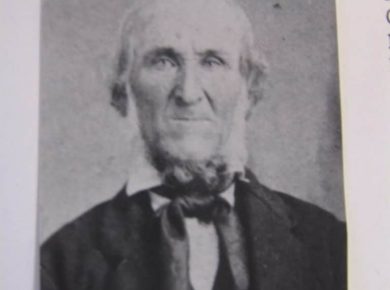
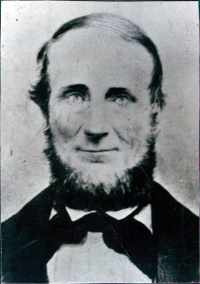
Family history excerpts of two paternal great-grand-parents, followed by two maternal great-grandparents of LaMar Adams:

Barnabus Lathrop Adams was born Aug. 28, 1812, in Canada to Joshua Adams and Elizabeth Chipman and was one of 10 children.
He was converted to the gospel and baptized in Canada, as was his brother Arza, the only two out of the large family. He moved from Quincy, Illinois, in 1840 to Iowa and met Miss Julia Ann Banker, who was born in Chateaugay, New York. She was the daughter of Platt and Thankful Marshall Banker. Barnabus and Julia Ann Banker were married on June 23, 1846, in Des Moines, Iowa.
When President Brigham Young selected the men for the first company of pioneers, Barnabus was chosen; he was a great help in making barges and floats used to cross the large streams. He and six other brethren came down into the Valley ahead of the body of pioneers and went back and reported conditions to President Young, who was sick. President Young asked what Barnabus thought of the place, and when he gave his opinion President Young said,
“Well, if it suits Brother Barney, it will suit me.”
Not long after arriving in the Valley, Barnabus returned to Farmersville, near Council Bluffs, Iowa, where he had left his young wife and found a baby girl had been born. He, with his wife and baby, crossed the plains in the Homer Duncan company, arriving in September 1848.
Soon after his arrival he was appointed by President Young to find the best timbers and have bridges and roads made so that timbers could be brought down for buildings and fences. He had a small cabin built near the mouth of Little Cottonwood Canyon. There was a deerskin hung at the opening for the door, and the top of the cabin was so poorly roofed that snow came through on the bed. After that he had a substantial adobe house built in Salt Lake City.
Soon after moving into the new house, Barnabus started getting timbers from a canyon in the west mountains, which is still called “Barney’s Canyon.” From that canyon and others timber was cut down and hauled for the Social Hall, the Tabernacle, the Salt Lake Theatre and other public buildings.
On the ranch near the canyon he had a considerable number of cows and sheep, besides oxen, horses and wagons, to haul timbers and carry on other work. Many immigrants got their start in life, working for “Brother Barney.”

Hannah Gove Chase Adams, was born Dec. 11, 1834, in Lincoln, Vermont, the daughter of Sisson A. and Miriam Gove Chase, who were members of the Society of Friends, commonly called Quakers, and she was taught in her girlhood that it was wicked to sing, whistle, or dance or to wear any bright clothing or to use any vulgar or profane language.
When the Elders of the Church began preaching in their neighborhood, Hannah and her parents were soon converted and baptized. Soon after, they moved to Nauvoo. Instead of being on a big farm with no near neighbors, she was in a comparatively large city with friendly neighbors all around. Hannah enjoyed singing at church.
Although not quite 10 years old, she shared the sorrow of the people generally when the Prophet and Patriarch were martyred and remembered distinctly going to see them when they lay in state. She also remembered being at the meeting when the mantle of the Prophet fell on Brigham Young.
In the spring of 1853 they left for the Valley with two wagons, one drawn by two oxen and the other by four steers. They also had two cows which supplied milk for their evening and morning meals, and what was left was carried in a can in one of the wagons, and by the jolting was converted into butter and buttermilk. When on Sept. 11, 1853, upon emerging from Emigration Canyon she got her first view of Salt Lake Valley, she at once recognized it as the exact place she had seen in a dream or vision before leaving Iowa.
About 1855 her father bought a two-roomed log cabin on 8th E. Street. The women made their own candles for lighting their house and their own soap, at first with wood ashes and later with concentrated lye and grease. They also washed and carded wool and spun it into yarn to knit into socks and stockings. All of their knitting and sewing they did by hand.
Hannah worked for some time in the family of that great scholar, astronomer and apostle, Orson Pratt, and received a very earnest and cordial invitation to become his wife. She also had other proposals of marriage but none suited her fancy until she met and became acquainted with Barnabas L. Adams.
He was tall, fully six feet and well formed, was industrious and had a generous disposition. On Nov. 16, 1856, they were married and she went to live with Barnabas’s first wife, Julia Ann.
On Aug. 1, 1865, Barnabus took to wife Miss Ellen Nelson, a young girl from Southern Utah.
On June 1, 1869, Barnabus went up into City Creek Canyon. Previous to going he lifted a wagon box onto the wagon alone, and it was thought that his heart or some other vital part of his body might have been overstrained in that way, as the next day, just after sitting down to eat dinner in the canyon, he suddenly fell back, ceased to breathe and his spirit passed on to his well-earned reward. The next day funeral services were held. He passed away so suddenly that no provisions were made for the family. There was land, stock and sheep, but no money. Hannah and Ellen went in together and rented two rooms, one block north of first wife Julia’s home. They took turns, one caring for the children while the other went out to do a few hours’ work to earn money. Hannah later married Edward Blair.
The best of feelings existed between Hannah, Julia and Ellen, and their children always manifested the sincerest love towards each other.
On July 27,1897, just after the 50th anniversary of the entrance of the Pioneers into Salt Lake Valley had been celebrated, Hannah’s spirit passed to join the loved ones on the other side.
Source: History by Amy Hannah Adams Thomas, daughter.


 Brother Joseph