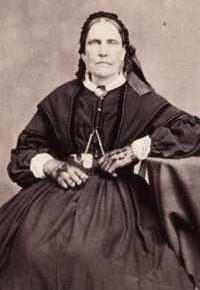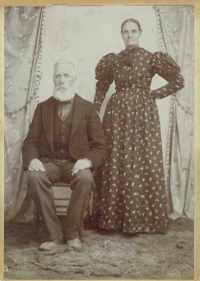
HIBBERT, Mary; Wife of William Smith

0 1
Read Time:2 Minute, 12 Second
(As reported by Mary’s Daughters
Mary-Ann McNeil, Alice Gatliff, and Rose Rasmussen,)

Submitted by DeLoy F. Johnson

William Smith and Mary Hibbert

About 4 July 1857, William took his four year old daughter, Mary-Ann and went to St. Louis, Missouri where his Mother, Mary [Smith] Dale lived. He was to find work and be near her as she was reportedly alone.  [William’s wife] Mary stayed with a member family in New York until she had means to travel.

Mary said she left the following year to join William and Mary-Ann. The following year Hannah was born to them at Cheltenham, St. Louis, Missouri, on 31 May 1858. They were living in St. Louis when the Civil War broke out in 1861. About 2 June 1862 [t]hey took a steam boat up the Missouri River to Florence, Nebraska; where they remained for six weeks.

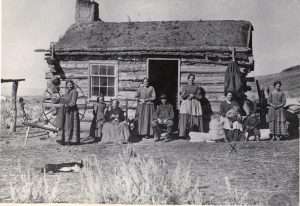
Mary said while they were living there they lived under a united order. They were living in a mud-thatched cabin or lean-to which William was helping to build for the migrants. [T]hey were instructed to help plant crops for the forthcoming migration. She said William reported he had nothing to plant or the wherewith to obtain sufficient to plant. Then one day several individuals came and handed off a handful of corn or grain until we had sufficient to sparingly plant on the assigned area.

While living in this mud-thatched [cabin] Mary said she was alone during the day as many of the men had taken work at outlying farms or on the docks. Their cabin was some distance from any community.  She said she did laundry, crochet, tatting, and sewing for others. It was on one of those days when . . .  suddenly an Indian fell into her cabin holding his belly. She could see his belly had been slashed open exposing his entrails.

Mary said she never was frightened. She said a total calm came over her and she felt she was being directed to help this man. She could tell he was not a Sioux as his ware and cuttings were not the same as she had seen around the area. She said she went to the nearby corrals and secured several strands of horse hair.

When she returned she put them in her hot teapot. Then with her two sewing needles she did a straight line stitch from one end of the laceration to the other, on both sides pulling his belly back together. When she finished he got up and left and was never seen there by any persons.

Happy
Happy
0 %
Sad
Sad
0 %
Excited
Excited
0 %
Sleepy
Sleepy
0 %
Angry
Angry
0 %
Surprise
Surprise
100 %
You May Also Like

SMOOT, Doug: Modern-day Pioneer of Technology

After completing 42 years at BYU, Doug now (2008) is a principal in Combustion Resources Co., continuing his work in energy, fossil fuels and combustion A member of several professional organizations, he has published approximately 200 technical articles, eight invited review articles, and four books on combustion. He received the first Governor’s Medal for Science and Technology in Utah in 1987. Two of his books (written with others) have been translated into Chinese. An internationally recognized authority in energy, combustion, and fossil fuels, Doug has consulted with over 100 organizations in the U.S., Mexico, China, Japan, India, Egypt and several European countries.
View Post

JEPPSEN, Niels Andersen

The day after their wedding they walked to their farm in North Ward (now named Harper Ward). She carried a basket with her dishes in one hand, while with the other hand she helped Niels carry a large box which contained their worldly goods. A large stove kettle was fastened to the box, while suspended on a stick, which he placed across his shoulder with a sheet with quilts wrapped inside.
View Post

James Henry Rollins, Faithful Pioneer

The San Bernardino colonizers were called back to Utah by Brigham Young when Johnson’s Army threatened. Henry and his family heeded the call, leaving behind still another home. In Utah, they settled in Minersville where he opened a lead mine and served as postmaster. He spent most of his life there serving faithfully in the church as a Bishop and in other callings well into his 80’s. He spent his last years in Lyman Wyoming to be near his children, where he passed away February 7, 1899.
View Post

Life of James Kippen

Mr. Kippen was a firm believer in the teachings of his church regarding work for the dead, doing work along this line in the temple for members of his family who had died out of the faith of the Mormon Church, believing that by this means he would be able to save their souls. He passed all through the scenes of hardships and difficulties which the settlement of Utah made a matter of history, and during the Johnston Army troubles, he served as a guard in the Green River country and in Echo Canyon.
View Post